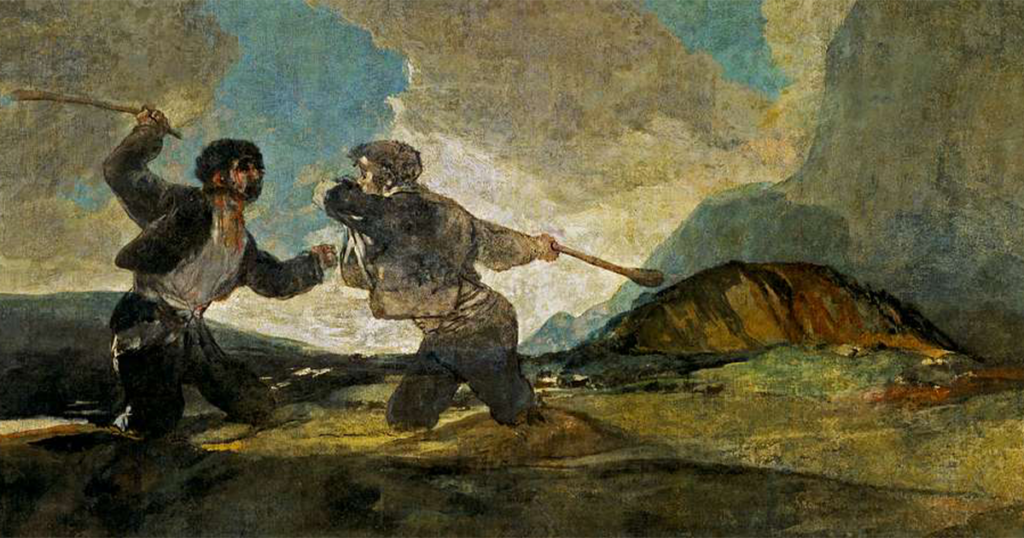
A spooky painting by Francisco Goya has haunted me for decades. Painted around 1820 on a wall of the artist’s house and later transferred to canvas, it depicts two men, standing deep in mud or perhaps quicksand, holding cudgels poised to strike each other. They are alone in a stark landscape. The lighting suggests the sun rising or dying. Neither man sees the surrounding hills, or the vast sky, or even the mud. There is a fierceness in the way they are posed. They will not stop. Each is concerned with only one thing: to bash the other’s brains in.
One is already blood streaked, but neither is close to being vanquished. One favors an overhand strategy; the other prefers a sidearm stance. Either approach would probably do the job. Neither man has diminished power. Wounding is not an option, and neither seems interested in “working things out.” No one is present to act as a second in this duel, or to wish the combatants well, or to try to resolve whatever conflict has led them to this moment. No one is present to persuade them to pause, step aside, think the whole mess through, shake hands. I want to shout, “Whoa there. Slow down. Let’s have a beer and talk man-to-man about it. Are things really that bad?” But there is no negotiating table and, as in war, there are ultimately no rules.
I have thought about what might have brought the men to this, what human act or acts might have led to this apocalyptic moment, pregnant with imminent disaster. Was it caused by a property dispute, a matter of honor, the desire for revenge, a religious difference, fraud, bald cheating, love of the same woman, mere gossip or rumor, some long-standing and half-forgotten animosity or hate? Was the duel the only solution? Is this the best those 19th-century men could do after thousands of years of evolution? And with cudgels, which feel so primitive!
Surely we have evolved beyond cudgels. We live in an age of international councils dedicated to peace. We have governments and laws. We have medicines that can cure or prevent many diseases, analysts to help solve our problems, concert halls to bring us the finest music ever composed, books to challenge and report our conflicts and to remind us of common sense, planes to transport us to other continents, an internet that allows us to talk to anyone anywhere, so-called artificial intelligence that will soon be able to do practically anything, and wristwatches that are even better than Dick Tracy’s.
It is a brave new world. Weapons have evolved from the cudgel and pike to missile, drone, and bomb. Thanks to science and technology, we are able to kill quicker, and in greater numbers. Many of our recent and most lethal wars have elusive and mysterious origins, like the conflict between Goya’s two poor souls caught in their demonic dance of death, panting to strike, ready to slug it out in the mud.
For many years, I thought that art, literary and visual, was a kind of enchiridion, or guidebook, with answers to the great questions that I was asking. But Goya’s profoundly sad men should not affect me, nor should Kafka’s gigantic insect or Flannery O’Connor’s Misfit. They’re not real any more than Bottom the Weaver’s lion is real, any more than the figures on Keats’s Grecian urn, in their fixed positions, never to kiss, are real. Goya’s warriors are frozen, safe, poised forever in stasis, never to do what they are meant to do. On the canvas, on the urn, the figures of art will never change. Unlike all of life. And yet, those men on Goya’s canvas seem alive, as alive as Falstaff is when he announces, in Henry IV, Part One, that to banish him is to “banish all the world!”
Not real and real. Unspeaking and full of questions. Are they all emblems of some immeasurable mystery that urges us to think and feel beyond the horror of all we are and might become—the horror of being conscious and alive?