
“Calling a spade a spade” and “giving credit where credit is due” may seem like opposites. The first is a tangled path through briar, the second a stony uphill climb. The tangled path you might follow regretfully or even fearfully, thinking of consequences, possibly pushing along in anger. You climb the stony hill begrudgingly, maybe belatedly recognizing the need to trudge at someone else’s heels. Unless, of course, you are in love. In which case, all your accolades are meager praise for the one you contemplate and are fixated on.
But by the time you’ve come through the enveloping fog of love and stand in the bracing wind that clears your head of all romance, you may think any attention at all was too much for the once-beloved. And it’s no wonder: in Spanish, the verb contemplar means the same as in English—”to consider.” But it can also mean “to spoil a child.” Too much attention, in other words, is an evil.
And yet, wandering dazed in the fog, stumbling and even falling because we will not focus but choose instead to follow our obsessive dream—what do we care then for the mots justes, the exact words given in correct (and usually stingy) measure? Would that we bruised ourselves endlessly rather than have the veil fall away!
We don’t get to choose though—not whom we love, nor for how long. The best we can do is give in to the feeling when we have it, and proclaim our love however we can. It’s not always easy. Jim Croce knew that. “Every time I tried to tell you, the words just came out wrong,” he sang. His solution? “I’ll have to say I love you in a song.”
But just as big a problem as how to say it is how to get the beloved to listen. We protect ourselves in cages of our own making—breathable, livable, even comfortable. So comfortable, we’d rather not venture out. The effort it takes to truly listen—to let something in—can feel like too much work. We want to put it off. We say, “later.” We say we’re busy. We wait.
So by this circuitous route, I come to my point, which is that I listened to a wonderful song the other day, called “The Sea and the Shore.” It’s a love song written by Amy Speace and Robby Hecht, performed by Speace and John Fullbright, about love that didn’t triumph. About love between the sea and the shore. My childhood friend sent me a link to the song. My instinct was to respond that I would listen to it later, when I had time. I wanted to put it off. But when would ever be a better time? So I listened, right there on the couch. The house dark. The cat asleep in my lap. The hour 11:30 p.m.—far past my bedtime. And I was thrilled: the sea returning, the shore abiding, the shells, the white caps, the demanding moon, the time long ago that both the sea and the shore can remember, when hopes were shared and promises were made. The sea to the shore renews vows of love. The shore to the sea says it is too late.
I wrote to my friend, “I think I love it!!”
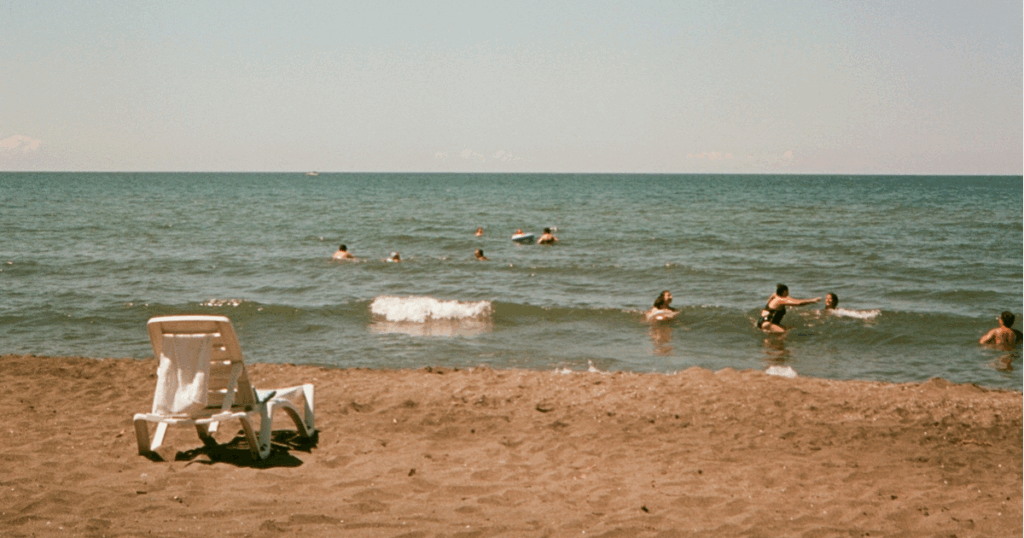
I thought of my friend and a time almost 25 years earlier—a quarter of a century!—when she and her husband and two children, her sister and brother-in-law and nephew and niece, all visited me in Spain. My two children, their father, and I lived then in a different house in a different town, on the ocean’s edge. We danced, we sang, we talked, we cooked. We walked to the ocean. Barefoot on the beach, we bathed our feet in the tide. We built sandcastles, we laughed as they melted back into sand. One day, we all walked the coastal path to the city and ate arroz negro—rice with squid and its ink—on the terraza of a restaurant overlooking the rocky end of the beach. In the sunshine of that June day, among our great throng of children and adults, my friend and I sat next to each other—as exciting to me as any first date. I was having some problems in my life, and I think I broke down and cried at some point during the visit. How did my friend respond? I can’t remember—only that her response was perfect. I fell in love essentially. She came into the small closed places of my life and took me out into the bright open places of hers. Something similar happened to her, she told me back then, though I don’t know if she remembers. Something I said or did or the way I acted or held up—something small in her old friend lit a spark.
For me it was something big—she got me back together without any fuss, with just her smile, her good humor with everyone, her ability to laugh at herself and shake her head to protest that your teasing and complaints were exaggerated, all at the same time. “I can be easy, too,” I thought, feeling for that all-too-short time that perfect understanding was possible. We had it.
I can’t sing, and I don’t write poems, so I can’t give credit where credit is due in those lyrical ways. But I can write a few lines—write them better than I could speak them. So here it is: “I’ll have to say I love you … in this essay.” She’ll understand.