
Netflix Goes to Vietnam
When a filmmaker wanted to understand the war that changed his father, he decided to make a documentary
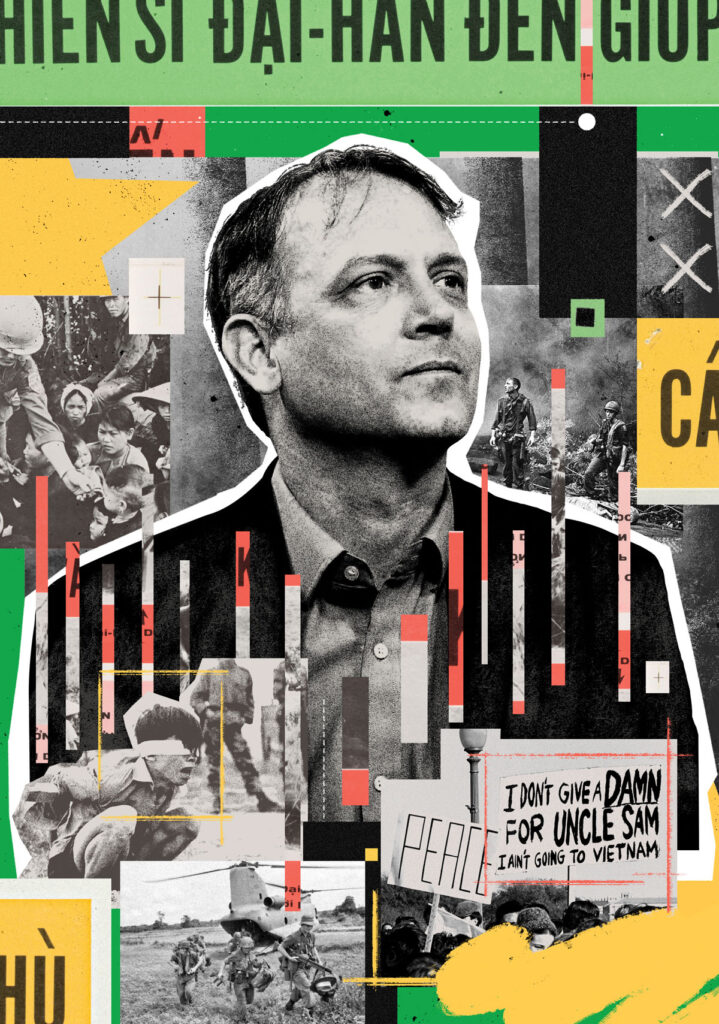
On April 30, 2025, Netflix released a five-part, nearly seven-hour documentary on the Vietnam war. This marked the 50th anniversary of the fall—or was it the liberation?—of Saigon. The Vietnam war as shown on Netflix does not look like the war that Ken Burns filmed for PBS in 2017. It is not a war “begun in good faith” by honorable men. It is a war begun in bad faith by men who ended up being skunked by history and hubris.
The opening shot in Turning Point: The Vietnam War introduces us to Scott Camil, who recounts his trajectory from gung-ho Marine to antiwar activist. One of the organizers of the Winter Soldier Investigation—held in Detroit in 1971 with the aim of revealing American atrocities in Vietnam—Camil confessed to committing war crimes and would later join the 800 other veterans, including future senator John Kerry, who marched on Washington to throw their military medals onto the Capitol steps.
As Camil testified in Detroit, it was not uncommon for America’s soldiers in Vietnam (of whom there were half a million) to cut off ears, cut off heads, torture prisoners, napalm villages, rape women, massacre children, slaughter animals, and shove captured Viet Cong soldiers out of helicopters. Peasants were herded into concentration camps while Vietnam was drenched with chemical defoliants and bombed with more tonnage than was dropped in World War II. Camil was inscribed on Richard Nixon’s “enemies list,” and FBI Director J. Edgar Hoover ordered that he be “neutralized.” Camil was shot by federal agents and nearly killed in a drug sting in 1975.
As Camil said of his two tours of duty in Vietnam, “I got two Purple Hearts. I was wounded. I killed lots of people, and where was my thanks?”
In May 2024, I receive an email from Bo Kovitz, who identifies herself as a producer on the Netflix Vietnam series, which is being directed by documentary filmmaker Brian Knappenberger. I have written extensively about Vietnam, the war, and its legacy here in America, and she wonders whether I am willing to be interviewed on film. “The series,” she writes, “aims to give Netflix’s vast audience a comprehensive understanding of the roots and ongoing realities of the Vietnam War, with an emphasis on first-hand accounts from all sides.”
Not having heard of him, I look up Knappenberger. A prolific filmmaker, he has made documentaries ranging from war reports out of Afghanistan and Ukraine to stories about internet activists like the group Anonymous and Reddit cofounder Aaron Swartz. Knappenberger’s two most ambitious projects for Netflix began what he calls his Turning Point franchise. In 2021, Netflix released the five-part series Turning Point: 9/11 and the War on Terror. In 2024, it released the nine-part Turning Point: The Bomb and the Cold War.
This new documentary is supposed to explain the Vietnam war to a generation born long after it ended—no easy task. Beginning in 1945 and ending 30 years later, the conflict consisted of two Indochina wars, one French and the other American. The first war in Vietnam propped up the French government as it struggled to keep its domestic communist party at bay. The second Indochina war refought the first one. So what is this thing we call the Vietnam war?
It was a failed attempt to reestablish a French empire.
It was a front in the Cold War, a campaign to prevent a domino from falling.
It was the final salvo in the demise of European colonialism.
It was a CIA operation that began with the creation of a puppet regime in South Vietnam.
It was a nationalist struggle for the reunification of Vietnam.
It was a civil war.
It was a counterinsurgency.
It was a category error by Army generals who thought they were refighting World War II.
It was a sideshow for politicians afraid to lose a war on their watch.
It was a noble cause.
It was a war crime.
It resulted in an antiwar movement, back on the home front, that was either tearing the country apart or saving its soul.
Hundreds of documentaries have been made about the war. The Vietnamese produce films valorizing their historic struggle. The French console themselves by showing how America’s losing strategy was no better than their own. The British cast a cool eye on “the quiet Americans” who were naïve do-gooders and failed spooks. American filmmakers focus on Vietnam veterans and the bad dreams they brought home. But regardless of perspective, many documentaries about Vietnam tend to share certain features, making use of historical footage, voiceovers, featured presenters, tape recordings, letters, journals, maps, diagrams, reconstructions. And, if you can afford it, a film on the Vietnam war will have the world’s best soundtrack, including everyone from Jimi Hendrix to the Rolling Stones.
Soon after I agree to participate in the documentary, Kovitz sends me a list of subjects that she wants me to cover. These deal mainly with the origins of the war and CIA agent Edward Lansdale’s work in turning the former French colony of Cochinchina into the Republic of Vietnam. By the time I arrive at the film studio in Boston, my talking points and notes are 60 pages long.
As I get wired for a half day of filming, I meet Knappenberger. He is a well-built man of Pennsylvania Dutch stock, with a cleft chin and green eyes. He is casually dressed, wearing an open-necked shirt and sneakers. He has a kind of prowling gait, an edgy bounce to his walk that, I learn later, comes from his being a photographer. The Boston film studio has a full crew, working with high-definition cameras and lots of lights, but Knappenberger often shoots alongside his team with smaller, hand-held devices. Later, as I watch him filming at the Vietnam War Memorial in Washington, I notice how he circles his subjects with a kind of light-footed precision.
The Boston filming is more straightforward. Knappenberger asks questions off camera. I answer them, and occasionally he asks me to clarify what I said. We touch on only a portion of Vietnam’s early history—the stuff that I think is important because there would have been no war to defend South Vietnam if South Vietnam had not been created. I will get another chance to make my case during a second day of filming, but in the meantime, I arrange to meet up with Knappenberger again at his production company in Los Angeles. I want to learn how Netflix makes movies. I am hoping to flip the script and wire the director for an interview of his own.
Netflix is a giant maw of a company with a gaping need for “content”—dramas, documentaries, specials, miniseries, serials. Knappenberger is making a
“Netflix Original,” but the term is a bit of a misnomer. Netflix Originals are financed and streamed by Netflix but are made by independent production companies. Unlike the Hollywood studios of old, Netflix is not a big operation with lots of sound stages. It licenses shows from PBS and other producers, and it finances Netflix Originals. The mix is about 50-50, but Netflix is pushing to produce more of its own material.
Knappenberger was a known item, already having done a lot of work for Netflix, when he was tapped to cover the 50th anniversary of the end of the Vietnam war. Documentaries are cheaper to produce than dramas, but this was going to be an expensive documentary, involving travel to Vietnam and interviews across the United States. Netflix guards its financials more closely than the United States protects its war plans. But if an expensive documentary costs $10,000 a minute, then Netflix might be spending between $4 million and $5 million to cover the war in five episodes lasting more than 400 minutes altogether. This might seem like a lot, but it’s actually a bargain, nothing more than a blip in Netflix’s commercial portfolio. The company spends $18 billion a year on movies and shows, releasing a cascade of content that reaches 700 million viewers and produces a profit of more than $20 billion a year. Even The Electric State, a recent sci-fi flop, garnered more than 25 million viewers, whereas a hit like the first season of Squid Game has been watched by more than 265 million.
“We need to be the best version of everything,” said Bela Bajaria, Netflix’s chief content officer, as she premiered the platform’s 2025 lineup. Netflix makes documentaries that focus on politics and culture. It makes biographical and sports documentaries. It makes war documentaries, such as biopics of Churchill and Hitler. But a documentary on the Vietnam war is something different. Vietnam is the third rail in American politics. It is a force field of resentment and recrimination. It attracts partisans who blame journalists and generals for losing a war that would have been won if only the United States had followed the advice of General Curtis Lemay, Air Force chief of staff, who said of the communist Vietnamese that we should “bomb them back into the Stone Age.”
A few weeks after our meeting in Boston, I fly to California to visit Luminant Media, Knappenberger’s production company, which is housed in several cramped rooms on the upper floor of a 1920s art deco tower in downtown Los Angeles. “Friends tell me that LA has the oldest intact downtown in the country,” Knappenberger says. “It’s good for artists looking for cheap rent, but the electricity goes out a lot.” A few blocks down the street is Skid Row, where thousands of homeless people sleep on the sidewalks. Luminant will be moving soon to Eagle Rock, another low-rent district to the northeast, where the company will have more room and better electricity.
Knappenberger introduces me to some of the two dozen people working on his Vietnam series: producers arranging interviews, researchers combing through transcripts, editors syncing footage in video bays. “Many of the people working here have a background in journalism, which is not that common in this business,” he says. “We transcribe all our interviews and fact-check everything, even if documentaries are not series of facts. You can get all the facts right and miss the truth.”
With the laid-back demeanor of someone who grew up in Colorado, Knappenberger has a boyish smile. “Knappenberger is a German name,” he says, “but my family has been in America for eight or nine generations, so I’m not that German.” In spite of his casual artist’s vibe, Knappenberger is running a multimillion-dollar project on a tight schedule. He has already filmed for three and a half weeks in Vietnam, where he shot dozens of interviews while traveling from the Mekong Delta up to My Lai and from there to Hanoi. After recruiting former combatants from both sides in the war, he needs to edit this footage and deliver it to Netflix in a few months. “They have to translate it into 35 languages and get ready to stream it to 300 million paid subscribers. This takes some time,” he says.
In 1970, the year Knappenberger was born, his father, Cliff, was in Vietnam as an Army specialist repairing counter-battery radars. “He was a patriot,” says Knappenberger of the man who had enlisted at the age of 27—a decision he later regretted. “He came home from the war with a visceral hatred of Richard Nixon and a roll of Super 8 film marked ‘Cambodia.’ I never knew why my father was in Cambodia until I learned that this is where Nixon sent troops across the border in 1970.”
Knappenberger never talked to his father about the war, and their relationship was “strained” after his parents divorced when he was in his 20s. Knappenberger grew up in Broomfield, near Rocky Flats, where the United States manufactured the plutonium cores for nuclear bombs. “As a kid, I had to figure out why Daniel Ellsberg and lots of other people were in town protesting at Rocky Flats and getting arrested. I was eight years old at the time and already learning about the Cold War.”
Knappenberger’s father designed disk drives and mainframe computers for IBM, which had a factory in Boulder. “There was a big drafting table in our house, and my dad had this perfect architectural handwriting,” Knappenberger says. “It was stunning, even when later, like other designers, he switched to using computers.”
“I was a techie,” Knappenberger continues. “I was really into computers and programming. I had one of the first PCs. My dad brought it home from work. My mom was an educator, super into computers, with one of the first Apple machines, even before there were Macintoshes. Along with cameras, I just loved this stuff.”
When he turned 12, Knappenberger received a Pentax 35 mm camera from his father, who hid lenses around the house for him to find. Knappenberger recalls that the family was getting ready to go on a road trip and that his father had outfitted a Ford Econoline van as a kind of mobile home. “It was on this cross-country trip that my dad taught me how to use the camera,” he says. “I remember him telling me that focus is not just struggling to get an image. It’s part of a palette for deciding how one thing relates to another. That moment defined my life. It’s what I have been trying to do ever since then.”
Knappenberger studied photography and journalism at Colorado State University in Fort Collins. His portfolio got him an internship and later a job at the Maine Photographic Workshops (now known as the Maine Media Workshops), where some of the country’s best photographers visit and teach. Knappenberger stayed in Maine for two years before moving at the age of 26 to Los Angeles.
“I knew a lot about cameras by the time I arrived in Hollywood,” he says. “I worked as a production assistant on some of the cheesiest shoots in town, but I always had my Super 8 camera with me and was always filming. I worked for free on independent movies as a loader in the camera department. Hollywood is almost like the military. It’s strict about not jumping rank or shooting film if you’re not a camera operator. But when directors saw what I was doing, they began using my stuff. Then I got my hands on their professional gear and started filming on weekends and off hours.”
In 2002, he codirected a documentary called Ascent: The Story of Hugh Herr, about a rock climber who has lost his legs in a climbing accident but still climbs with prosthetic limbs. He made documentaries for National Geographic and PBS, including eight episodes of something called Not Your Average Travel Guide. By 2012, Knappenberger, the former techie, was making films about hacker culture and Aaron Swartz, who was put on trial by the government for releasing academic papers from an MIT server and who committed suicide at the age of 26. Directing two or three projects a year, some as long as 10 episodes, Knappenberger began producing documentaries on free speech, the press, the separation of church and state, the atomic bomb, 9/11, and the war on terror. Other documentaries were ripped straight from the day’s headlines. These often dealt with the abuse of children (The Trials of Gabriel Fernandez and Scout’s Honor: The Secret Files of the Boy Scouts of America).
“I have always been protective of the vulnerable,” he says. “I don’t know why you would want to be in this business unless you were doing something meaningful. I began thinking about kids when my son Declan was born. He was one year old when my movie about Aaron Swartz came out in 2014. It does something to you, having a kid. It brings out things you didn’t notice before.”
Knappenberger likes making films about underdogs and troublemakers, films that nail guilty culprits and lately, films that explore big historical issues. So where does Vietnam fit into the picture? “It kept coming up as I was making the Cold War series,” he says. “I knew I wasn’t doing it justice. It would have to be a film of its own. There was also the personal element … my dad being in Vietnam when I was born and then never talking about it. It’s a part of my childhood that I haven’t finished facing.
“I wondered if too many films had been made about the war, but then I realized it’s a major turning point in American life. America is a different place after Vietnam. We questioned everything about who we are as a country. It rocked our trust in our institutions and way of life. People were staggered about how they were lied to. We realized we were not the people we thought we were.
“Vietnam has defined our current moment, our loss of belief in our institutions, the divisiveness in our politics, our relationship to media and journalism. To understand where we are now, you have to go back to Vietnam.”
Knappenberger and I are drinking coffee at a table in a conference room when he offers to take me next door and show me some footage. “I’m not supposed to do this,” he says. “You have to promise not to talk about it before our release date.” He also warns me that the footage might end up on the cutting room floor.
We walk into a room and stand behind one of Knappenberger’s colleagues, who is working at a big computer in an editing bay. He pulls up an interview with George Wickes. Wickes was an officer with the OSS—precursor to the CIA—who was sent to Vietnam at the end of World War II. The OSS supplied Ho Chi Minh with guns and Chesterfield cigarettes in exchange for his help recovering American pilots shot down by the Japanese. In the footage we are watching, Wickes is reading from a letter that he sent to his bosses in Washington in 1946. Comparing Ho Chi Minh to Abraham Lincoln as “kindly rather than fanatic,” Wickes recommended that the United States support Ho and not the French or the Chinese, who had already occupied Vietnam for a thousand years.
Colonel Peter Dewey, Wickes’s OSS colleague in Saigon, had cabled Washington with similar advice: “Cochin China is burning, the French and the British are finished here, and we ought to clear out of Southeast Asia.”
Officials in Washington knew that nationalism would be the next historical wave to wash over Vietnam. This struggle for independence would not be stopped by a French army or an American army or the armies of various client regimes that rose and fell in South Vietnam. American officials may have known this, but it was not what they told the American public as nearly 60,000 body bags and 300,000 wounded soldiers returned from Vietnam.
A few weeks before the documentary is set to air, Knappenberger sends me a “screener.” This is the low-definition rough cut of his film—filled with watermarks—that goes out to reviewers. “We’ll up-res it before it’s released,” he says. The five parts, each longer than an hour, are irregular in length and not interrupted for commercials or other breaks. “This is old-school Netflix,” he says.
The antitheft measures on the series are so tight that I get access only after two Netflix technicians team up to help me. I pull an all-nighter to watch the film straight through. It is a rich tapestry of archival footage, maps, timelines, White House tape recordings, and close to 100 interviews with veterans, protestors, historians, and other witnesses to this war that still haunts us today. One sequence shows the flag of the Republic of South Vietnam—a country that ceased to exist 50 years ago—being waved on the ramparts behind the U.S. Capitol during the failed coup attempt on January 6, 2021. Apparently, America’s Proud Boys are still struggling to reinvent this lost cause as a glorious fight for freedom.
Out of Knappenberger’s documentary tumbles all the government-issue gobbledygook that was invented during the war. The United States is winning hearts and minds by turning the countryside into a free-fire zone and defoliating it with Agent Orange. Words like spin and phrases like credibility gap appear along with the Five O’Clock Follies. We get Zippo lighters burning hooches and body counts revealing light at the end of the tunnel. The decent interval for recovering POWs turns into a mad scramble for the last helicopter out of Saigon.
According to the credits, I am one of the featured presenters in the series, but my role is minor compared with the people who are interviewed at length, such as Vietnamese-American authors Viet Than Nguyen (The Sympathizer) and Le Ly Hayslip (When Heaven and Earth Changed Places). I function more like a Greek chorus, summoned occasionally to introduce characters or comment on human folly. In fact, these were my instructions when I was flown to Washington for another day of filming.
When I watch the Netflix screener, I am disappointed to see that George Wickes has hit the cutting room floor. “It was painful,” Knappenberger tells me. “We had to be really vicious about what we cut.”
I am also sorry to see that Edward Lansdale is missing. Lansdale is the CIA agent who created South Vietnam. He was working undercover as an Air Force colonel and therefore not technically a CIA agent, but his money and manpower leveraged the former French colony of Cochinchina into the supposedly independent nation of South Vietnam. The Battle of Saigon in May 1955—an urban street fight between Lansdale’s CIA-backed republicans and the French colonial forces that still controlled southern Vietnam after World War II—would level parts of the city and kill more people in central Saigon than the Tet offensive of 1968. South Vietnam was born from this fight between the CIA and France’s Deuxième Bureau. Before it was an anticommunist crusade or a civil war, Vietnam was an Asian version of spy versus spy. Thanks to this U.S.-funded campaign against the old regime, French sympathizers who gathered at the Continental Hotel for afternoon cocktails booed when Lansdale appeared.
Wickes and Lansdale may be missing, but Knappenberger uses a remarkable amount of taped footage from the White House. The record exposes John F. Kennedy’s early enthusiasm for the war, Lyndon Johnson’s descent into the quagmire, and Richard Nixon’s duplicity in billing himself as the peace candidate while planning to bomb Vietnam into submission. “We found the actual [tape recording] machines they used,” Knappenberger says. “We ended up buying nine different models and filming [the machines] as we ran the recordings.”
Six weeks before his Vietnam series begins streaming, Knappenberger calls to tell me that he has finished editing part five, with the entire series to be released all at once on April 30, 2025. He has already begun his next project, a documentary about the separation of powers and how our system of checks and balances is no longer working.
“This goes back to Vietnam,” Knappenberger says. “It’s how Richard Nixon saw his presidency, as something above the law. I imagine the documentary will turn into something politically subversive. This seems to be what I do to the material I’m working with.”
One result of our conversations: Knappenberger has started talking to his father about the war. “My mom had already told me that he had a tough time transitioning back to civilian life,” he says. “My dad confirmed what I had been hearing from other vets. In 1970, during the 10 months he was in Vietnam and Cambodia, morale was disastrous. Drugs were common. Soldiers who didn’t want to fight were destroying their equipment. ‘I hit a wall of hostility on coming home,’ my dad told me. ‘I don’t think I ever should have gone.’ ”
“This has been a powerful piece for me,” Knappenberger says about his film and his conversations with his mother and father. “It has taken me back to the formative years of my childhood. Vietnam stripped the innocence from our country. The disillusionment we feel today starts in Vietnam. It’s truly one of those massive shifts in the tectonic plates of history.
“If I can get philosophical for a moment, I think there is no such thing as the past. I believe the Vietnam war changed us. It isn’t ancient stuff. It’s a vibrant part of the world we live in now. We’re trying to understand what’s happening in politics and in our society. We want to know about the chaos we live in, and you can’t do this without understanding Vietnam.”
Correction: An earlier version of this article misstated the name of Brian Knappenberger’s father.