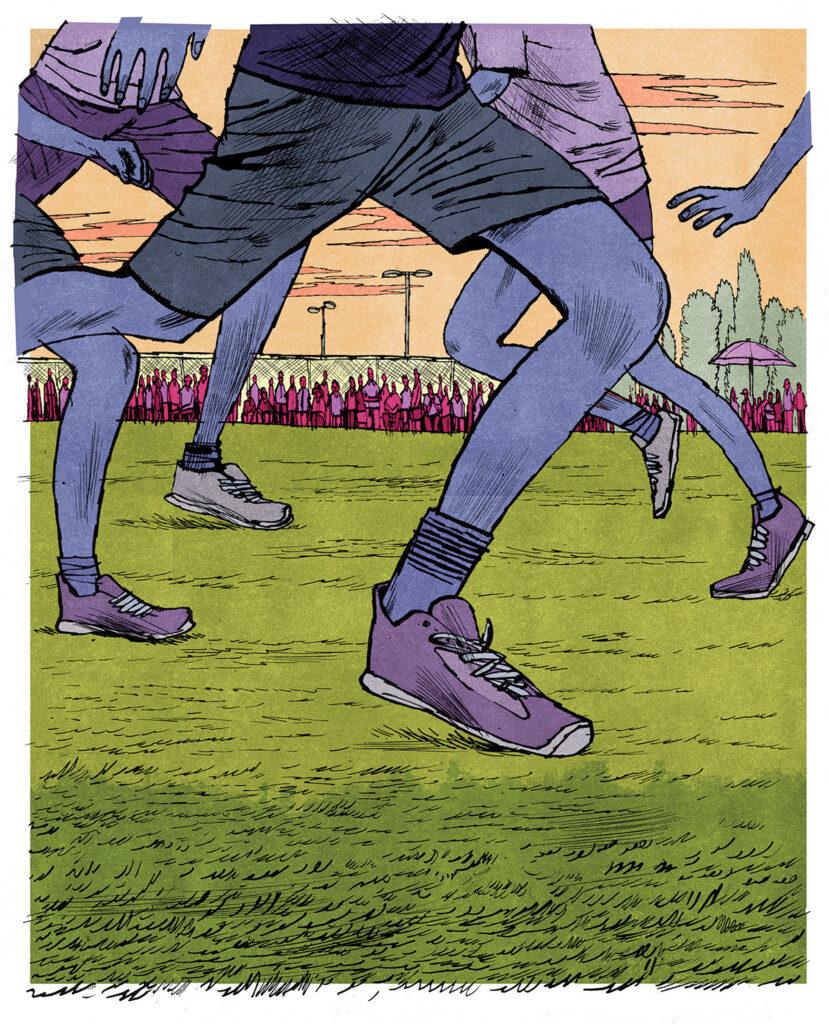
Ask your middle-class or wealthy friends with children between the ages of eight and 18 to do something fun on a weekend in the spring or fall. I would bet that at least half of them are busy, off in some exurban wasteland, logging in to apps like TeamSnap and SportsEngine and GameChanger as they shuttle their kids back and forth between a $200-a-night room at the Marriott, a Chipotle, and a sports field.
I am an unlikely sports parent. I was never on any kind of team; I spent my high school afternoons working at a health food store, creating self-bound books of poetry, and experimenting with various methods of mind expansion. Yoga and a few shuffles around the track are the closest I get to playing a sport these days. When I was a new parent and heard friends with older kids talking about the hectic swirl of tryouts and tournaments, I silently pledged that would never be me.
And yet.
Rec sports for grade-school children were the gateway. There were no tryouts. For $100, my husband and I could sit in a local park for eight weekends in a row and watch our children play softball and soccer. Some of the kids on their teams, forced by their parents to participate, stood forlornly on the field; others exerted themselves in earnest. A few seasons of this uneven patchwork made it clear that my children wanted something more intense. Both had inherited athleticism, apparently from other family members: My daughter was a fast baserunner good at catching softballs, and my son was scoring most of the goals on his soccer team. If we wanted them to have a chance at making their high school squads, friends counseled, we would need to get them on competitive teams.
Thus I was initiated into the vast network of private sports teams that, in a narrowing funnel, direct children into high school, college, and professional sports. These “travel teams” are fueled by families’ labor and cash; many coaches are minimally compensated parents. When my husband told me we’d have to pay $1,500 to the softball team our daughter had just qualified for to cover tournament entry fees, I was shocked. And that didn’t cover the uniforms, equipment, hotels, and ubiquitous gear that families haul in and out of their SUVs each weekend: canopies, WeatherPods, GCI Outdoor chairs, coolers, and double-decker collapsible wagons to trundle it all to and from the fields.
Let me pause here to say that I love what competitive sports have done for my kids, now 11 and 13 years old. All the platitudes I scoffed at as a teenager—that sports teach hard work, perseverance, and collaboration; that they can be inspiring, ennobling, and transcendent—are true. My children have built their confidence, learned how to lose graciously, and bonded with their teammates. Their coaches have mentored them into more capable and compassionate people.
Not only that, I love their teams. The first time I leapt from my seat screaming when my son scored a goal, my husband looked at me with wonderment. Hadn’t I been the one questioning whether the kids should even do this? Soon enough, I had bought team T-shirts that I, like other parents, wore to each event. When they won tournaments, I cried with joy.
Yet I’m willing to bet that most parents whose children play competitive sports have seen the darker side, too. Kids’ sports can be ugly, vicious, and elitist. I’ve watched parents throw things at umpires. I’ve heard coaches scream obscenities at their players. I’ve seen kids hurt each other on purpose. And I’ve witnessed friendships torn apart and parents divided over who gets how much playing time at what position. There are placards on each field at the softball complex in our local park that say something like, “I’m just a kid. It’s just a game. My coach is a volunteer. The umpires are humans. No college scholarships will be handed out today.”
Login to view the full article
Need to register?
Already a subscriber through The American Scholar?
Are you a Phi Beta Kappa sustaining member?
Register here
Want to subscribe?
Print subscribers get access to our entire website Subscribe here
You can also just subscribe to our website for $9.99. Subscribe here

true