
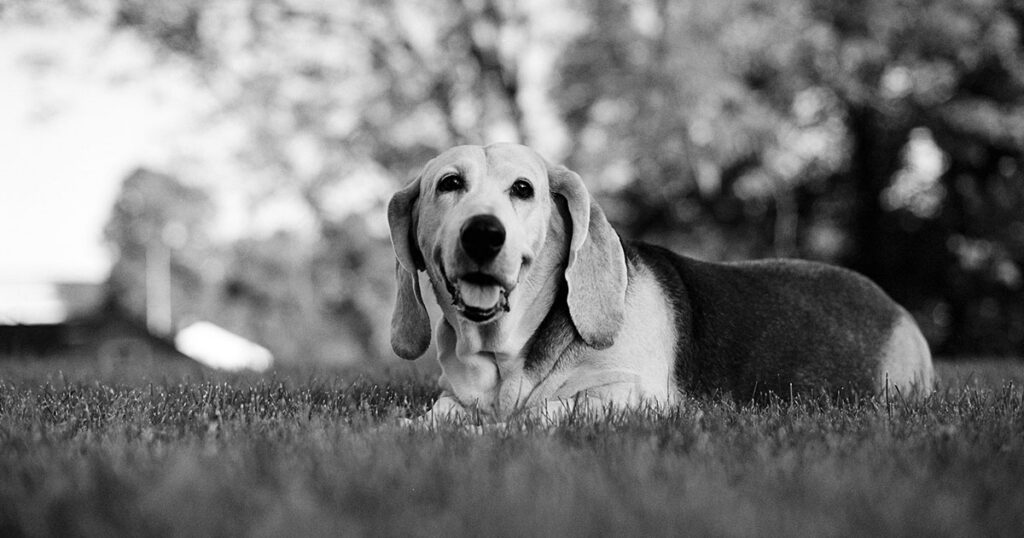
“It was Wicas,” my son told me. “Or something similar.” We were sitting at a café terrace, waiting for our coffee, and I had just remarked that I ought to stop at the house where the old yellow dog had lived and ask the owner his name. It had been less than a week since I’d walked by one morning and discovered that the dog wasn’t there. The chain was missing from the ring in the cement by the doghouse. Sad, I’d thought, walking on. Sad, but considering how sometimes the dog barely had the strength to stand, not surprising.
The first person—the only person—I’d told about the dog’s demise was my son. Both of us had felt sorry for the dog and made a point of stopping to pet him whenever we walked by his home.
“Wicas.” I repeated. “You asked the owner?”
My son said yes, one day when the owner happened to be outside. Wicas was what he remembered. Wicas sounds like whiskers, I thought. I shouldn’t forget.
I wondered aloud if the word meant anything in Spanish. My son didn’t think so.
The café was on a corner two blocks from our home, across the street from the high school. We were under the awning, though the day was cloudy, with neither rain nor sun to shelter from. Our German shepherd Toby was under the table, looking his usual mournful self. Once confident and assertive, he was now timid, meek. When the waitress arrived with our coffees, she cooed at him, as you would a baby, but Toby hardly looked up until she asked if she could give him a treat. Sure, we answered, and she produced a small dog biscuit about the size of a penny, and let him take it from her fingers. Then she offered another, cooing the whole time. Wicas, if that was really his name, had lived his life on an eight-foot chain. He could have used some of this gentle attention. Now that he was gone, the occasional three minutes I’d spent rubbing his head and back seemed piddling. I sighed. The waitress ran her hand over Toby’s head. She asked his name, and we told her. “Good Toby,” she said with a final pat before going back inside.
Three days later, out on a morning walk with Toby, I was nearing the farmyard when the white van belonging to the yellow dog’s owner drove up. The man was already unloading things when I reached the spot and greeted him, then commented on his dog’s death.
“He didn’t die.”
The man’s tone was brusque. He stopped his work and stood looking at me.
I was taken aback. Before I could ask where he was, the man told me they had stolen him. “They?” I said, stupidly.
“Someone.”
He told me that first they had reported him for keeping the dog on a chain, so he had moved the dog into an enclosed yard, behind a corrugated metal fence. He indicated with his hand. Then they had stolen the dog from that yard.
This seemed unbelievable. “Oh no,” I said. Then I asked how old the dog had been, automatically using the past tense. “Twelve,” the man said.
“He seemed so infirm. His legs trembled.”
“I was giving him pills for that. He was getting better.” The man sounded very bitter. “But they stole him.”
The man was tall and thin with a receding hairline and a beak nose, not handsome but arresting. He had been very curt but was softening with my obvious incredulity. My disbelief was not just for the dastardly interference of people but even more for the tale itself, though the man didn’t know that. I found it hard to believe anyone would steal a feeble old dog barely able to stand on his own legs. How had they even moved him? You’d have to scoop the animal up in your arms, and you’d have to be strong enough to do that. “Poor dog,” I said, meaning it.
I doubted very much that the dog had ended up coddled in someone’s living room or enjoying the freedom of a grassy lawn somewhere, doted on by a new family. The man’s strong emotion also struck me as off—I’d considered him more a lackadaisical owner than a conscientious one. There is a law prohibiting keeping dogs on chains, and I had once or twice thought of reporting the owner myself—like the rainy morning I had found the bedraggled dog in front of his doghouse, the chain twisted around his back leg so tightly that he couldn’t move. Bad enough to live on a chain, but one without a chain swivel is pure neglect.
That day I had unhooked the chain from the dog’s collar so I could unwind it from his legs. I inspected the swollen leg—no cut or abrasion—and urged him to try and stand. He took two wobbly steps into his doghouse, where he sank back down on the cold cement floor. At least he was out of the rain. I hooked the chain back to his collar.
The next day I checked the leg—no longer swollen—and then added a swivel snap to the hook, so that turning would not knot up the chain and shorten it. “No more nights in the rain,” I told the old yellow dog while Toby stood patiently by.
I had a chance a few days later to mention my intervention to the owner. I skipped the part about the neglect and went straight to the point: The new swivel clasp was there to keep the chain from twisting and shortening as the dog turned. The man, who had eyed me warily, ended up thanking me. “Yes, that swivel is a clever little gadget,” I commented. I saw no good coming from trying to shame the man.
That was about two months before the dog disappeared. So what little I did was done in the nick of time. The trick would be to apply the lesson to my own dog, and gladden his life all I could while I still could.
And here I was, on that morning several days after the dog had disappeared, listening to the owner’s tale. He was bitterly condemning whoever had caused this upset in his life.
“There are very bad people,” he said, which sounds simplistic in English but not so in Spanish: Hay gente muy mala.
I nodded, but I wasn’t sure. About the man, for example, I was up in the air. I asked, “What was the dog’s name?”
“Wilkin,” he told me, and I repeated it: “Wilken.” Wilken rhymes with silken. But what did the name really matter now that the dog was gone?
“Well,” I said. “Goodbye.” It sounded lame to me, but what else could I say? “I’m sorry,” I added.
“Yes,” he said, and repeated that bad people exist. Then he went back to unloading his van, and Toby and I continued down the lane. Maybe, I thought, the man had loved his dog. So I forgave him. And Wilken—Would he forgive the man too? If he’s found a place at the side of San Roque and is looking down from on high, I hope he sees his owner’s woe. A good heart isn’t an excuse, but it makes it easier for other goodhearted beings to forgive us. And who more goodhearted than a dog?