
The good thing about accumulating years is that you no longer feel required to keep up your end—at least not in everything. Once, long ago in a different city, my neighbors’ dog escaped. When I saw it near the highway, I went to their house and rang the bell. The grandmother was home alone. “Can you go get the dog?” I asked through the intercom. “Oh, goodness no!” she said with a trill of mirth. So I went and captured the runaway and brought him back myself. The old woman opened the automatic gate from inside the house, and I pushed the dog through. The dog had been two blocks away. Was the woman so feeble that she couldn’t go for it herself? At the time, it was hard to believe. Not so now. What is hard to believe now is how shame at weakening powers and annoyance at limitations can evaporate, replaced by a gauzy film of gaiety and delight. Delight at what, you wonder? At the absurdity of expectations. “Me? You want me to go catch the dog and bring it home?” From deep within her gated house on the side of the hill, the old woman’s merry laugh of disbelief still rings in my memory.
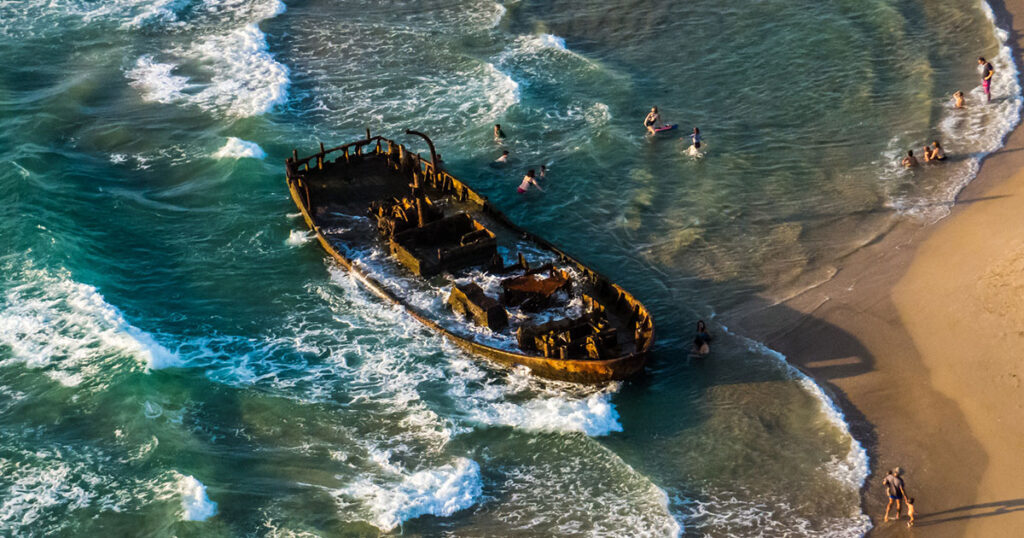
I think the body, a vessel that carries you through life, is like a sinking ship, and every death a drowning. Spanish, like English, has a term for someone who survives a shipwreck, náufrago, but no specific word for someone lost and drowned at sea. Such a word would be handy. One moment a person is in control of the vessel, and the next they and their vessel are no more. It’s incomprehensible. “Gone?” I just could not understand that about Jerry, my mother’s companion. Or Frank, another companion, or my grandmother or my own father. They were here, I saw them just yesterday, so to speak, and you’re telling me they’re gone? Like rocks, they sank from my world.
The parents of my best friends from girlhood died in a house fire at the end of 2025. They are the most recent to disappear. Looking at pictures of where they went down, I find myself thinking they might resurface—maybe some yards off, out of sight—to come walking back to where the house had stood. An animal would trail them, because they always had animals. Jim would be laughing as he tilts his head back; Terry with her raspy chuckle would be talking to the animals, telling you what she said and what they answered. But no tell-tale bubbles arise at the site. They are gone, their home with them, never to be seen again. Because the dead don’t return.
Except they do. Some months after his death, my father seemed almost alive again. He was more present in my thoughts than he had been during the last couple of years of his life. It was strange, but moments of my past that I hadn’t bothered to revisit in years were like open rooms, and I glanced in. There was my dad, everywhere I looked. The only reason I didn’t say, Dad, you’re here! is that I knew he wasn’t.
But the me I spied in those rooms wasn’t in the present, either. The girl and her father of the past were unaffected by the events of the present. They went on about their business with no concern for me. “As if I were the ghost!” thought I, watching scenes from this other world unfold. This was almost as good as having him back. I couldn’t visit him, true, only look on from a distance. But for 11 months of every year while he still lived, I couldn’t share a meal or take a drive with him either, because I was in Spain. As the fifth anniversary of his death approaches, I think of him seated in his recliner, either reading or dozing, his headphones on his head, tuned to NPR. He is waiting. Since he can’t rejoin my world, it occurs to me he is waiting for me to step into his, peopled by so many old friends.
As time goes by, I find my dad grows into the person he once was, assuming the characteristics of a younger man. Returning in memory, gaining heft, becoming firmer in outline—the opposite of growing ghostly. The dead I know do not just occupy those rooms in my mind but begin to furnish them, as if moving in. And then they move aside, making way for new arrivals, such as Jim and Terry, just getting their bearings.
Well, I think, death doesn’t look so bad after all. After his Parkinson’s diagnosis, my father and stepmother gave us the news. He was on the back patio, in one of the twin chairs with the green cushions, looking relaxed. I hear him say again, with measured calm, “I plan to enjoy my decline.” That, overall, is what he did, letting others do the worrying. And he is still enjoying himself, I believe. He laid the groundwork for this final chapter, this low-key, triumphant return, all through his life. If he could see himself, he’d be proud.
Newer arrivals mean he no longer sits dead-center in the room. Nevertheless, he continues to have a strong presence. If I close my eyes, I can see him.
But I wish we could be together in the same room. “Do you know what this is all about?” I’d ask, nodding toward our friends and family. Because it’s hard for me to understand.
I’d also like to tell him something new from my life. For example, that I’ve just learned another meaning of proud. It means projecting slightly from the surface, like a dowel you’d leave sitting proud, to sand down. “Did you know, Dad?”
He was handy, so he’d know. But in my reverie, he’s not quick to speak. Waiting beside him, I want to sit proud, keeping my head up as he did through life: If I’ve learned anything from my dad, it must be not to preen. While I wait for his answer, I think of the prow of his boat, well-used and even nicked and, yes, battered by time, but sitting proud above the water. Who’d expect the boat to go under, him to perish, and for you yourself to be a castaway of his shipwreck? Or my girlhood friends to lose both their parents in a single staggering conflagration? Their parents worked in health and education, but their true passion was community organized sustainable living. One day in town, Jim bumped into an acquaintance. “Jim,” the guy said, “why do you have hay in your hair?” Jim laughed. “Why don’t you?” When I ask my dad why he’s so relaxed, he laughs.
“Why aren’t you?”