
Gratitude Isn’t Everything
The revolutionary Patriots owed much to their forefathers, but their fight for universal rights embraced a wider mission
Last July 5, Vice President J. D. Vance, in accepting the Claremont Institute’s Statesmanship Award, argued that the Declaration of Independence ought not to be viewed as the foundation of American nationality. Although the principles enshrined in the document are “beautiful” and “wonderful,” he said, they are insufficient to secure the homeland. True patriotism requires more than superficial agreement with abstract ideals. It derives from grounding in “a particular place,” in which residents develop and cherish “social bonds,” as they come to know one another as neighbors, send their children to the same schools, worship in the same churches, and participate in a common way of life. Nothing too controversial here, except for what he had to say about immigrants: that they ought to bide their time before suggesting improvements in their new homes. Rather than criticize the United States, newcomers should show gratitude to those who built America. It is the legacy of the founders from which we benefit today, their accomplishments we must honor with patriotic pride.
Vance’s message played down ideals in favor of rights and duties. His insistence on the gratitude we owe to the founders of this nation evokes the rhetoric of the 18th-century New Englanders who led the way to independence. They were defending not just basic liberties but also the way of life in which these were embedded. Theirs was a call to honor the legacy bequeathed by their forebears. It was a family story of inheritance, gratitude, and duty, not unlike that prescribed by the vice president. But in the course of their mobilization against Britain, the Yankee rebels and their allies in the Continental Congress came to embrace a broader, more universal mission.
How they did so is a tale of widening horizons that gave every Patriot a place in the fight, no matter how long-settled they were in New England or how new they were to the cause. They did not treat love of country, with a sense of belonging, as incompatible with devotion to democratic ideals. Far from being mutually exclusive, these commitments can and ought to strengthen each other. You can be at once a champion of your community and a citizen of the world.
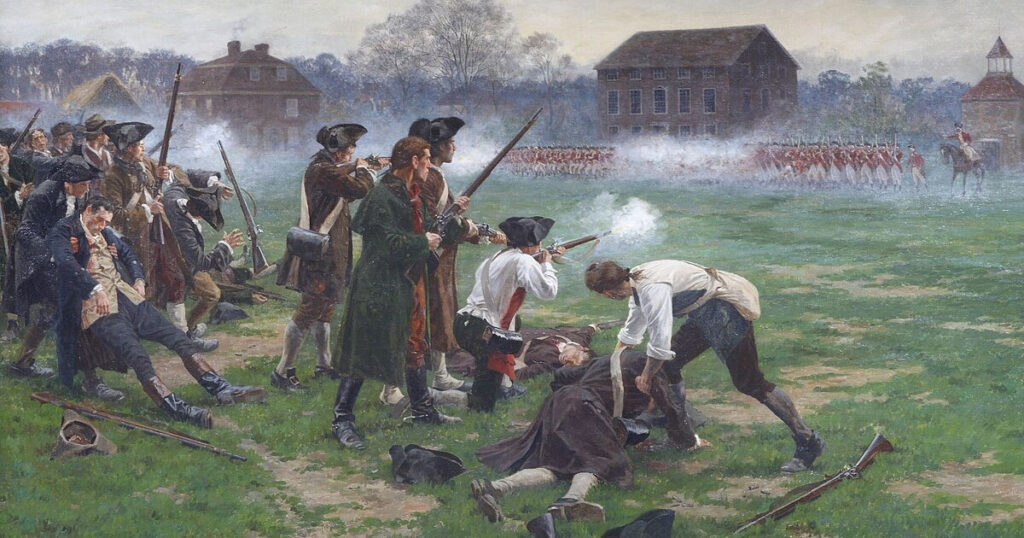
Consider the Massachusetts towns of Lexington and Concord, where the war began on April 19, 1775. On that date, 251 years ago, 800 British Regulars were dispatched from Boston into the countryside on a mission to seize the weapons and military stores the colonists were stockpiling in anticipation of war with the mother country. Concord was the destination of the king’s men. Eighteen miles west of the capital, it was the principal armory of the popular resistance. Passing through Lexington, the Redcoats confronted 70 militiamen on the town common and fired on them without orders and without apparent provocation. After that volley, six men lay dead, most of them shot in the back; another nine were wounded.
At Concord, the invaders met opposition at the North Bridge, where local forces, augmented by reinforcements from surrounding towns, sent them packing in a clash that Ralph Waldo Emerson would later memorialize in his 1837 poem “Concord Hymn,” hailing “the shot heard round the world.” As alarm bells rang throughout the land, men from “every Middlesex village and farm” and beyond headed for Concord. Close to 4,000 provincials harried the British retreat along the “bloody battle road” back to Boston. Only the arrival of another 1,000 troops at Lexington with heavy artillery spared the expedition from becoming a complete rout. In the end, 73 Regulars lay dead, 174 wounded, and 26 missing, for a casualty rate of close to 20 percent. The American toll was comparatively slight, with losses amounting to two or three percent.
Concord and Lexington arrived at their battle stations by different routes. Concord was the older, richer town. The first English settlement above tidewater, beyond the sight and scent of the sea, it had grown to some 1,500 people (265 families) by the eve of war. Most of those residents were farmers, reaping the benefits of fertile soils along the rivers flowing through town and succeeding to “planting fields” made ready for cultivation by the Native peoples they displaced. Concord also had a lively commercial sector. Well-located on the King’s highways, the village was a center of trade, a seat of courts, a staging ground for military expeditions, a hub of communications with nine taverns, and a gathering place for town meetings and Sabbath worship. Its top leaders were plugged into the royal government in Boston, which rewarded supporters with military commissions and judicial appointments. With good reason it was chosen as the principal depot for military provisions.
By contrast, Lexington was a backwater, with no retail stores, no major thoroughfares (except for the highway on which the Redcoats passed through), no river for transportation or milling, just two taverns, and few cosmopolitan connections. First settled around 1642, it grew slowly as a section of Cambridge and did not become a separate township until 1713. Six decades later, the population numbered 750—half that of Concord’s.
Despite these differences, the two towns would make common cause in defense of a shared way of life. Concord was at first hesitant to put its opinions on record, and until the summer of 1774, it kept its distance from the gathering protest movement. Not Lexington. Residents at a town meeting were quick to denounce the Stamp Act as an infringement of the rights guaranteed the colonists under the Massachusetts Charter of 1691, including “their Darling and constitutional right, Never to be Taxed but by their own Consent, in Person or by their Representative.” Parliamentary taxation was an affront in two ways at once. It treated the people of the Bay colony as second-class subjects, without the same rights enjoyed by their English brethren, and it betrayed the legacy of liberty their 17th-century forebears had secured from the Crown through “Firmness and resolution.” It was thus incumbent on Lexington to defend that inheritance and to maintain it intact for “ourselves” and “posterity.” Let the world see and “future Generations know” that they honored the gift of the ancestors, “valued the Rights they enjoyed, & did not tamely resign them for Chains and Slavery.”
This rhetoric of gratitude foreshadows the vice president’s speech last year. In the Revolutionary movement it was a mark of militancy to appeal to the ancestors in protests against British policies. Such statements rehearsed the history of New England from the Puritans’ first settlements down to the latest generation. Lexington elaborated on this narrative in January 1773. The saga opened as the Puritans fled the tyranny of Charles I and Archbishop Laud, made the hazardous Atlantic crossing, and carved out new homes in the American wilderness. “Our worthy ancestors … [endured] many Struggles with their Enemies in the Face of every Danger and at the expence of much Treasure and Blood,” the Lexington town meeting declared. They thereby “secured to themselves, & transmitted to us, their Posterity, a fair and rich Inheritance, not only of a pleasant fertile Land, but also of Invaluable Rights & Priviledges both as Men & Christians, as stated in the Royal Charter of this Province, and … [guaranteed] by the Faith of the British Crown & Kingdom.” So precious a legacy came as a sacred trust. It was the townspeople’s duty to protect and preserve this birthright of liberty and pass it on intact to the next generation. To do otherwise would betray their very character as a people.
The rhetoric of filial duty became ubiquitous in 1774–75 and with good reason. To punish the Bay Colony for the Tea Party and to curb what royal officials deemed a disorderly democracy, Britain effectively revoked the revered 1691 Massachusetts Charter. Under the Massachusetts Government Act (MAGA), the Crown took over the hiring and firing of all judicial officials and excluded the assembly from its previous role in choosing the provincial council, the upper chamber of the general court. Most important, the new law barred town meetings without the governor’s consent, except for an annual session to elect municipal officials. MAGA was a direct attack on local autonomy and on popular influence in government. To the inhabitants, these arbitrary changes, imposed from above, amounted to disinheritance, and as worthy heirs of virtuous forefathers, they rose up in outrage. Concord’s minister, William Emerson, grandfather of the philosopher, prepared his congregants for war with a call to “Arise my injured Countrymen, and plead … with your Arms, the Birthright of Englishmen the dearly purchased Legacy left you by your never to be forgotten Ancestors, and if God does not help, it will be because your Sins testify against you.” The very manual of “rules and regulations” that guided the Massachusetts army highlighted at the outset of the text the trials of “our pious and virtuous Ancestors” and pledged the soldiers to restore and preserve “the free Exercise of all those civil and religious Rights and Liberties for which many of our Fore-Fathers fought—bled—and died.”
The appeal to the ancestors evoked a people with a shared history, a common religion, a source of collective pride, and a duty to posterity. As an origin story, it bonded the Patriots together as a united family stretching across generations and rooted in a particular land. To a reader today, it brings to mind Vice President Vance’s rhetoric of patriotism, with its dangerous potential to devolve into ethnic and racial nationalism. The New Englanders were certainly racially exclusive. In their accounts of the past, Native people were as dispossessed from history as they were from the land, mattering mainly as aids or barriers to the English advance. Nor was there room for men and women of African descent, whose tribulations and losses in the involuntary Middle Passage into American slavery—“servants for life,” as they were known in Massachusetts—vastly exceeded anything the English endured in their “errand into the wilderness.” The Puritan saga rested on genealogical privilege.
The appeal to the ancestors eased the route to revolution. Clinging to the charter, the people of Massachusetts portrayed themselves as conservators of history and trustees of a patriarchal bequest. The British, under the sway of corrupt, power-hungry rulers, were the innovators and aggressors. But the convictions animating the rebels of 1775 broke out of this backward-looking frame. There was never a single discourse of opposition to British imperial policies. For all its reverence for New England’s patriarchs, the town of Lexington recognized that the “Rights and Priviledges” set forth in the royal charter were not just concessions from a benevolent Crown. They inhered in the people of Massachusetts “as men and Christians” and rested on the foundation of universal natural law. Nor could George III unilaterally break the royal compact with the Bay colony. “If Charters are not deemed sacred,” Patriot leader Joseph Warren declared, “how miserably precarious is everything founded upon them.”
Defending the homeland transcended considerations of “blood and soil.” Some Patriots saw the revocation of the royal charter as a golden opportunity to break with the past. As the town of Worcester argued, Massachusetts was legally in “a state of nature” and hence free to establish a new government, even a simple democracy, by popular consent. So thoroughgoing a rejection of the ancestral legacy had advantages. Every colony had its own origin story; the descendants of Roundheads and Cavaliers invoked different—and incompatible—pasts. Better to rest the colonists’ case on a foundation of “the principles of our natural, essential, and unalienable rights,” as an Essex County Convention argued in 1774 and, as Thomas Jefferson would carry out so eloquently in the preamble to the Declaration of Independence.
The idealism inherent in that perspective had an expansive potential. Joseph Warren, president of the Massachusetts Provincial Congress, led the way. As Massachusetts stood on the precipice of war, he foresaw an opening of the American mind. The debate over Parliament’s right to tax the colonies had inspired “an allmost [sic] universal enquiry into the rights of mankind in general, and of British subjects in particular.” And this investigation, he predicted, would result in “such a liberality of sentiment, and such a jealousy of those in power as will … secure us against the future approaches of despotism.”
Martyred on Bunker Hill, Warren did not live to see the Massachusetts defense of the forefathers’ legacy transform into a fight for the universal rights of man. The Patriots of 1775 did not see an incompatibility between loving your homeland and supporting the democratic rights of humankind—and welcoming seekers of liberty to our shores. For all the debt owed by the new arrivals to the Puritan fathers, freedom did not depend on descent. On April 19, 1775, the Patriots were still thinking primarily of charter rights on Lexington Common and at Concord’s North Bridge. Thanks to their sacrifices, they helped to make possible a revolution in the name of universal rights to “life, liberty, and the pursuit of happiness,” for which we, in turn, can still be grateful.