
Undesirable: Invasive Species, Humans, and Where We All Belong by Amy Crawford; Oxford University Press, 288 pp., $29.99
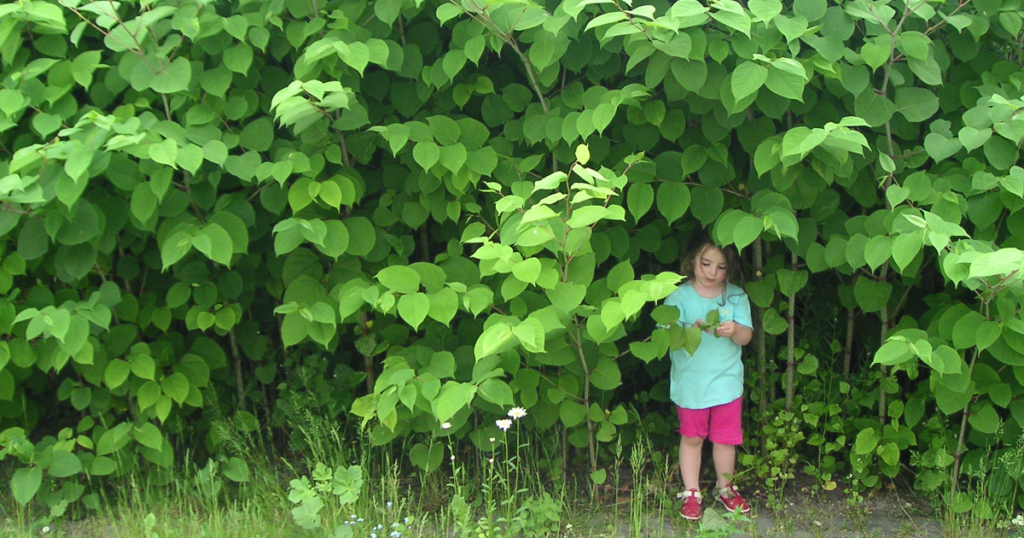
In 2013, a 52-year-old lab technician in England bludgeoned his wife to death with a perfume bottle, then killed himself. However shocking, this crime probably wouldn’t have made headlines beyond their hometown if not for the man’s suicide note. “The balance of my mind,” he wrote, “was disturbed by … a patch of Japanese Knotweed which has been growing over our boundary fence.” Knotweed is a tenacious invasive species, nearly impossible to eradicate, and often causes property values to plummet. “The worry of it migrating onto our garden and subsequently undermining the structure,” the man concluded, “has led to my growing madness.”
As science writer Amy Crawford demonstrates in her thought-provoking new book, Undesirable, invasive species have a way of unbalancing people. Even among biologists and conservation officials, any pretense of objectivity often gets tossed out the window: They regularly liken invasives to “metastatic cancer,” “merciless killers,” and “public enemy no. 1.”
Still, that rhetoric is understandable sometimes, given that invasives cause $2 trillion in economic damage worldwide each year—destroying crops, spreading diseases, undermining buildings, and choking out native plants and animals. Invasive bugs and earthworms have even reached Antarctica. The United States has been hit especially hard, with a reported 51,000 non-native species having crossed its borders.
Biologists and angry amateurs alike have developed all sorts of methods to combat invasives: traps, nets, electric zappers, specially trained beagles to sniff them out, as well as some dastardly ways of culling them. The latter includes a truly dystopian device called the Felixer, a solar-powered, AI-driven unit that senses feral cats—which slaughter native birds at abominable rates—and sprays them with poison, which the cats ingest while licking and grooming themselves. Although these measures are deployed in the name of preserving fragile species, as one of Crawford’s sources grumbles, “Killing plants and animals doesn’t seem to me like the best way of celebrating biodiversity.”
Uglier still, with the rise of modern populism, the rhetoric about invasives crossing foreign borders often echoes the language used to denounce human immigration. Sometimes, the contentious debates over human and biological migrants overlap and feed upon one another. Invasive cane along the Rio Grande has exacerbated droughts by sucking up groundwater, while simultaneously providing cover for both narcotraffickers and undocumented people crossing the southern U.S. border. In Australia—where invasive species wreak particular havoc—young people have floated conspiracy theories that immigrants first imported invasive flora and fauna from their homelands, perhaps to sell in exotic markets.
However, the politics of invasive species don’t map cleanly onto the left-right spectrum. As Crawford writes, liberals “see the right-wing anti-immigration position as morally repugnant, while opposition to invasive species remains an uncontroversial tenet of standard-issue progressivism.” Conservatives, in contrast, “consider border security paramount” with regard to humans, but “dismiss environmental regulations that might tamp down biological invasions as a threat to freedom.”
All this gets even more muddled when you realize that, in nature, many assumptions about invasive species are wrong. Native species rarely just succumb to invaders. Most do fine. In certain cases, invasive species provide critical shelter or food for endangered native birds that would likely disappear otherwise.
Horror stories about invasives don’t always survive scrutiny, either. Remember the 1990s scare over “killer bees”? Or take kudzu, the vine that once seemed poised to devour the South. It currently covers 0.1 percent of the South’s 200 million acres of unoccupied land—hardly a calamity. But the places it thrives are telling: empty cropland and cleared sections alongside highways. Places, in other words, that humans regularly see. Our fear is seemingly just a psychological sampling bias.
Even deciding whether a species is invasive or not can be tricky. Horses originally evolved in North America, where early human settlers encountered them thousands of years ago and helped wipe them out via hunting. Spaniards reintroduced them while colonizing the Americas in the 1500s, and some escaped and went feral. So are horses invasive? And is that judgment based on sound ecological principles, or the fact that modern humans find wild horses romantic? A related issue is determining at what point in the past we draw the line between native and non-native. After all, every species originated somewhere, and as Crawford notes, any point we pick to stand athwart biology and yell “stop!” is arbitrary, “a screenshot from a movie that has no clear beginning or end.”
Crawford contends that much of our fear of invasives actually stems from larger worries about climate change and other looming environmental catastrophes. Those are overwhelming problems that no one human can solve. Moreover, every one of us who drives or uses plastics is complicit in them, which feels crummy. In contrast, we can oppose invasive species with clean consciences. Moreover, individuals can do something about them—tramp through the woods and tear out groves of garlic mustard, or participate in bounty hunts for pythons (at least in South Florida). Alas, the separation between climate change and invasive species isn’t so clean, since rising temperatures often push species to migrate into new territories.
Undesirable is a short book, and could have been shorter: There’s a bit too much about the infighting among, say, academics or animal-rights activists. Ultimately, though, Crawford does exactly what good nature writers should: She illuminates why this potentially nebulous topic matters, wades through the complexities, and offers a deeper understanding than perhaps even the scientists involved possess. After reading the book, it’s simply untenable to argue that native always equals “good” and invasive always equals “bad.” Above all, Crawford invokes a sort of Serenity Prayer of Biology as we navigate the tumultuous world that invasives have thrust us into—a plea for the wisdom to “recognize what we can fix, what we can’t, and when we might just have to accept that our world has changed forever.”