
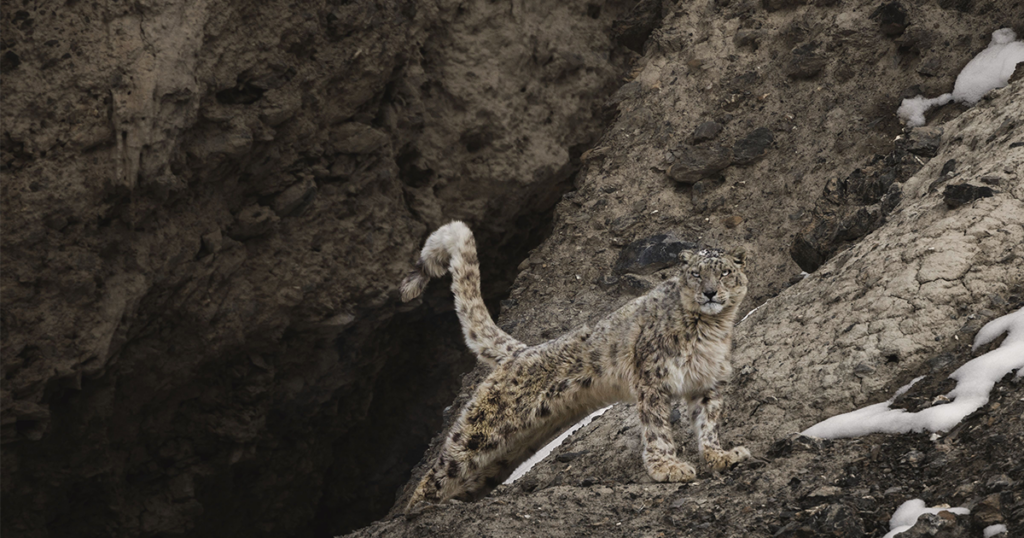
The Ghost of the Mountains: Unraveling the Secrets of the Snow Leopard by Kulbhushansingh Suryawanshi; Riverhead Books, 336 pp., $32
Have you seen the snow leopard?
No! Isn’t that wonderful?
These lines come from Peter Matthiessen’s 1978 classic, The Snow Leopard, which documents his journey with field biologist George Schaller high into the mountains of Nepal. The book is alive with insights into both outer and inner worlds rarely seen, looming like Everest above any author who dares tackle the same place and subject. This alone would intimidate a lesser writer than
Kulbhushansingh Suryawanshi, but his new book, The Ghost of the Mountains, stands on its own.
As a young man growing up in central India, Suryawanshi dreamed of climbing mountains, and in his late teens he went to the Himalaya to train as a mountaineer. While there, he discovered the print of a snow leopard near his camp—and nothing was ever quite the same. Four years later, as a student at the National Centre for Biological Sciences in Bangalore, he sought to make snow leopards the subject of his master’s thesis, only to be told by his professor, “You will never see a snow leopard.” Suryawanshi compromised by choosing to study blue sheep, the leopard’s prey. Despite his professor’s doubts, he encountered more than a few snow leopards during his research, and they ignited his imagination. In The Ghost of the Mountains, we follow him in his pursuit to track, study, survey, understand, and with any luck save these elusive big cats.
Suryawanshi’s is an important and often delightful book, and it is perhaps unfair for me to turn once again to its predecessor. But that is exactly what I did at around page 103. I picked up The Snow Leopard for the first time in more than 30 years, curious to know whether my late-middle-age self would revere the book as much as I had when I first read it in my 20s. It turns out that I did, and soon I was lost not just in Matthiessen’s mountains but also in the subjective strangeness of his quest—that is, lost in sentences like these:
The ground whirls with its own energy …
I grow into these mountains like a moss. I am bewitched. The blinding snow peaks and the clarion air, the sound of earth and heaven in the silence, the requiem birds, the mythic beasts, the flags, great horns, and old carved stones, the rough-hewn Tartars in their braids and homespun boots, the silver ice in the black river, the Kang, the Crystal Mountain.
What I found in The Snow Leopard was mystery and strangeness, and if the journey required some trudging, like reading Dostoevsky when you are young, it was worth hiking hundreds of pages to get to those transcendent shimmering moments. This is exactly what is missing in much of contemporary nonfiction: Editors too often banish the first person along with any quirks of self, embracing as their guiding aesthetic a kind of false objectivity.
Which brings me back to The Ghost of the Mountains. The ground might not whirl with quite as much poetic energy as it does in Matthiessen’s book, but Suryawanshi’s prose is clear and restrained as he takes us along on his studies, first of the blue sheep, a creature really more goat than sheep, and then of snow leopards themselves. He spends months in the field, where, at the end of each long day, he stays in a small, cold room heated by dung. We trek with him as he tries to solve the mysteries of the interactions between prey and predator, at first embracing the idea that keystone species, like the wolves at Yellowstone, are the drivers of an ecosystem, but then revising this theory to fit the more complex workings of the Himalayan ecosystem. Particularly impressive is our guide’s regard for and consideration of local herders, whose animals are inevitably part of the snow leopard’s diet but who, despite this, often regard the cats with awe and respect. Suryawanshi is no aloof scientist. He has spent years among the people who share a landscape with the leopards, and the solutions he seeks are often hands-on and practical. Such research, though, involving so much time in remote places, carries a personal cost: After the birth of his daughter, Suryawanshi begins to question all the time he must spend away from home and the dangers of life in high mountains. This is yet another parallel to The Snow Leopard: Matthiessen’s months-long trek took place less than two years after the death of his wife, while his eight-year-old son waited at home.
div class=”pullquotel”>Suryawanshi describes local guides now ushering tourists to spotting scopes aimed at snow leopards that are all but posing across a gorge.
The Ghost of the Mountains is in many ways an uplifting book, but there is sadness in it, too. In the Spiti Valley, where Suryawanshi saw that first paw print, he describes local guides now ushering tourists to spotting scopes aimed at snow leopards that are all but posing across a gorge. Meanwhile, roads have opened to formerly inaccessible places. He writes, “I could see that what was happening to Mount Everest was going to happen to the snow leopard. It was only a matter of time before overcrowding, human garbage, and accidents profoundly shaped the experience of seeing the snow leopard. People would come imagining the world described by Matthiessen and find something devoid of meaning.” Left unsaid is the role that science itself, with its radio collars and camera traps and obsession with quantifying, plays in dispelling mystery. I am not naïve and fully acknowledge the necessity of studying the cats; without scientists and advocates like Suryawanshi, not just the mystery but the animals themselves would be extinguished.
And yet, I can’t help but dwell on the loss. “There is something forever unknowable about them,” Suryawanshi writes of the cats he studies. Less unknowable now in a time when tourists snap pictures of them for “a few likes on social media.” A part of me wishes we didn’t know as much and that some things could stay hidden in this all-too-known world.
And that part thinks it would be wonderful not to see the snow leopard.