
A Newer Species of Trouble
When the lines between natural and technological disasters become blurred— and ultimately erased
In 1973, Yale sociologist Kai Erikson visited the ruins of several coal-mining towns in Logan County, West Virginia. The previous February, a mountaintop dam full of coal waste had unleashed a flood of toxic sludge, destroying about 550 homes and leaving more than 100 people dead. When Erikson arrived, he encountered “a scene of such heavy, muted pain that I have a hard time finding words to capture it,” he wrote.
After that trip, his field studies took him again and again to communities coping with the aftermath of disaster: a mercury spill in Canada; an underground petroleum leak in Colorado; the nuclear accident at Three Mile Island in Pennsylvania. He collected insights from these visits and distilled them into a slim but seminal book, A New Species of Trouble (1994).
In industrial civilization, Erikson wrote, humans had unwittingly made an unsettling trade. On one hand, we had increasingly buffered ourselves against natural disasters such as wildfires and hurricanes. On the other, the progress that afforded this protection had also yielded something else: the phenomenon of “technological disasters,” which he defined as “everything that can go wrong when systems fail, humans err, designs prove faulty, engines misfire, and so on.” The oil tanker crashes; the dam collapses; the reactor operator slips up. “The first thing to say about this new species of trouble,” he wrote, “is that it is a product of human hands.”
Erikson (who happened to be the son of famed psychoanalyst Erik Erikson) theorized a psychological difference in how humans react to these two types of events. Although natural disasters—or “acts of God,” as they used to be called—could be devastating, people tend to accept them as part of life, an unlucky break. Technological disasters, by contrast, provoke “outrage rather than acceptance or resignation. They generate a feeling that the thing ought not have happened, that someone is at fault.”
In the years since that book was published, we’ve had our share of technological disasters. There was the 2015 leak at a natural gas storage facility in Southern California that released more than 100,000 metric tons of methane and other toxic chemicals over the course of four months; the 2023 train derailment in East Palestine, Ohio, in which cars carrying hazardous substances caught fire, contaminating the surrounding area. These incidents and others would have fit seamlessly into A New Species of Trouble.
But we have also seen another development: The lines between natural and technological disasters have increasingly blurred. The most emblematic catastrophes of the Anthropocene are those in which humanity and nature collide and collude. The tsunami causes a nuclear meltdown; radiation contaminates the soil. Climate change intensifies the drought; the drought abets the arsonist.
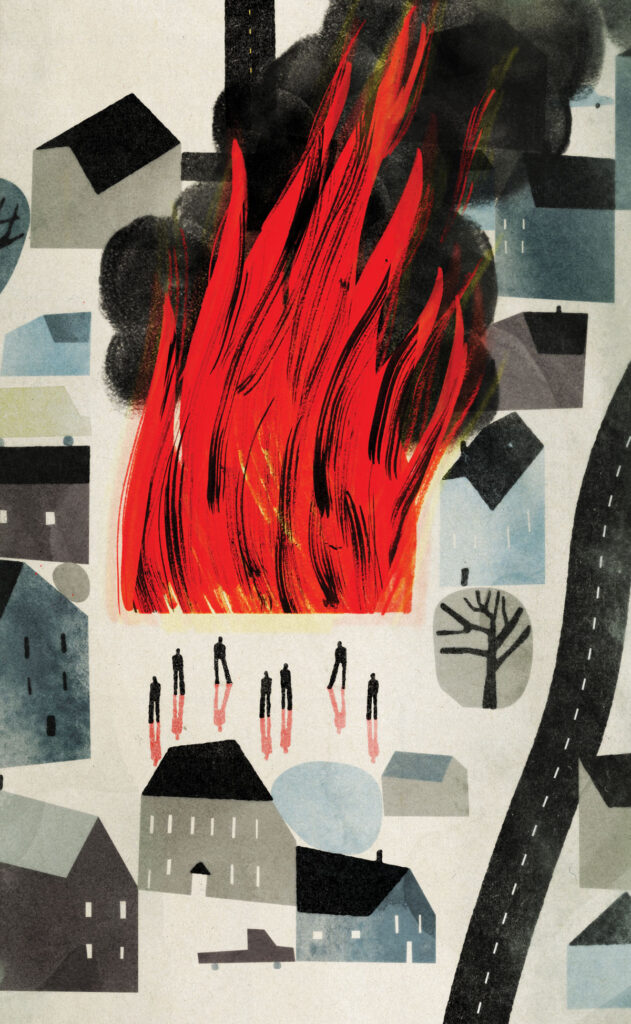
This newer species of trouble was epitomized by the Los Angeles fires of last year, when a mélange of natural and unnatural forces produced one of the most shocking and costly calamities in American history.
“There is something uneasy in the Los Angeles air this afternoon, some unnatural stillness, some tension,” Joan Didion famously wrote in 1967. “What it means is that tonight a Santa Ana will begin to blow. … For a few days now we will see smoke back in the canyons, and hear sirens in the night.” She quoted Raymond Chandler: “On nights like that every booze party ends in a fight. Meek little wives feel the edge of the carving knife and study their husbands’ necks. Anything can happen.”
The Santa Ana winds blew long before midcentury literary icons enshrined them in poetry, before Spanish settlers arrived in the Los Angeles basin, before the invention of the steam engine. In other words, they’re natural. But in early January 2025, the winds blew in a city, and on a planet, that had changed substantially since all of those prior developments. The global temperature had risen by 1.3 degrees Celsius—2.34 degrees Fahrenheit—since preindustrial times. In the fall of 2024, Los Angeles County had record-low precipitation. The autumn had been conspicuously warm. The shrubs and grasses were aching to burn.
Then came two points of ignition, one on the west side of the city, the other on the east. At a trailhead in the Pacific Palisades, a 29-year-old Uber driver allegedly started a small fire. It was soon suppressed, but almost a week later, according to authorities, undetected embers from that fire met with those Santa Ana winds, reigniting the blaze. The same day, January 7, another fire started in Eaton Canyon under a dormant power line. The leading theory is that the magnetic field of a nearby active line may have induced an electric current in the idle line.
These fires swiftly grew into hellish conflagrations that obliterated two communities, Pacific Palisades and Altadena. They destroyed more than 16,000 structures and killed at least 31 people. (Hundreds more people are thought to have died soon afterward as an indirect result—from health conditions exacerbated by the smoke or because of disruptions to the health care system.)
Through mishap or malice, through one person’s momentary impulse or the accretion of hundreds of years of choices, human hands multiplied the damage caused by the elements—and the elements multiplied the damage caused by human hands.
But there’s another feature of Erikson’s new species of trouble. He focused on what he dubbed “toxic disasters,” which make up many, though not all, technological disasters. A plane crash, for example, is a technological disaster but not a toxic one. Toxic accidents “contaminate rather than merely damage,” he wrote; “they pollute, befoul, and taint rather than just create wreckage; they penetrate human tissue indirectly rather than wound the surfaces by assaults of a more straightforward kind.” Living in the aftermath of a toxic accident such as a nuclear meltdown or chemical spill, people feel an insidious and pervasive dread. You don’t know exactly where the contaminants are, so you fear them everywhere, including in your own body.
The Los Angeles fires were a toxic disaster. When a modern city catches fire, the smoke contains residue of not just the organic matter of trees and grasses but also all the materials in our homes and cars, furniture and clothes, toys and electronic devices: lead, asbestos, plastics, metals. These particles, liberated by fire, stream into the lungs of firefighters and fleeing residents. And they settle into buildings and soil long after the flames have been extinguished. A recent study by UCLA researchers found elevated levels of potentially carcinogenic compounds inside houses within the burn zones.
Last June, in a commentary published in JAMA Internal Medicine, researchers made a startling comparison. They argued that to understand the Los Angeles fires, we should look at the consequences of the burn pits constructed on U.S. military bases in Iraq and Afghanistan: “The chemical profile of the smoke from the LA fires is similar to that of a massive, uncontrolled burn pit, with the release of toxins such as lead, mercury, volatile organic compounds, and other harmful substances.” Exposure to these toxins, they wrote, has been linked to respiratory, cardiovascular, and neurological conditions.
For residents returning to their homes or trying to rebuild in the Palisades and Altadena, the danger is far from over. “One reason toxic emergencies provoke such concern is that they are not bounded, that they have no frame,” Erikson wrote. Imperceptible contaminants “do no immediate damage so far as one can tell, and then begin their deadly work from within—the very embodiment of stealth and treachery.”
How does the psychological response to the California fires compare with the reactions Erikson so astutely observed? It’s hard to generalize; the range of reactions is wide and heterogeneous. In any disaster these days, there is a tendency to seek human culprits. But those who get the most blame—mayors, fire chiefs—are not necessarily the most culpable. It’s just easier to point fingers at them than at the diffuse network of corporations and lawmakers that bears responsibility for the conditions that made the fires so ruinous. And yet, for some, indignation may be tempered by the knowledge that wildfires have always been a feature of life in Southern California.
Of course, the natural, pre-industrial world was full of risks, whether from poisonous berries, hungry lions, or storms against which people were more vulnerable. We are no longer at the mercy of the elements to the same degree. We have a greater capability than our ancestors did to protect ourselves from natural disasters, with advance warning systems, firefighting equipment, and hospital infrastructure that didn’t exist a century ago. But we are simultaneously increasing the frequency and destructiveness of these events, in a kind of race against ourselves. We live in unease, anticipating the next disaster, knowing we are surrounded by hazards, uncomfortably aware of the complicity of our own species. One line from Erikson’s book still wholly applies: “An all clear is never sounded.”