
A Teacher and a Friend
The roots of Anthony Benezet’s campaign against slavery—and his belief in Black and white equality—can be traced to the remarkable school he ran out of
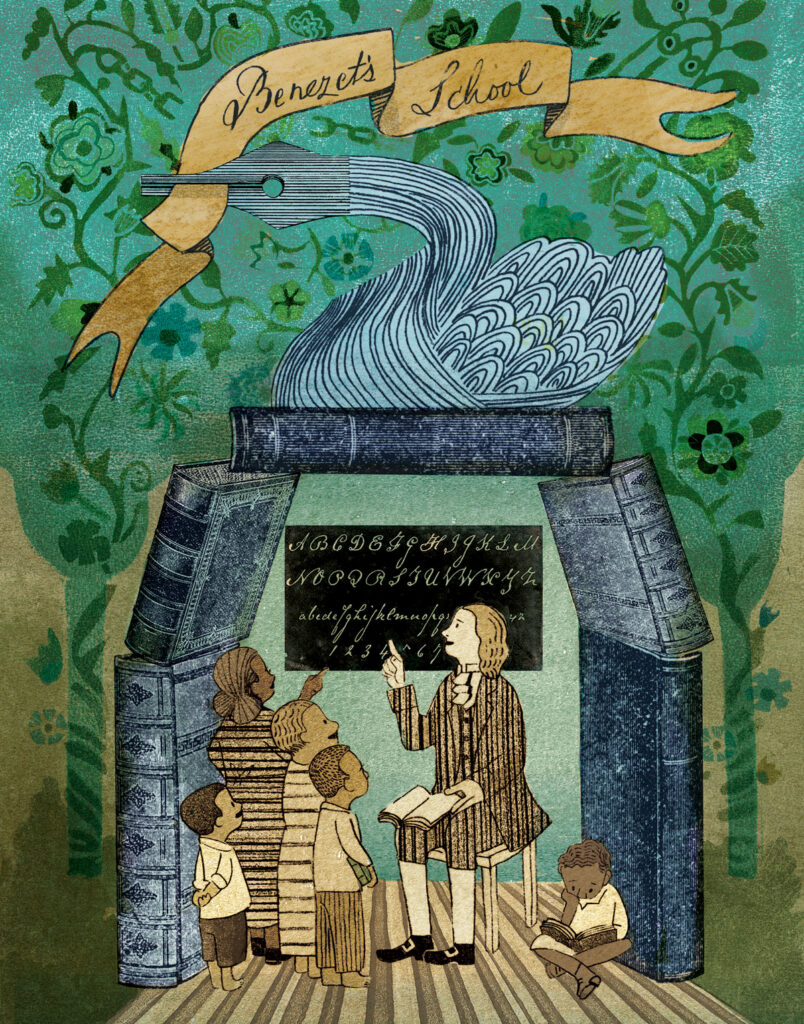
In his 2007 book, Head and Heart, Garry Wills called Anthony Benezet “the one unquestionably authentic American saint.” More than 200 years earlier, French revolutionary Jacques Pierre Brissot wrote, “Who is equal to Benezet? Who was more virtuous than Benezet? Who was more useful to society, to mankind?” Benezet, an 18th-century Philadelphia Quaker, was instrumental in ending the transatlantic slave trade. It was Benezet, too, who precipitated America’s long national discussion of Black and white equality, an unthinkable concept in his day. He was a person of not only national but global importance. Yet astonishingly, he has almost entirely slipped out of the American historical memory. Today, this man, who did so much to trigger America’s abolitionist movement and England’s as well, is known mainly to a small circle of scholars.
Philadelphia’s Quakers had started brooding about slavery in 1688, seven years after William Penn founded the colony of Pennsylvania. A group of Friends in nearby Germantown had issued a remonstrance that made its way to the Quakers’ highest colonial authority. “We are,” the Germantown Friends declared, “against the traffic of men-body … To bring men hither, or rob and sell them against their will, we stand against.”
The remonstrance went nowhere, with the matter deemed too “weighty” and complex. The fact was that too many Quakers, including a large percentage of their leaders in the late 17th and early 18th centuries, owned slaves. Some even dealt in the business of buying and selling enslaved people. Quakers believed that all people had the spirit of God within them, women as well as men, Black people and white, American Indians—the Inner Light didn’t differentiate. But though Black people might have been considered equal to whites spiritually, that didn’t mean they were equal otherwise. And here Quakers shared the common prejudices of their time.
The perception of Black inferiority was understandable enough. In the mid-18th century, the 13 colonies had a quarter of a million enslaved people, 20 percent of the overall population. Though conditions varied, almost all lived hard, distressed lives that were physically, emotionally, and mentally exhausting. Kept illiterate, they had no access to the advantages white people enjoyed: education, rights, control over their persons and their labor, the common customs of individual, family, social, and civil life. Husbands and wives were often cruelly separated from each other, and children from their parents. Oppressed by these dehumanizing circumstances, they were perceived by the white world as incapable and contemptible. Imagine, said Benezet’s friend and fellow abolitionist John Woolman, if free people suffered the same circumstances: “[Would] we be less abject than they are?” But the idea of a humanity shared by Black and white people was to most an alien concept, absurd on its face.
This common street-level prejudice was part and parcel of a larger construct, one that provided an intellectual framework that oriented scientists, philosophers, theologians, and humanists, a presupposition that inhabited the minds of the era’s great thinkers and ordinary people alike. This principle, the so-called Great Chain of Being, provided a way of organizing the plenitude of nature—minerals, plants, and animals, including humankind—into a scale according to complexity, reasoning ability, and other criteria. The races of man fit into this continuum as well, best illustrated by Carl Linnaeus’s Systema Naturae, in which the great taxonomist placed white Europeans at the top of the hierarchy and Black people at the bottom.
The Great Chain of Being as an organizing principle had its origins in Plato and Aristotle, but it was in the 18th century, as the intellectual historian A. O. Lovejoy explained, that the concept attained its widest diffusion and acceptance, as influential during that period as the theory of evolution would be after Darwin. This most fundamental scientific theory of its time nurtured a jaundiced perception of Black people, both enslaved and free, and the power and extent of this distorted perception were deep and lasting. Although slavery itself was age-old, the New World association of Africans with the institution gave it a racial identification it didn’t previously have. With its steps of gradation, the Great Chain of Being provided a rationale for keeping Black people in perpetual servitude.
Given the universal perception of Black inferiority, it is perhaps not surprising that the idea of educating Black slaves was seen as both futile and dangerous. In the southern sections of the country, laws with significant penalties prohibited teaching the enslaved. In South Carolina, the fine for doing so was £100 “current money.” In other southern colonies anyone, white or Black, who dared teach enslaved individuals could be fined, imprisoned, or whipped. Educating Black people was considered a clear and present danger, especially in the aftermath of South Carolina’s Stono Rebellion of 1739, in which a literate enslaved man led a group that killed owners of a local store, seized weapons and powder, and marched toward Spanish Florida, killing more than 20 whites and setting fire to plantations along the way.
Into this world stepped Anthony Benezet. Born in 1713 into a Huguenot family that had escaped France when he was two years old, Benezet moved with his family to England and subsequently to Pennsylvania, where both he and his father joined the Philadelphia Society of Friends. Benezet was what we might today call a late bloomer, unable to settle on work until he was 26, when he found a job as a teacher and discovered his vocation. He had fallen into his career in the classroom by chance: An opening had presented itself, and in need of a job, he took it. “In the first instance,” one of his friends wrote, he “commenced teaching for a subsistence.” But he soon discovered a talent for teaching and then a passion for it. As a schoolmaster in Philadelphia’s Quaker school system, he was known for his innovations in curricula and for his gentle manner with students. “If I have any service at all in creation,” he wrote to a friend, “it is in the education of children.”
In 1750, at the age of 37—well into middle age by the standards of the time—Benezet created a small explosion in the world of education. He began teaching Black children in his home at night, fully understanding what a controversial thing he was doing but never imagining the consequences for both himself and society.
We do not know what specifically led him to take this action. We do know that Benezet had Black friends, an unusual circumstance then. And we know that he spent considerable time talking with Black people who worked along Philadelphia’s bustling Delaware River waterfront. It was there, too, that he saw Black children, some accompanying their mothers or fathers, some themselves bound to masters, others running through the streets unattended, none of them able to read, write, or do sums. We can easily imagine how Benezet would have been moved with compassion toward them, leading him to establish what in a short time came to be known simply as Benezet’s School. It was the first school for Black children anywhere in the American colonies.
The classroom where he taught was most likely in the downstairs living area of the home he shared with his wife, Joyce. The residence itself was one of Philadelphia’s early brick houses, two stories, well built but, like its Quaker owners, modest. His students were free and enslaved, both Black and “mulatto.” Later he opened his classroom doors to adults as well. During the 1750s, while teaching white students at Philadelphia’s Penn Charter School, he persuaded the Quakers to open a girls’ school, arguably the first American day school for girls. Teaching Black and white students the same curriculum at the same time allowed Benezet a singular perspective. Judging his Black students’ progress, Benezet reported,
I can with truth and sincerity declare, that I have found amongst the negroes as great variety of talents, as among the like number of whites, and I am bold to assert that the notion entertained by some, that the blacks are inferior in their capacities, is a vulgar prejudice, founded on the pride or ignorance of their lordly masters, who have kept their slaves at such a distance as to be unable to form a right judgment of them.
Benezet carried on his home night school for 20 years. Then in 1770, he persuaded the Quakers to establish an “Africans’ School” as part of the Friends’ public-private school network. The success of his night school provided the necessary evidence: The alert, curious, receptive students demonstrated that the idea of Black schooling was not a lost cause. At least so far as the Society of Friends was concerned, Benezet had proved that Black people were intellectually as well as spiritually on the same plane as their white contemporaries, equal members of the same, single human family. In terms of the general beliefs of the time, Benezet’s home school and the Quaker Africans’ School were breakthroughs.
Both schools ended up playing an important role in Philadelphia’s Black community. Absalom Jones, cofounder of the Free African Society and leading architect of the African Church of Philadelphia, learned to read and write at Benezet’s night school and would later comment on the importance of the mathematical instruction he received there. James Forten, a Black sailmaker whose business acumen made him one of Philadelphia’s wealthiest citizens, attended the Africans’ School. Forten’s father, who taught him sailmaking, may well have been a student at Benezet’s home school. Jones and Forten were leading abolitionists; Forten was an important supporter of William Lloyd Garrison’s The Liberator. Along with Richard Allen, they were at the center of organizing and giving shape to Philadelphia’s African American community and its emerging institutions. It’s a reasonable assumption that Jones, Forten, and many of their fellow students were stimulated toward accomplishment by educational environments that recognized their humanity and potential, a rarity in colonial America.
Benezet maintained his close ties with the Africans’ School until his death in 1784. As his health deteriorated and he began to anticipate the end of life, Benezet reaffirmed his earlier conclusions about Black intelligence and potential. As he wrote, he’d had the opportunity for many years of knowing the temper and genius of the numerous Africans under his tutelage.
When he died, he left the bulk of his estate to the school (after providing for his wife). The first line of his will read, “Be it remembered that I, Anthony Benezet, a teacher of the free school for the black people of Philadelphia …” For all that he had done in his life, this is how he regarded himself.
Benezet’s biographers have noted his school, but they have failed to convey its historical significance. Instead, almost all commentators have concentrated on the immense influence of his antislavery writings, which did so much to end the transatlantic slave trade. Yet a close reading of those texts illuminates how Benezet’s experiences with Black students gave his antislavery discourse its galvanizing force. What he found among his students, namely that they were full human beings, not only spiritually but also in terms of talent, intellect, and temperament, directly informed his understanding of the slave trade—“this enormous evil,” he called it, “this prodigious iniquity.”
We can safely assume that Benezet was appalled by the institution of slavery before he launched his night school. But until then, he had neither written nor spoken much about it. Only in 1750, the year he opened the school, did he begin talking about slavery, insistently and publicly, “lifting up his voice on behalf of an oppressed and wretched portion of his fellow beings,” as his early biographer Roberts Vaux put it. It took Benezet a while to get his thoughts in order, but once he did, he began to write.
His first publication came in 1754: An Epistle of Caution and Advice Concerning the Buying and Keeping of Slaves, which was presented to the Philadelphia Quaker monthly meeting, then to other monthly and quarterly meetings, and finally to the senior Philadelphia Yearly Meeting. An Epistle was an exhortation to the writer’s fellow Quakers, urging them to live up to their faith as Christians, to their sense of plain justice, and to their feelings as human beings. They should avoid in any manner “the practice of making slaves of our fellow creatures.” He invoked Christ’s command, the Golden Rule: Do unto others as you would have them do unto you. It was the first time the Quaker overseers had allowed that fundamental Christian maxim to be published, given how awkwardly it reflected on slaveholding Friends. Benezet also invoked Exodus: He that stealeth a man, and selleth him, or if he be found in his hand, he shall surely be put to death. Not that any nonviolent Quaker would ever put anyone to death. But Benezet wanted his readers to understand the utter depths of the practice of buying, selling, and owning human beings. “We entreat you in the bowels of gospel love,” he wrote. Do not “keep them in bondage.”
An Epistle was the first antislavery remonstrance the Philadelphia Yearly Meeting ever adopted, but the practical effect was somewhere between modest and nil: The Society of Friends issued no order to free slaves and imposed no penalties for owning them. Quaker slaveholders contended that abolishing slavery would “give uneasiness to many brethren,” that it would create disunity, and that the matter was one perhaps best left to God. After all, “the Lord in time to come might open a way of deliverance for these people.” Over the years, the Quaker community evolved on the issue; by the end of the 1750s, most Quakers condemned slavery. But still there was no formal prohibition, and many Friends who owned slaves were simply not motivated to give them up. The enslaved people had cost good money, worked well, and—at least from the Quakers’ perspective—were often treated decently. Given those circumstances, Benezet’s appeal to Christian love, fairness, and justice had little of the desired effect.
His next tract, Observations on the Enslaving, Importing, and Purchasing of Negroes (1759), took another approach. Like the epistle, Observations was addressed to Benezet’s Quaker religious community, but it also initiated what became an ongoing endeavor that grew from his experience at his night school: to enlarge the understanding of Black people as equal human beings.
Observations is an essay on the Golden Rule that unpacks the saying beyond its obvious meaning in order to bring out its underlying theme. The text of the Golden Rule provides a precept for moral behavior. The subtext on which the precept rests is the assertion of reciprocity or “mutuality.” Benezet’s exegesis of “that divine Rule” brings together we and they: “To do unto all Men, as we would they should do unto us.” The two sides, ourselves and others—in this context, white and Black—are linked in a relation of reciprocal morality. The two races exist, writes Benezet, on the same moral level. In this regard, Observations marks the ongoing expansion of a mind wholly engrossed by the great moral issue of his time: what we would call racism, although the word itself wouldn’t be coined for another 150 years. In opening his Black school, Benezet had recognized that African Americans had the same talents and intelligence as whites. Now his recognition of Black intelligence had taken him beyond the question of educability, to a deeper level of conviction about the essential sameness of the races.
Observations was without precedent not only in thought but also in rhetoric. The tract included vivid portraits of the murder, kidnapping, plunder, and carnage that accompanied the slave trade. Benezet found material for these descriptions in various travel narratives that by this time had become available. Europeans who had lived in Africa for years and had been intimately involved in the slave trade described the blood-drenched warfare that accompanied the gathering of slaves. They wrote about the capture of children (“carried in sacks”), the slave marts where humans were bought and sold “like beasts,” and other hair-raising cruelties.
No one before Benezet had ever presented such vivid descriptions as an antislavery argument. Benezet—according to one modern commentator, David L. Crosby—virtually invented this rhetorical style, which set him apart from earlier antislavery polemicists. It’s not hard to imagine the effect these word pictures must have had on nonviolent Quakers, never previously exposed to the naked ferocity that marked chattel slavery.
The scenes of horror Benezet described in Observations gripped people’s imaginations. His next work, A Short Account of That Part of Africa Inhabited by Negroes (1762), intensified the effect. He had previously stated that Black people possessed intelligence, talent, temperament, character, and morality, just as white people did. But these characteristics were difficult to see in a population as oppressed as America’s enslaved Africans. What was needed was an understanding of what the lives of Black people were like before the degradation of slavery was forced upon them. Such an understanding, however, was impossible in America. Benezet needed to look abroad.
As it turned out, the same writers who had described slavery’s brutality in Africa had also spent years with Africans who lived ordinary lives under normal circumstances. These writers provided rich documentation of such encounters as well. “Africans are,” wrote Willem Bosman, Dutch chief merchant for the Gold Coast, “generally friendly with strangers, of a mild conversation, courteous, affable, and easy to overcome with reason. In conversation they discover a great quickness of parts and understanding.” “They are,” wrote William Smith, another European who had lived in Africa for many years, “civil, good-natured people, industrious to the last degree.” Andre Brüe, the French governor for Senegal, saw them that way, too. Africans, he wrote, were “generally good-natured and civil, and may be brought to anything by fair and soft means. If you make them presents they will recompense you double. If you want anything of them and ask it they seldom deny it, even though they had occasion for it themselves. But to treat them harshly or think to gain anything of them by force is to dispute with the moon.”
From these unimpeachable witnesses, Benezet wrote, “it will appear that the Negroes are generally a sensible, humane, and sociable people, and that their capacity is as good and as capable of improvement as that of the whites.” Benezet had been making this case in one way or another since the early 1750s, but for white people who had encountered Black people only as illiterate, subservient laborers and viewed them as dull, slothful, and dissolute, the idea that they were in truth sensible, humane, sociable beings must have been more than a little disorienting.
A Short Account moves from one innovative argument to another. It demonstrates that Blacks and whites are “by nature upon an equality,” as Benezet put it. But in this book, he reached beyond the insular world of Quakerdom and, for that matter, Christianity. Benezet was not a man of the Enlightenment, but he lived in the heart of the Enlightenment era, with its expanded definitions of humanity and humankind’s capabilities. In A Short Account, he appeals to the secular world by incorporating the ideas of three Enlightenment thinkers—James Foster, George Wallace, and Francis Hutcheson—who inveighed against slavery as a fundamental violation of natural and legal rights. In so doing, Benezet broadened his audience and provided himself with an extra dimension of firepower at a time when Enlightenment thought was striking lightning in the minds of men and the principles of democratic political theory, espoused by Locke and Montesquieu, were gathering adherents in Europe and the American colonies. Each of the Enlightenment figures Benezet now brought into the fray insisted that according to natural law, an individual’s self belongs exclusively to that person and cannot be alienated—not by kings, not by governments, not by other persons. Liberty is essentially inherent in personhood; so for Black people, so for white people, so for all people.
By the time of A Short Account, Benezet’s tracts had already had a disruptive effect on opinion in Pennsylvania. His friend Benjamin Rush (George Washington’s surgeon general) wrote to a British colleague, “Anthony Benezet stood alone a few years ago, in opposing Negro slavery in Philadelphia; and now three quarters of the province, as well as the city, cry out against it.” By this time, his books were also having consequences in other, unexpected places.
Abolitionism in England was not much of a public topic until a government bureaucrat named Granville Sharp took up the cause of Jonathan Strong, an enslaved man who was about to be sold off into the West Indies, and by chance came across a copy of A Short Account in a bookstore. Benezet’s book gave him much of the information he needed to shape his legal arguments, which won the day, and Strong was freed by London’s lord mayor. The case awakened the English public to slavery and slave trade issues and made Sharp a public figure.
Seven years later, Sharp—who by this time had become England’s leading abolitionist—brought another case against a slaveholder who wanted to sell his property to a West Indian buyer. This, the James Somerset case, was heard by England’s chief justice, Lord Mansfield. The Jonathan Strong case had been decided on narrow grounds. Strong had been freed, but the decision didn’t pertain to anyone but him. The James Somerset case, however, had potentially widespread consequences for slavery itself.
As the opposing lawyers were preparing to present their case, Sharp received several copies of Benezet’s recently published magnum opus, Some Historical Account of Guinea. Sharp in turn gave copies to Lord Mansfield, to First Lord of the Treasury Lord North, and to the solicitors who would be arguing the case for him.
Some Historical Account provided Sharp and his solicitors with in-depth information unavailable elsewhere. It made them experts on Black slavery and the transatlantic slave trade. No doubt it stoked their emotions about the cause they were representing. In the end, Mansfield’s verdict did not free all of England’s 15,000 enslaved people, as Sharp had hoped. But it did establish that England had no laws pertaining to slavery and that a person who brought an enslaved individual into the country could not sell that person. Over the years, Sharp and Benezet became close allies. As abolitionist sentiment in England grew, Sharp became chairman of London’s Abolition Committee, which had been initiated by the Society of Friends, itself heavily influenced by Benezet.
Another Benezet ally was John Wesley, founder and leader of the increasingly broad and influential Methodist movement. Wesley had been against slavery for years, but it had never featured significantly in his sermons or writings. But Some Historical Account struck him with such force that he would confront slavery head-on for the rest of his days.
Benezet’s work moved Wesley to compose his own antislavery book, Thoughts Upon Slavery, in which he not only used Benezet’s ideas and information but also copied whole sections of Benezet’s text outright. Benezet was only too happy to have Wesley’s work made public, and he himself republished Thoughts Upon Slavery with his own extensive notes. Wesley’s preaching and writing against slavery riveted huge audiences. “Do you never feel another’s pain?” Wesley asked the slave ship captains and plantation owners. “Have you no sympathy? No sense of human woe? No pity for the miserable? When you saw the flowing eyes, the heaving breasts, or the bleeding sides and tortured limbs of your fellow creatures, was you a stone or a brute? Did you look on them with the eyes of a tiger?”
Benezet’s circle of comrades and supporters grew to include, in addition to Sharp and Wesley: Benjamin Franklin, Benjamin Rush, Abbe Raynal, Marquis de Condorcet, and Black abolitionists Quobna Cugoano, Olaudah Equiano, James Forten, and Absalom Jones. But none was as consequential as Thomas Clarkson.
Clarkson was a 24-year-old divinity student at Cambridge University when he won the Junior Latin Essay prize. A year later, he entered the competition for the senior prize, which required an essay on the topic, “Is it lawful to enslave others against their will?” Knowing little about slavery, Clarkson was at a loss until he came across Benezet’s Some Historical Account, the same book that had moved Wesley so profoundly. “In this precious book,” Clarkson wrote, “I found almost all I wanted.” Benezet’s book, he said later, “was instrumental, beyond any other book ever before published, in disseminating a proper knowledge and detestation of this trade.” Clarkson ended up winning the senior prize as well.
Clarkson’s entry in “an innocent contest for literary honor” continued to have a profound influence on his thought. On his way to London after giving a reading in Cambridge, he was so troubled by Benezet’s exposition of slavery’s horrors that he got down from his horse and sat “disconsolate on the turf by the roadside. … Here a thought came into my mind, that if the contents of the Essay were true it was time some person should see these calamities to their end.”
After a period of soul searching, Clarkson gave up his clerical aspirations and devoted himself to the campaign against slavery. He first associated himself with the London Abolition Committee and then succeeded in pulling the reform parliamentarian William Wilberforce into the struggle. Wilberforce was one of the most forceful speakers in Parliament, and in 1789, he entered his first bill to prohibit the slave trade. The shipping interests and sugar industry fought back with all their immense wealth and political power. It took the antislavery forces 19 years—until 1808—before the opposition finally crumbled and Great Britain prohibited the slave trade. In that time, Clarkson served as Wilberforce’s chief adviser, public relations person, and researcher, as well as the orchestrator of the massive petition drives that fueled Wilberforce’s campaign.
Benezet died 24 years before the antislave trade bill passed. But for decades, his spirit continued to influence the great debate. Wilberforce used some of Benezet’s arguments and, as historian Maurice Jackson has shown, even some of Benezet’s language. “No good effort is ever lost,” Clarkson wrote. “For if he, who makes the virtuous attempt, should be prevented by death from succeeding in it, can he not speak, though in his tomb? Will not his works still breathe his sentiments upon it?”
Slavery itself was abolished in England in 1833. In America, abolition took a longer, rougher road. But Benezet had been there at the start, and he had lit a fire under that movement as well, beginning in 1750, when he first opened his home to students of color.
Benezet left few obvious traces of his interior life. He kept no journal, no diary. He rarely talked about himself. But in his essays and books, we can trace the evolution of a mind that started in the room where for 20 years he taught Philadelphia’s African and mixed-race children. For all the vast influence of his antislavery efforts, the idea of Black and white equality may well be Benezet’s most profound and enduring contribution to the American democratic enterprise.