
Afloat Between Worlds
What is the meaning of the mystical visions that a sailor experiences at sea?
There are moments at sea when the veil between worlds thins. Somewhere between midnight and morning, surrounded by nothing but wind, stars, and the ceaseless breathing of the ocean, I find myself slipping out of time. It’s during these hours, when I am adrift and alone, that visions visit me. Not hallucinations or idle daydreams, but something older and more intimate.
The first came during a night watch on the open Pacific. I was aboard Lorraine Marie, my
Swedish-built Malo 42 sailing yacht, with my partner, Lupita. We were 23 days and about 2,700 nautical miles out from El Salvador and still six days and 770 miles from landfall on the island of Hiva Oa in French Polynesia. A young man who once crewed for me told me that the worst part of being at sea was being trapped with his own thoughts. The solitude he felt, despite the presence of others onboard, unsettled him. I’ve never felt that. I find my own mind not just tolerable, but companionable. The sea is vast, yes, and empty, but I don’t feel lonely on it. I feel invited.
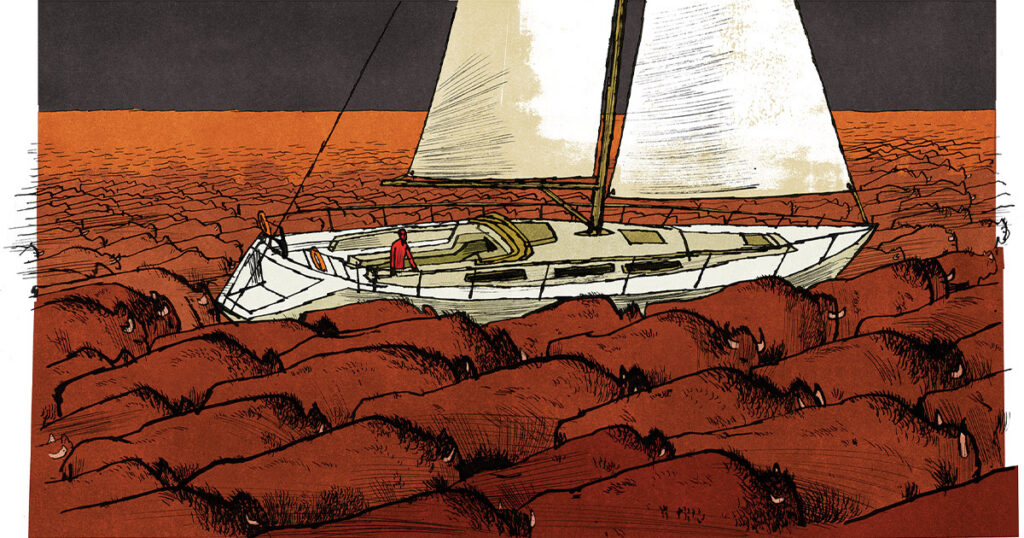
The winds were steady and full, the kind mariners pray for and poets revere. The sea moved beneath me like a landscape of swells and moonlight, loud with the music of rigging and rushing water. Lupita was asleep below. I sat at the helm, eyes half-lidded, somewhere between vigilance and reverie, when the waves around the boat began to shift in shape. No longer just moving water, they became bodies—massive, humped forms galloping silently beside me. Not beasts of burden, but kin. Bison. And not of this world, but of memory or myth. We were running together, bound by some ancient oath I had long forgotten but could suddenly feel pulsing in my chest.
They moved with silent thunder, their hooves stirring no spray, their shadows slipping over wave crests like memories across a restless mind. I recognized their shapes first—those familiar back-humped silhouettes outlined faintly by the moon—but it was the feeling that truly undid me. A sudden rush of belonging surged through my body. I wasn’t observing them; I was one of them. My limbs remembered a gait I had never known. My breath synced with theirs, a great pulsing rhythm that stretched across space and time. We ran not in fear or haste, but with sacred intent, as if answering some ancient call still echoing across the plains of this ocean.
There was no need for language. They communicated their presence by vibration, memory, communion. I felt them acknowledge me, not as an outsider peering into a mystery, but as a brother rejoined. We were on a pilgrimage, not to a destination but toward a truth. In their silent company, I felt no loneliness. Only purpose. Only peace.
When the herd faded—suddenly, as if a door had closed—I was left in silence so profound, it roared. The stars returned to their proper places, the boat to its lurching rhythm, the sea to its ceaseless babble. But I remained altered. A part of me had galloped into eternity and not quite come back. I sat there, dazed, with the ache of something ancient pressing against my ribs—a longing for the vision and also for the place within myself that it had reawakened.
Login to view the full article
Need to register?
Already a subscriber through The American Scholar?
Are you a Phi Beta Kappa sustaining member?
Register here
Want to subscribe?
Print subscribers get access to our entire website Subscribe here
You can also just subscribe to our website for $9.99. Subscribe here

true