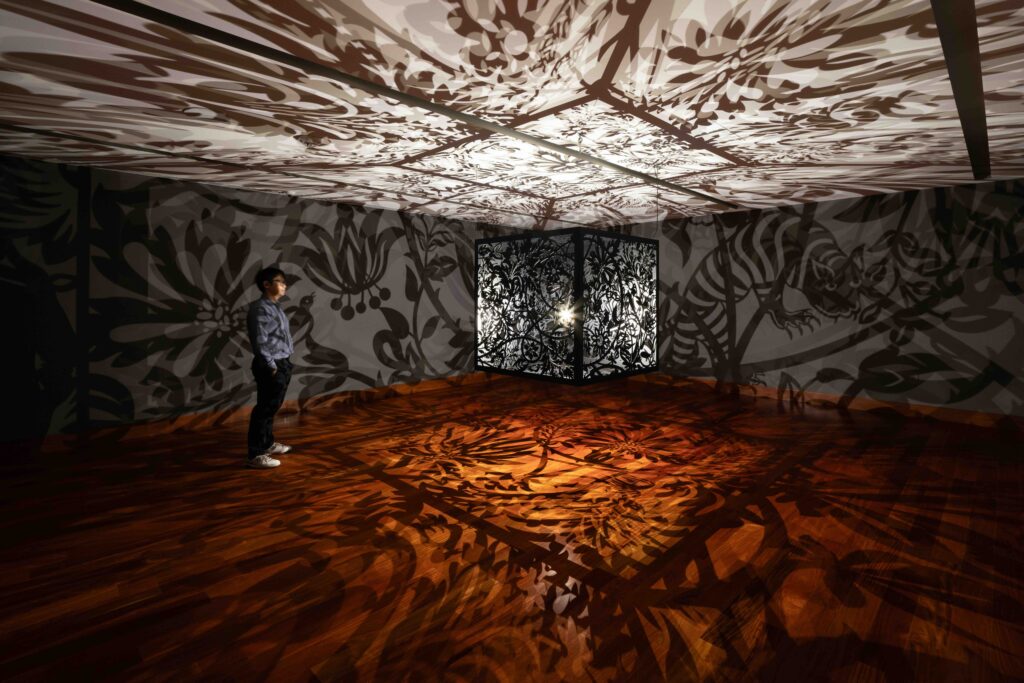
Growing up in Lahore, Pakistan, Anila Quayyum Agha was always stuck by the lacy jali, or pierced window screens, of Mughal architecture. Historically, they served to divide men and women within religious institutions, she says. Later, as a fiber arts graduate student in Texas, Agha felt both pigeonholed and excluded by her dual status as a woman and an immigrant, so she began to think about inverting the jali to “create a sort of version of a feminist state that actually allows everybody in.” The result was a single-room installation entitled Intersections, the exhibit space illuminated by a patterned cube encasing a central light. She spent a year working on the first piece and has since made dozens more over the past two decades. “I was trying to create a place for a woman, to make a space very feminine—not just feminist, but feminine—and then allow everybody to be part of it,” she says. “Whether you’re queer or whether you’re a man or woman, it doesn’t matter.” Interwoven, a career retrospective featuring one of Agha’s installation cubes, dozens of her paintings, and other sculptures, will be on view at the Frist Museum of Art in Nashville this spring.
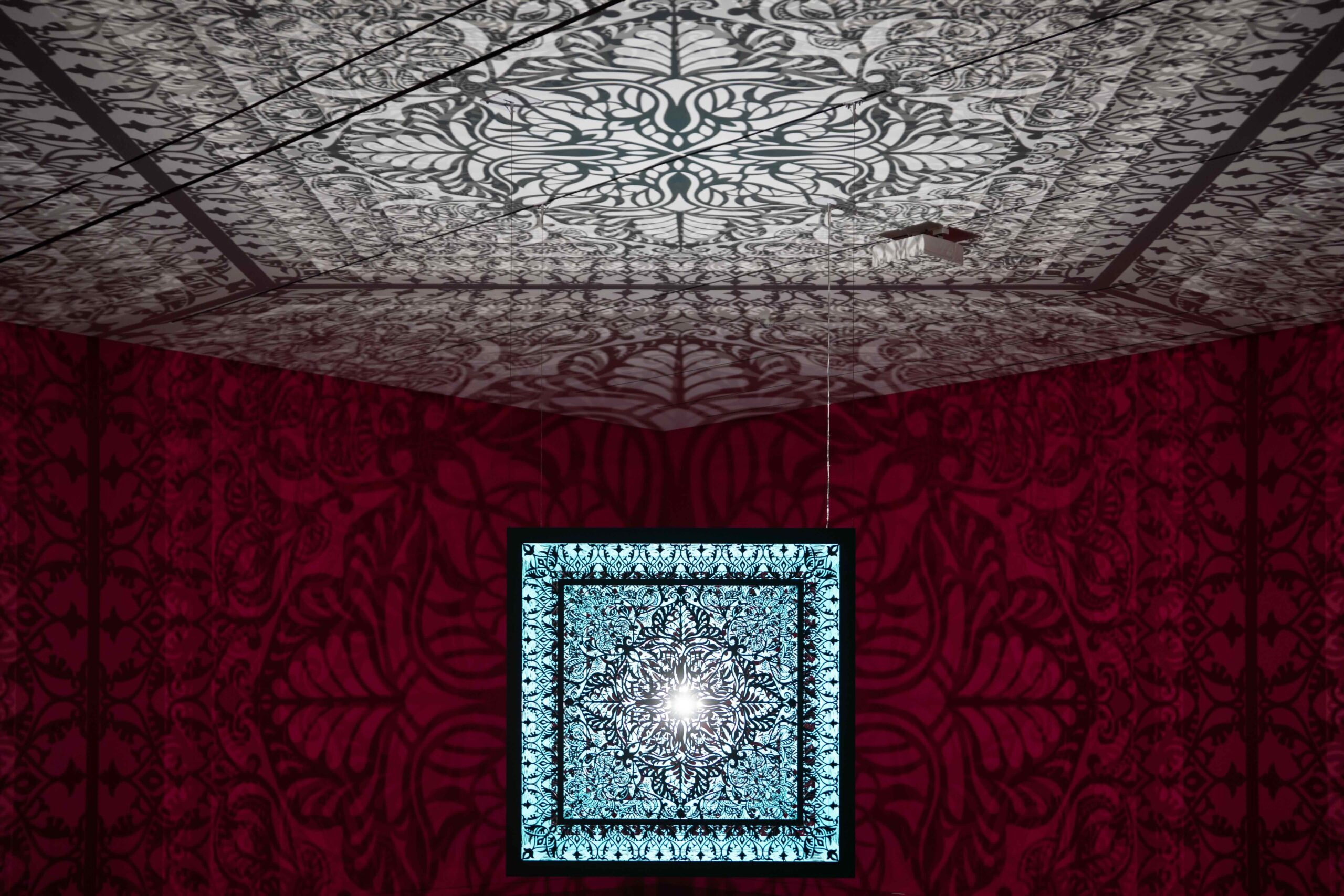 A Beautiful Despair (Teal), 2021, lacquered steel, halogen bulb, 60 x 60 x 60 inches. (Installation view of Anila Quayyum Agha: Geometry of Light, Seattle Asian Art Museum, 2025. (Photo courtesy of Chloe Collyer.)
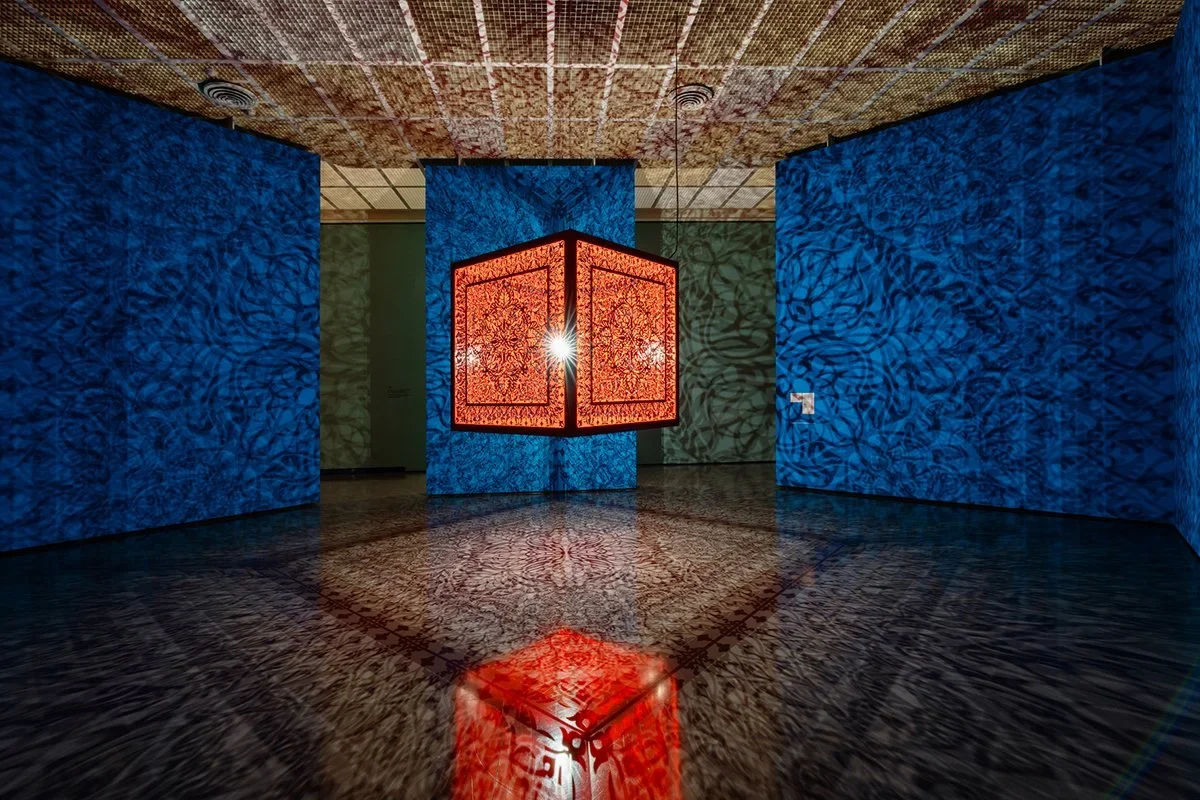
Agha is inspired by her travels in Southeast Asia, the Middle East, and Europe, which inform the patterns in her textile work, paintings, and most of all, cubes. Floral motifs and lattice designs dominate, with the occasional animal (such as a tiger) making an appearance. A single light source sits in the center of each cube, which has been carved to project shadows onto the walls of the space, immersing viewers in the whorls of Agha’s designs. The result is akin to one of the religious spaces she was initially inspired to emulate. “There’s this moment when people walk in, and I see them suddenly go quiet,” she says. “And then they start talking in whispers. It’s almost like when you walk into a cathedral with beautiful stained glass. It’s that kind of recognition that they’re in a place where something magical is happening.” Although these works are meant to inspire a sort of reverence, Agha also wants to emphasize that her “intent was to critique religiosity. A lot of monotheistic religions often separate men and women or keep women behind. If you give access to women for education and space, they can bloom and make things that will make the world a better place.”