
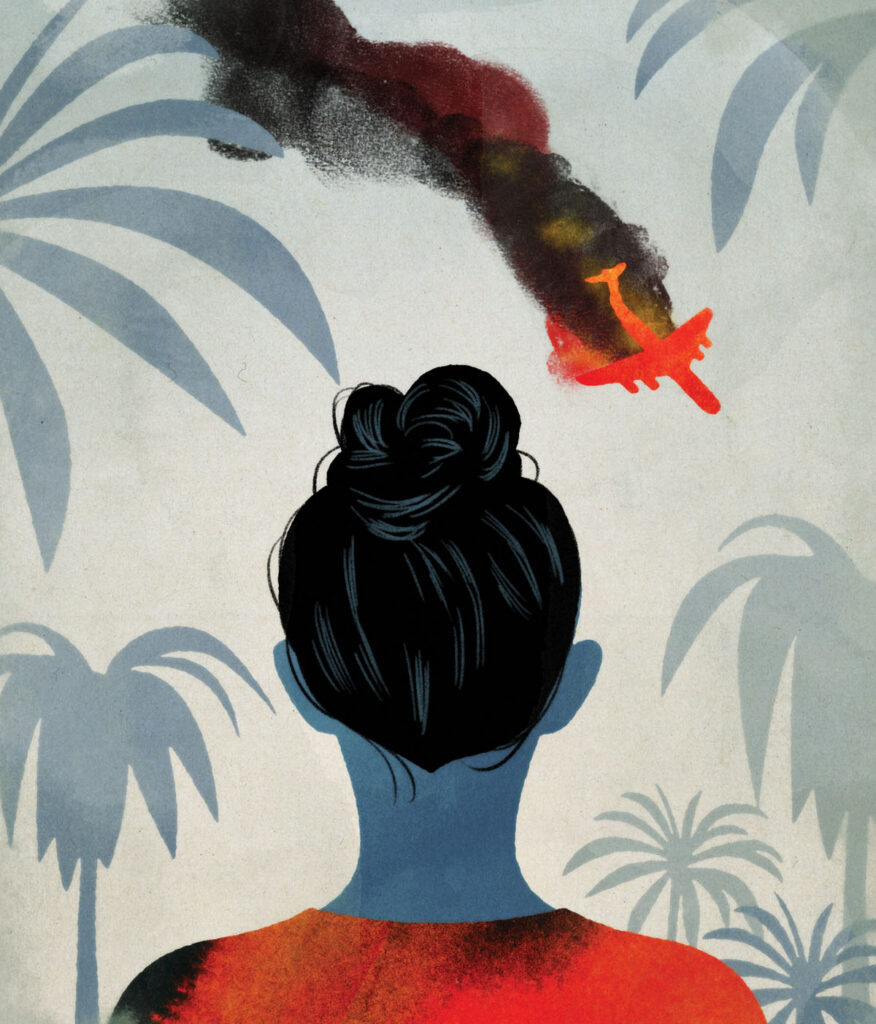
In 1973, when I was a sophomore in college, my parents moved to Vietnam. My father was in the CIA and had been posted to Saigon as part of the U.S. mission to drive out the North Vietnamese forces threatening to overtake the South Vietnamese government. He and two other CIA officials were to create and oversee a “black ops” radio station designed to spread propaganda that would disillusion the North Vietnamese and convert them and the Viet Cong guerrillas to democracy. My mother, designated a U.S. embassy “trailing spouse,” was a physical therapist. She provided health care to napalm victims and others wounded in the war. She also spent her days coordinating the social service efforts of the embassy wives.
Vietnam, as I learned when I visited my parents, was a place of many sensations. It was the aromas of fish sauce, coconut, and freshly baked baguettes. It was the roar of motorbikes, the rumble of army trucks, the screeches of hurtling cars. It was grim-faced, beautiful women hurrying in silky, pastel áo dàis and grim-faced men clustered at sandbagged street corners in green khaki and carrying loaded guns. It was skin sweaty and sticky from the oppressive, unrelenting heat. And it was daily meals of rice and fresh fish eaten to a soundtrack of intermittent, belly-clutching blasts from Vietcong explosives and grenades. It was a place steeped in sorrow, where the hardened Vietnamese people did whatever was required to survive and forge viable lives.
My parents were trying to do good. As a clandestine CIA operative, my father aimed to help people under repressive regimes achieve democracy, per the American creed as a superpower of the era. (This whole dynamic and mythology, in some part nobly motivated, was, of course, soon to be disrobed as arrogant and vastly flawed in both conception and execution.) And my mother was trying to help the injured, the sick, the disabled, the displaced, the traumatized, and the impoverished.
I witnessed both of them in action when I visited Saigon for Christmas. At a party held at my father’s radio station, known as House Seven, I sensed a genuine affection and devotion between him and the station’s Vietnamese employees. My mother, meanwhile, took me to visit two houses where women were being taught embroidery and other skills so as to be able to earn a living in some way other than selling their bodies on the street. In tiny living quarters cluttered with sewing machines, cloth, and thread, the women eagerly showed off their latest creations: beautiful dresses and flowing blouses embroidered with orchids and jasmine blossoms. My parents’ house was often filled with orphans who sat on the laps of embassy women. The children, fathered and abandoned by American servicemen, were set to be adopted by American families and would experience the added trauma of being taken away from their home country. The idea was to acquaint them with motherly figures who would cuddle and play with them, and to offer them a little taste of English before their new lives in America began.
Then, as 1974 turned into 1975, the American project in South Vietnam began to collapse. The grand scheme, nearly 20 years in the making, of trying to establish a democratic regime in the country, was failing. The U.S. ambassador, Graham A. Martin, insistently denied this, but all the embassy staff knew the truth. The explosions aimed at the capital from the surrounding countryside grew louder and more frequent each day, and the intelligence corroborated what was now inevitable. Embassy staff developed plans to evacuate the Americans from the country, but the plans were vague regarding the thousands of Vietnamese people who worked for and with the Americans. The administration began floating the idea that it would be okay to leave the Vietnamese staff behind, even though, because of their American affiliations, they would likely suffer punishment, retribution, re-education camps, or much worse.
When my father and his colleagues learned of this possibility, they made a carefully calculated choice. Acquiescing, at least by all appearances, to the ambassador’s belief that the South Vietnamese still had a chance to prevail and insisting that the work of the Americans should just proceed as usual, they moved the entire House Seven staff and family members—a total of 1,300 people—to an abandoned army base on Phú Quô´c Island. The ostensible plan was to keep beaming the radio programs from this new location. And there, under cover, the staff could more easily be evacuated when the North Vietnamese forces inevitably took control of the country.
My mother remained in Saigon. Panicked by the sense of imminent disaster, she hastened to get orphans adopted and out of the country before the city fell. She, like my father, wanted to stand by the people to whom the United States had made promises, with whom she had forged a connection, whose faces and hearts she knew, and whom she had come to love.
One day, I was in my dorm room at Carleton College, poring over my psychology assignments, when another student pounded on my door.
“Sara, you have a phone call. I think it’s from somewhere overseas. It’s really crackly.”
I was puzzled. Long-distance calls were expensive and overseas calls exorbitant, so my parents and I seldom spoke. We wrote letters instead. A phone call from abroad was very unusual.
When I picked up the phone in the stairwell, I heard my mother’s faraway voice through the static.
“Oh, sweetie, don’t worry. He’s okay,” she said. I didn’t know what she was referring to. She continued in the same mode. “We’ll be okay. Don’t worry. I’m in Taipei. He’s still there, but he’ll be okay, sweetie.” Her voice was all mixed up, the sentences rushed together. I didn’t know what she was talking about, but soon I could feel her anxiety like a hundred birds zooming in my stomach.
I was able to make out, as my mother urgently tried to convey her message, that things were really bad in Saigon. She had been evacuated, with the few other embassy wives who’d remained in the country, to Taiwan. She was in intermittent radio communication with my father, who was, she told me, still on Phú Quô´c Island with the House Seven staff. He was going to be okay, she kept saying. “He’s figuring it out. He’ll get out, he’ll get them all out. He’ll find a way.” Clearly, she was worried sick. My mother said, “I love you,” over and over, and she promised to keep me informed.
Before she hung up, almost in passing, she mentioned something about an orphan flight she’d helped load three and a half weeks earlier. “It was awful,” she said. “The babies were shrieking.” I didn’t really register what she was saying—she quickly resumed talking about my father. Only later would I hear of the trauma that wrote itself indelibly into my mother’s nerves.
With the American exodus nearing, my mother and the other American women involved in the embassy’s social service efforts, along with NGOs and orphanage directors, had begun organizing chartered flights to transport the orphans to their waiting adoptive families in the United States. The first flight of Operation Babylift was scheduled for the first week of April 1975. Several American caretakers had volunteered to look after the children during the flight.
On April 4, my mother and many others assembled at the Tan Son Nhut Air Base along with scores of babies and toddlers. My mother boarded the C-5A Galaxy, a cargo plane widely used by the U.S. Air Force, to help get the children settled. After the children were all buckled in, my mother stepped off the plane onto the tarmac, heaved a huge sigh, then turned to join the other remaining women in exhausted jubilation, all of them hopeful that the children would soon find themselves in nice homes.
Twelve minutes later, the massive Air Force cargo plane crashed in a rice paddy near the runway. One hundred and thirty-eight people died, 78 of them children.
The children—the living and the injured; the unconscious and the dead—were brought back to the terminal. My mother was changed forever. All her life, she had reached for the positive and salved herself by helping others. Now, insoluble sorrow settled upon her soul.
This is how my father’s Vietnam story ended:
Not long after he and his colleagues arrived on Phú Quô´c Island, the House Seven radio man was able to communicate with the embassy enough to know that the situation in Saigon was deteriorating. When my father heard on Vietnamese radio—not from headquarters—that Ambassador Martin had finally agreed to an American evacuation, it took many hours before he could reach his counterpart at the embassy to find out more. When he finally got through on April 29, he was hurriedly told, “Get out any way you can.” As he suspected, there was no plan for the evacuation of House Seven. When the helicopters took off from the embassy roof in Saigon, he and the others were left stranded in Vietnam.
My father was not completely shocked at the turn of events, but he was still stunned by those words from the embassy. One thing he refused to do was abandon those with whom he worked. As he later wrote in his memoir, he was compelled to meet “a moral obligation to deliver [his] Vietnamese employees and their families to safety” and to “give them a chance to rebuild their lives.”
Scrambling to find a solution, my father contacted ships passing through the Gulf of Thailand. Eventually the captain of the SS American Challenger agreed to take onboard the entire House Seven crew. In the early hours of the morning, the freighter was loaded like a pilgrim ship. As the vessel moved eastward across the Pacific, members of the House Seven team were crammed together, slept on deck, and ate food cooked by the sailors. Their quarters were hardly comfortable, and two babies were born onboard, but everyone survived the six-day journey to Guam, where the Vietnamese employees and their families were housed until they could be resettled safely in the States.
My modest father, never one for self-praise, was profoundly moved and grateful that the rescue mission had succeeded, but he was also traumatized by the experience. Those words, “Get out any way you can,” were like an icy lance thrust into his warm, pulsing body.
Both of my parents were trying to help people threatened or harmed by our country’s actions. The truth is, sometimes you try to help and you fail; other times you mess up (or are caught in others’ failures) and succeed. My father triumphed. My mother’s compassionate actions met with tragedy. All we can and must do, perhaps, is try.