Is the sonnet making a comeback? I’d like to think so, and I’m not the only one. Ken Gordon’s online publication The Sonneteer is making a strong case for the venerable form. And this month’s Next Line, Please prompt—to write a sonnet beginning with a line adapted from Shakespeare—testifies to the attractions of the 14-line poem as well as to the ability of our NLP all-stars. The three lines I tossed out as possible openers are these:
- Take all I love, from dolls to jewels to guns,
- When I wink, my eyes see things as they are
- To me, dear friend, you never can be old
Choosing option #1, Courtney Thrash submitted “Sunset on my Fortieth Birthday,” which she began to compose on that significant day:
Take all my loves, from words to jewels to suns
And place them in the hollow crescent moon
And let her hold the weight of all that’s done
For love. For love grows in her waxing womb.Then take the looking glass, that sea of sin,
And hold it to her light-reflecting face
And let her feel the weight of lines too thin
To see. For aged eyes her light erase.Take all I am, from word to womb to rune
And thresh it, watch it float from winnowed tine.
My mother’s mother bends—a sickled moon.
In truth, the spirit dies ere does the spine.Away, dark soulless night and sky, away!
This gentle moon grows surer by the day.
This wonderful effort struck Emily as “both Shakespearean AND Keatsian!”—a major compliment. She “really liked the repetition of line 1, almost pantoum-like” and the “image of the moon, the sea, the looking-glass, the female shapes—all beautifully crafted.” I happily concur. The third stanza of Courtney’s poem exemplifies her skill. Consider the adjective “sickled” for “moon”; the alliterative linking of “word,” “womb,” “watch,” and “winnowed”; and the quatrain’s last line, which Michael C. Rush praised by saying that it “breaks me.” I add my appreciation for the repetition of “For love” in line four.
Emily chose the same opening line for her “Play Therapy” and manifested a similar adroitness in the rhyme pattern she followed:
Take all I love, from dolls to jewels to guns
(a gun in the doll-house toy box, the jewel
a sticky-backed dazzle fixed to a thumb)
and, from senseless chaos, dare help unspool
meaning for the children left without
a chair to hold them up, the ones holding
burning heat they can’t pass on. I, too, doubt
No manual exists for folding
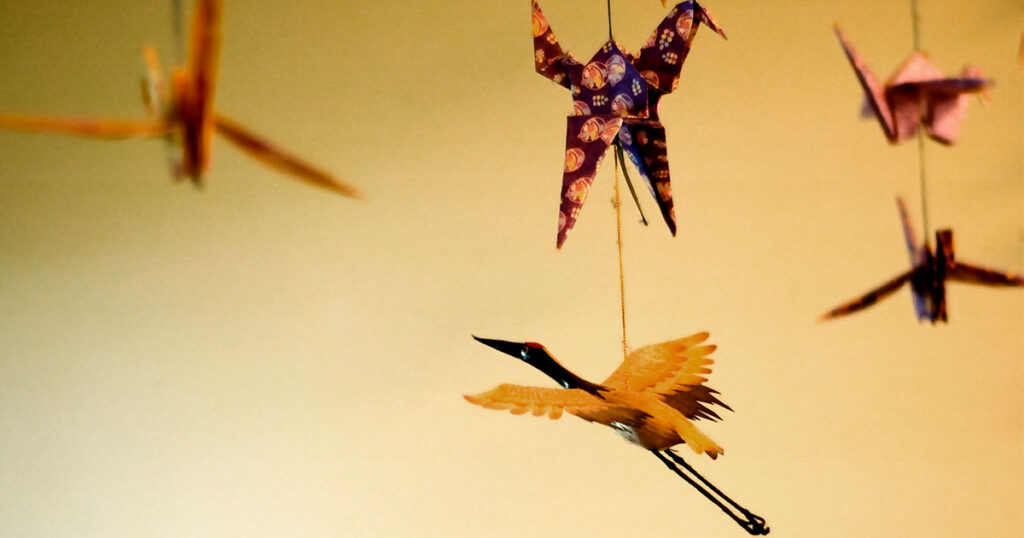
death into stars and cranes. When the river
we all grew up loving rose in the night
to topple the known world, Jenga tower
come to life, we had no words, just a kite:
hot-glued popsicle sticks, origami
paper, a doll hanging on by a string.
Of this recollection of summer camp (I’m guessing), Courtney Thrash cited, as her favorite part, “No manual exists for folding death into stars and cranes,” while Michael C. Rush observed that Emily’s lines “consistently break on a word that seems benign or containable,” then follow with a line that undercuts the benignity.
Beth Dufford did something splendid with the second prompt option. Like Courtney, she rhymed her poem to good effect:
When I wink, my eyes see things as they are
and when they’re closed, asleep at night, they see
things as they aren’t—aloft in a car,
about to fall, thinking this is how we
die, but no, now I find myself in France
with my sixth-grade teacher Mr. Steep in
pukka beads and platform shoes, two-tone pants,
feathered hair, an image projected from
a far fold of my neocortex, stored,
sorted, and now playing, one night only,
at the Lonesome Bijou where I’ve endured—
and starred in—every show. My eyes slowly
wake to see things just as they are: no time
but now, nowhere but here. A simple rhyme.
Of this tribute to the imagination as a means to supplant reality, Michal C. Rush, Palevanilla, Anna Ojascastro Guzon, and I all applauded the lines that include the one-night-only showing “at the Lonesome Bijou” and the anagrammatic play of “stored” and “sorted,” strategically separated by a line break. Emily admired the imagery and asked whether Beth had thought of a title for the piece. I nominate “Lonesome Bijou.”
Option #3 elicited “Sami Takes a Seat” from Palevanilla:
To me, dear friend, you never can be
Old. At best a kind deceit designed
to please. At worst, a self-deceiving lie.That first night under cool fluorescent light
Harry tells me that he doesn’t see age.
He is very serious. But I knowhe would never say I don’t see color
to a person of color. “Then you don’t
see me,” I say. He is very still,his face a puzzle solving itself.
Later, we will see each other in our
poems—fragile, ageless. But for nowwe are both relieved when another
student takes the seat between us.
The full poem wins us over as a corrective to the poetical idealization of its first sentence—much as Shakespeare’s Sonnet 130 (“My mistress’s eyes are nothing like the sun”) acts as a corrective to the hyperbolic praises bestowed on his beloveds in other sonnets. The analogy of age to color is original and convincing, as is the dying fall with which the poem ends.
Anna Ojascastro Guzon’s “Seeing Things” is striking from start to finish:
When I wink I see things as they are
not as they could be or as they once were.
In those moments, I unlearn the science
that assigns names to things we observe.
Frog, cloud, fly, orange, raisin, grain of sand.
When I see things as they are, nothing is
clear. Pathologies have no source. Wars have
no start and assessments are dispersed
from airplanes flying low. The paper leaflets
float, haphazard and graceful, catching light
and turning in winds, like confetti or
fortune slips. Answers scatter and end
up between sewer grates or leaves of grass
on traveled roads or in human hands
I particularly admire the “unlearning” of science, the allusion to Whitman in the penultimate line, and the simile that enlivens this passage: “The paper leaflets / float, haphazard and graceful, catching light / and turning in winds, like confetti or / fortune slips.”
Finally, here is Amanda J. Bradley’s “Winking Black”:
When I wink, I see things as they are:
we sheep, sport in this most dangerous game,
fodder and clod, matter formed to tame
or blame us in sweet nothings snared from thin air,
devil’s playground without care, self-anointed
lords beyond shame for the delible, written in sacred pain.
Where to house the rage bourn through millennia?
And oh, the ghosting, the ghosting, the ghosts.
Surehanded where they should refrain,
patriarchal ethic reinscribing. Each wound, each stab
each bullet, each bomb, each rape—ritual or no,
arbitrary and evil, copper teeth of demons hosting
frayed threads of belief in the Good, certainly mad.
I fiddle through the whimpers casting Harrods plaid.
The title works beautifully, and the poet conveys her sense of “sacred pain” by asking, “Where to house the rage bourn through millennia?
I wish I had space enough to quote more of the sonnets that came in. My compliments to all.
For next month, let us lie. All poetry involves lying—by definition, a metaphor identifies an object or sensation as something it is not. And we lie not only when we exaggerate or employ “poetic license,” but also when we resort to fiction or invention. When we write or say ,“I will love you forever,” we may be speaking in good faith, but we are uttering a falsehood. Sometimes we lie to ourselves, and self-deception is a fertile subject for exploration. While we are familiar with white lies, we might consider lies of other colors.
I suggest that we write poems inspired by this subject. You might devote a poem to one big lie—or to an inventory of lies. For inspiration, I highly recommend reading “The Decay of Lying” by Oscar Wilde and Sir Walter Raleigh’s great poem “The Lie.”
Maximum: 15 lines. Deadline: three weeks from the time this post goes up.