
Battle for the Ballot Box
How decades of legal attacks and court decisions have undermined the crown jewel of the civil rights movement
An American Problem: How the Country Built—and the Supreme Court Broke—the Voting Rights Act by Michael G. Miller and Kevin T. Morris; Princeton University Press, 376 pp., $32
“I hope that our votes still matter in November.”
That was my dad, back in May, when I was in my home state of South Carolina on a reporting trip. The General Assembly was preparing to hold a special legislative session to determine whether the state’s lone heavily Black congressional district—a seat held by Representative Jim Clyburn since 1993—ought to be dismantled. In the end, lawmakers decided against redrawing the map, with one Republican warning that eroding the district could have an unintended consequence: fueling Black voter turnout in the November midterm elections.
This was hardly the first time Black South Carolinians worried about the sanctity of the ballot box because of the state’s actions. Not long after President Lyndon B. Johnson signed the Voting Rights Act of 1965 into law, South Carolina—a founding member of the Confederacy—challenged provisions requiring states with histories of racial discrimination to change their behavior. The Supreme Court rejected the challenge. Still, the battle has flashed and flared ever since, with the high court in April striking a massive blow to the law long considered the crown jewel of the civil rights movement.
Michael G. Miller and Kevin T. Morris document this history in their incisive, meticulous, and timely new book, An American Problem: How the Country Built—and the Supreme Court Broke—the Voting Rights Act. Across nearly 400 pages, Miller, a political scientist at Barnard College, and Morris, a senior research fellow and voting policy scholar at the New York University School of Law’s Brennan Center for Justice, refuse to leave the country’s past sealed away in amber. Rather, they reanimate the people and political maneuvering behind one of the 20th century’s most consequential pieces of legislation, making a seemingly distant history vibrate again with urgency.
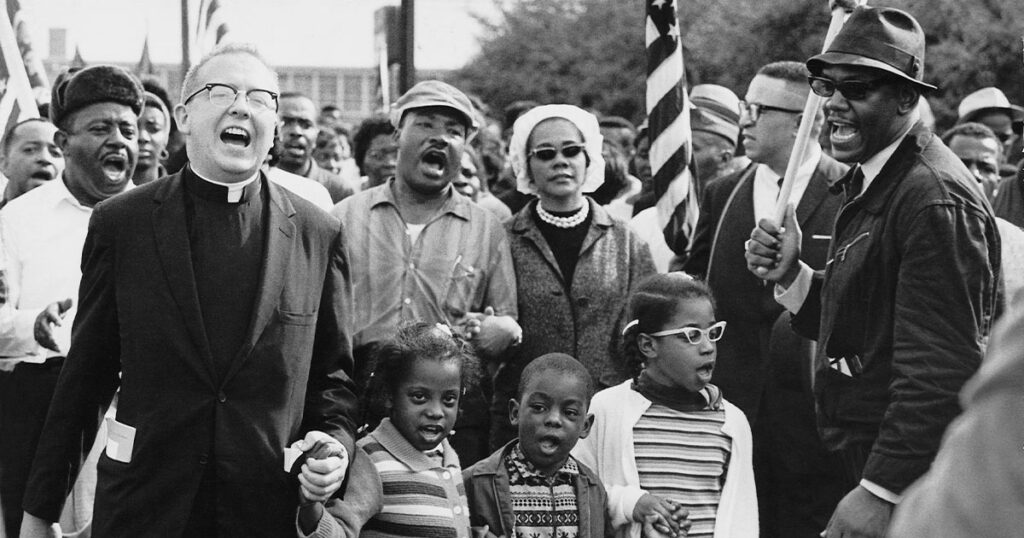
As Miller and Morris chart, galvanizing public support for Black voting rights was a master class in political organizing. One Sunday night in March 1965, 50 million Americans tuned in to ABC to watch the television premiere of Judgment at Nuremberg, a drama about the legal trials of Nazi war criminals. But the programming was interrupted by footage from the Edmund Pettus Bridge in Selma, Alabama, of police bludgeoning civil rights activists. “The juxtaposition of the film’s Nazi war criminals against American officials clubbing peaceful protesters was especially jarring,” the authors write. The fierce rage crackling among the public created the kind of momentum Johnson knew that he must harness. Just eight days after “Bloody Sunday,” he addressed more than 70 million Americans, laying before Congress a stirring case for protecting Black voting rights that became known as the “American Promise” speech.
By the beginning of August, the Voting Rights Act was the law of the land.
Episodes like this imbue An American Problem with color and energy. Miller and Morris are adroit storytellers, weaving together decades of history, political science, and legal scholarship without allowing the impressive sweep of their analysis to drain life from the people who shaped it. They rigorously examine what had to happen—and, more precisely, how people had to act—to transform Black voting rights from a mere demand into federal law.
Miller and Morris are both social scientists, and their training shines in the figures and tables that give empirical weight to their inquiry without slowing down the book’s propulsive narrative. One notable example is a time series showing the consequences of 2013’s landmark Shelby County v. Holder decision, which defanged the Voting Rights Act’s requirement that certain states and jurisdictions receive federal “preclearance” before changing their voting laws. (You could think of this as South Carolina, almost half a century later, finally getting what it wanted.) Miller and Morris show that the racial turnout gap, which had shrunk following the civil rights movement, ballooned in some areas in the wake of Shelby County. Other examinations combine existing research—such as a report from the Leadership Conference on Civil and Human Rights observing widespread polling-place closures after Shelby County—with the authors’ own analysis of voter-file data from every state, allowing them to test whether racial discrimination had evaporated as the Supreme Court claimed that it had.
Only once did I quibble with Miller and Morris. In the epilogue, they consider state voting rights acts, enacted by about a dozen states so far, which restore some of the protections eroded at the federal level. They doubt that these laws will do much to “stem the retrogressive tide,” particularly since states such as Alabama, Mississippi, and Texas are unlikely to adopt them. Though I agree that state voting rights acts are no silver bullet, years of reporting on these efforts have taught me that even bills with no hope of becoming law can be vital mobilizing tools, offering, as one attorney recently told me, a means to “educate and engage and empower voters.”
But, again, a quibble. For anyone who wants to understand the long and ongoing fight for federal voting rights protections—and the equally long and ongoing fight to undermine them—An American Problem is indispensable. Miller and Morris’s definitive text makes plain why, more than six decades after the Voting Rights Act became law, my dad’s concern sounds not only reasonable, but frighteningly prudent.