
They Stole a City: Wilmington’s White Supremacist Coup and the Families Who Live With Its Legacy by Lauren Collins; Penguin Press, 528 pp., $32
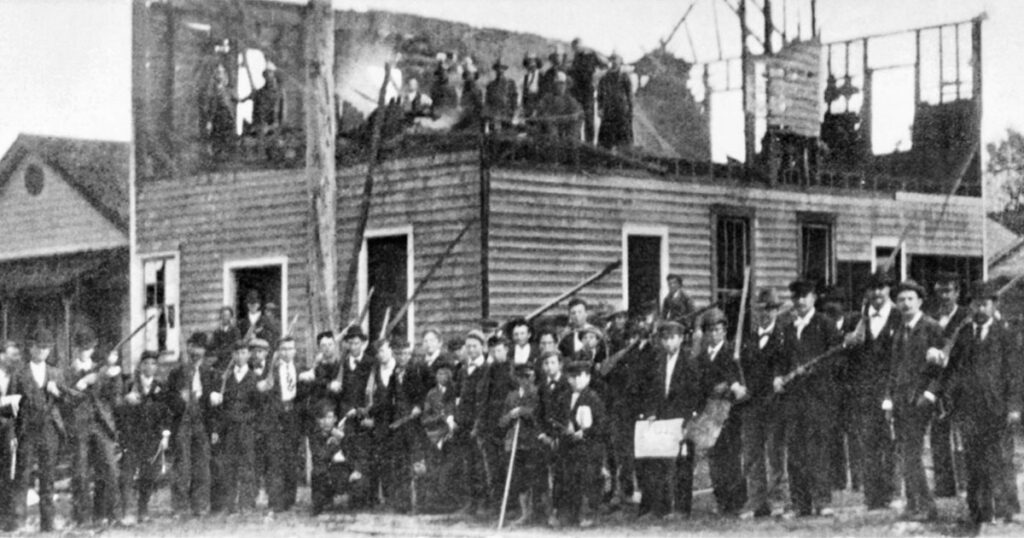
The violent overthrow of a multiracial government in Wilmington, North Carolina, on November 10, 1898—a coup d’état spelling the end of the Black vote and the beginning of racial apartheid in the state—gained national attention in 2020 with the publication of David Zucchino’s Wilmington’s Lie. In They Stole a City, New Yorker writer Lauren Collins expands the timeline and widens the lens, focusing primarily on four families, two white and two Black, whose members were present that day and have felt its impact for generations. The story begins two centuries earlier, with the arrival of white planters in the coastal Carolinas, where they accumulated land and human beings for the exploitation of both. In this brilliant synthesis of scholarly research, archival discovery, and oral history, Collins joins a new generation of historians working in the wake of George Floyd’s murder to interrogate incidents of racial violence (often state-sanctioned) that trouble our past and draw a through line to the present, sounding clarion warnings.
The Wilmington Massacre constituted a watershed moment in American history. In North Carolina, it cleared the way for a constitutional amendment that cleverly circumvented the 15th Amendment: A literacy test, combined with a “grandfather clause,” ensured that Black men, who were overwhelmingly illiterate, would be disenfranchised while allowing suffrage for illiterate white men. Though North Carolina was not the first state to adopt this strategy, its legislators promoted it broadly as the “North Carolina Way.”
Crucially, Collins observes, the massacre was long characterized as the opposite of political terrorism. Contemporary news reporters colluded with the perpetrators to call the event a spontaneous “race riot”: a chaotic uprising of Black men whose years in bondage had left them unfit to handle freedom and to which the white establishment dutifully responded by restoring order. This framing introduces two persistent themes that have obscured the path to lasting racial justice.
First is the false assertion of white victimhood. From the moment the Civil War ended, the “narrative of noble victimhood” had become “highly effective in encouraging nationwide amnesia about the issues—slavery, particularly—over which the war had actually been fought,” Collins writes. She observes that “white Northerners effectively let go of the war” as they chose reunion over confronting the afterlives of racial oppression, acquiescing to the genteel fictions of the Lost Cause. Fifty years after Gettysburg, President Woodrow Wilson presided over Confederate and Union veterans who shook hands across the stone wall of Pickett’s Charge. Wilson spent years of his childhood absorbing the Lost Cause narrative from the noble victims themselves; he lived in Wilmington, where his best friend was John Dillard Bellamy Jr., whose wealthy family of firebrand secessionists is one of the families Collins chronicles.
The second theme is an appeal to civility as the solution to racial conflict. The North Carolina Way returns on command to seal demands for racial equality under a veneer of “order.” In Wilmington, the fight for equal education offers an example. A 1951 lawsuit over inequitable funding was answered not in court but with bricks and mortar. Williston High, a gleaming new school for Black students, at least retained the name of the old school, a freedmen’s school purchased in 1915 at the insistence of Fred Howe, a member of a Black family that Collins traces. Yet its construction, Collins writes, was “a form of tactical beneficence, upholding the ‘North Carolina Way’ of opposing desegregation through legal maneuvering rather than overt, bombastic defiance.”
Black physician Hubert Eaton, a newcomer who had initiated the lawsuit, found the whole experience dispiriting. For what he saw as the “pitiful docility” of Black residents, he blamed the trauma of 1898. Their timidity was understandable, though: In one of the meetings held as a stalling tactic, the county attorney cited 1898, warning that the lawsuit threatened “fifty-three years of good race relations.”
By 1968—14 years after Brown—desegregation could no longer be avoided. But Williston High, its roots still planted in Reconstruction, was nourishing the Black community’s dreams and ambitions. Black parents and alumni found themselves aligned with white segregationists in protesting the merger. One meeting “nearly tipped into mayhem” as speakers argued from opposing perspectives on the Civil War and Reconstruction. That fall, as Black students entered white high schools, fights broke out, provoking a familiar reaction: White parents saw their children as victims of racial violence. “In their view,” writes Collins, “the volatile atmosphere in the schools was not a predictable consequence of a plan that Black people viewed as inequitable and white people viewed as undesirable … but rather a one-sided threat to ‘our way of life.’”
In January 1971, Black students organized to demand a Black studies curriculum and other concessions for what they had lost with Williston. Their boycott spilled into the streets, resulting in two deaths and the (eventually overturned) conviction of a group known as the Wilmington Ten, whose case became an international cause célèbre. Wayne Moore, one of the student defendants, connected their miscalculations to 1898. “Whole generations of effective black leadership had been wiped out,” he said. “We had few mentors.”
As the 100th anniversary of the massacre approached, a biracial group of community leaders began planning a commemoration. By then, the truth about Wilmington, Tulsa, and other sites of white supremacist violence was calling for a reckoning. But event planners aimed to “heal the wound” rather than face the massacre’s consequences. Ten years later, even after a state-commissioned report detailed the atrocities of the day and suggested concrete ways to “repair the moral, economic, civic, and political damage,” the same community group erected a simple memorial depicting six cast-bronze oars arrayed in an upright arc—an allusion to the nearby Cape Fear River. Said its creator, “We wanted a memorial that did not blame anyone–that did not make anyone feel guilty.”
“November 10, 1898, is a centuries-long day that isn’t over yet,” Collins writes. It continued on January 6, 2021. The two “mobs came together in different contexts—one local, one national; one high on victory, the other stewed in defeat—but they fed on common entitlements and animus,” the 1898 fear of “Black rule” resurfacing at the Capitol under a Confederate battle flag. Against such overt threats to our democracy, appeals to civility will only keep us from excavating the knotty roots of our violent past, perpetuating the cycle.