
Blood—and Beauty—at the Root
Fifty years ago, Alex Haley’s landmark novel changed the way many Americans thought about race
Remembering Roots: How an American Classic Transformed the World by Lucas L. Johnson II; Broadleaf, 221 pp., $25.99
Learning about slavery as an elementary school student meant being hit by a wave of emotions I didn’t yet know how to process: anger and sadness, most definitely, but also shame and embarrassment. In a classroom of Black and brown and white students, discussion of human bondage functioned like an unwritten invitation for the non-Black kids to direct inquisitive looks at the Black kids, as if 10-year-olds were supposed to act as spokespeople for an institution of oppression. (Maybe you’ve seen Black TikTok users parody this social choreography in videos, an affecting reclamation of those awkward adolescent moments.)
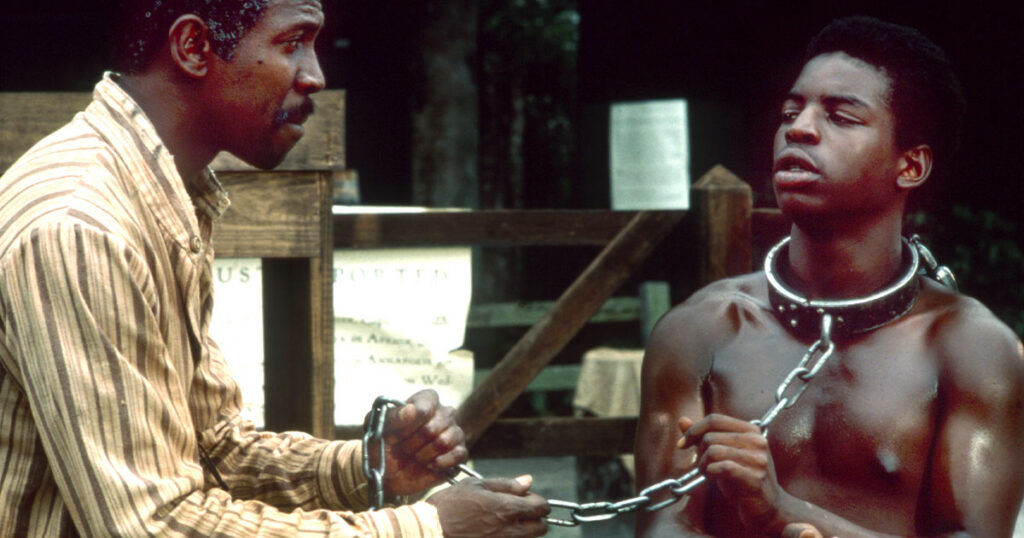
I gasped when I saw this emotional terrain revisited in former Associated Press reporter Lucas L. Johnson II’s affirming new book, Remembering Roots, which uses the 50th anniversary of Alex Haley’s novel Roots: The Saga of an American Family to examine how the Pulitzer Prize–winning work reshaped the country’s understanding of race. “When we got past the shame aspect, then we began to recognize the value of that story,” says LeVar Burton, who played a young Kunta Kinte in the landmark 1977 miniseries adaptation. Roots, through its humane narrative of Black kinship and heritage, helped many Black Americans to shed the humiliation, the inherited psychic burden, attached to slavery.
The emotional complexity that Johnson surfaces is only one reason that Remembering Roots lands a powerful punch. More than that, he understands that Roots was never just a book or script. No, it was a communal experience that played out in classrooms and living rooms all around the country. Accordingly, Johnson structures the book as something of a collective testimony, braiding together commentary from educators, museum staff, and ordinary readers. The result is a text that, though at times thin on sustained analysis, treats Roots as a shared cultural and emotional legacy, one that’s allowed generations of Black Americans to rethink history—and the agency we have to reclaim it.
Johnson demonstrates this communal dynamic early on, using an especially vivid example: In many African cultures, parents will hold their newborn child up to the moon and declare, “Behold, the only thing greater than yourself,” to connect the child to something ancestral and enduring. This tradition appears in the Roots novel and miniseries, and while reporting his book, Johnson discovered how deeply the “behold scene” has imprinted itself in Black cultural memory. Upon asking interviewees about it, “almost immediately, I would get, I did that,” he writes, “and then they would proceed to tell me, with excitement in their voice, the events of the night and what they said.” One man, now in his 40s, recalls learning that his father had performed the ritual with him, knowledge that has helped him to make peace with life’s hardships, including completely losing his sight at 22 years old. Such intimate intergenerational testimonies imbue the book with emotional gravity.
Yet Johnson doesn’t confine his exploration of Black kinship to symbolism and memory. He extends it into something more tangible—Black Americans’ attempts to reconstruct fractured family histories through DNA testing, an endeavor supercharged by Haley’s discovery of his own heritage, depicted in Roots: The Next Generations, the television adaptation of the novel’s last seven chapters. Gina Paige, cofounder of the website African Ancestry, tells Johnson that she references the “whipping scene” from the original series—in which Kunta is beaten until he accepts the name Toby—to motivate Black Americans to trace their African lineage. “That [scene] is a visual representation of how … the names we were given are not our African names,” she says.
Rendered in direct, earnest prose, Johnson’s book is undoubtedly affecting—and relatable. Several moments prompted flashes of personal recognition in me, as when Johnson describes meeting Paul Nauta, senior marketing communications manager for FamilySearch, and learning that “in just about every family, there’s someone, or a group of individuals, who … take it upon themselves to connect the ancestral dots.” In my family, those people are my dad and sister, who, through years of dogged genealogical research, connected with some of our white relatives descended from slaveowners and learned that our ancestors may have served in the military as far back as the 19th century.
Still, there were other moments when I wanted Johnson to push his analysis further. For instance, he embraces the promise of DNA testing without seriously grappling with its attendant risks—including privacy breaches and misuse by law enforcement—and the possibility that these dangers could disproportionately affect Black Americans, who often turn to DNA testing for ancestral searches because of the scarcity of more traditional archival avenues. These shortcomings, however, don’t sap the book of its genuine emotional power, and Johnson never claims to be offering readers deeper, more probing cultural criticism.
Plus, Johnson’s book is arriving at precisely the right time. Americans aren’t just gearing up to commemorate the country’s 250th anniversary; they’re doing so during a political season in which fights over how to teach history have dramatically intensified, and in which many would rather promote a gaunt, sanitized version of our shared past—one devoid of moral clarity and historical complexity. (Just consider that a school system in Tennessee, where Haley spent part of his childhood, recently attempted to banish Roots from its classrooms.) What better way to push back against this impulse than by remembering a man whose work stands as a forceful rebuttal to it?