Blood-Blue Sky
How horseshoe crabs and ecological grief connect with the wonders of the human heart
Shortly after takeoff, the pilot announced that we were flying into the hurricane and should prepare for a bumpy ride. His tremulous voice did not inspire confidence. I fished in my pocket, closing my fingers around the Klonopin nestled there for my first flight after a life-threatening cardiac episode five weeks before. Simply sitting on the tarmac in Chicago had made my heart skitter and adrenaline flow, despite the presence of my partner beside me. My electrophysiologist had cleared the trip, I reminded myself; in fact, when I told her its purpose, she insisted that I go.
That was before Hurricane Helene formed in the western Caribbean in late September 2024.
Nashville, my destination, was too far inland to fall fully in its path, but the immense storm system threatened to pummel the city with a days-long downpour. As the plane hurtled toward the weather, I tried to calculate how rising floodwaters would affect my access to medical care if I had another emergency.
I was headed to Vanderbilt University for a climate change–themed theater festival, one that would explore the idea of ecological grief. The irony wasn’t lost on me. I’d written a play for the festival: a buddy comedy about a girl and a horseshoe crab. The girl has a heart condition, like me. She wants to be independent, but as the play goes on, she discovers that her survival is bound up inextricably with the lives of strangers: the pharmacist who informs her of the medication shortage after a superstorm wipes out a warehouse; the cardiologist permanently on call who just wants to read a trashy thriller on the beach. The more the girl tries to become self-sufficient, the more she finds herself ensnared in a net of interdependence. She works in a lab where blood from horseshoe crabs is drawn, processed, and used for biomedical purposes. Overcome by guilt, the girl kidnaps one of the creatures and takes it on a road trip, to release it back into the ocean before it dies.
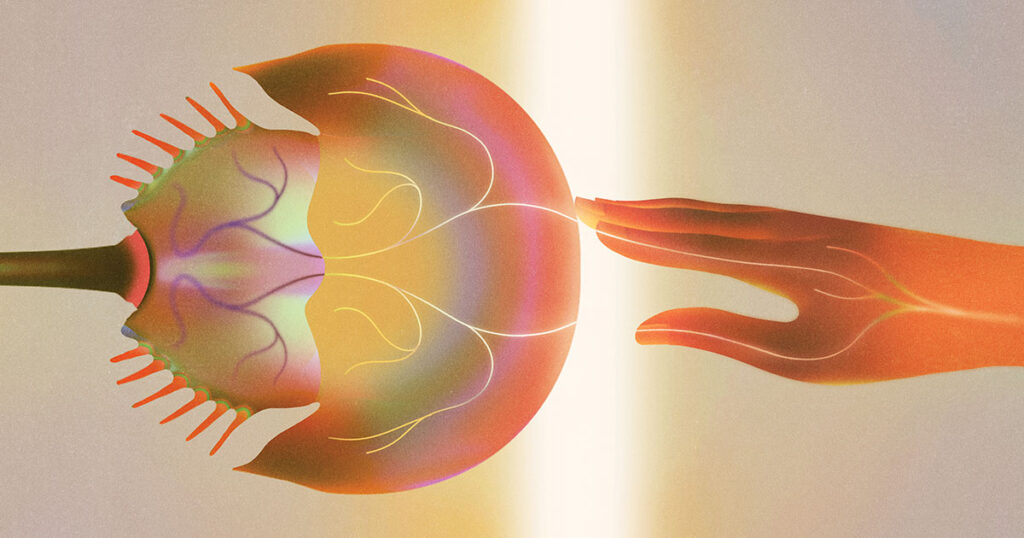
At 450 million years old, horseshoe crabs predate dinosaurs. They’re some of the most ancient creatures on earth, nicknamed “living fossils.” They actually aren’t crabs at all but arthropods, more closely related to scorpions. They’re so ancient, their blood produces an unusual compound called limulus amebocyte lysate (LAL), which clots when it encounters endotoxins. What you need to know about endotoxins is that they’re bad news. You don’t want them to hitch a ride inside your body. By detecting endotoxins during, say, the development of a vaccine, LAL can save lives. You’ve likely benefited from horseshoe crabs if you received a Covid vaccine, for which they were harvested in astronomical numbers. LAL is also used to test IV fluids to make sure they’re sterile and safe to enter the human bloodstream. I’d say the value of horseshoe crab blood is incalculable, but on the market, it amounts to about $60,000 per gallon. There’s one other unusual feature about this blood: it is the softest hue of blue.
The color of sky without a whisper of clouds.
The color has no influence on its value, but it makes the fluid eerily beautiful.
Aside from its blood, a horseshoe crab couldn’t be considered aesthetically pleasing. We’re not talking charismatic megafauna here. An almost iridescent shade of brown, its exoskeleton has spiny ridges, and it has 10 hungry-looking legs on its underbelly, above the world’s ugliest washboard abs (actually gills). It uses its spindly telson—that tail-like wand—to maintain equilibrium and right itself when overturned by waves. Its mouth and 10 eyes aren’t discernible. It has a nervous system, which I presume means it can experience pain.
A synthetic version of LAL exists, but biomedical companies in the United States haven’t widely adopted it yet because of regulatory hurdles and bureaucratic inertia. Despite evidence of population collapse, there hasn’t been a widespread push to save the horseshoe crab. Conservation efforts have come mainly from avid birders, since a rare sandpiper—the red knot—depends on horseshoe crab eggs as a food source for its migration from the Arctic Circle to Tierra del Fuego. Red knots are adorable—quintessentially charismatic. But no one seems to care about horseshoe crabs for their own sake.
Lab technicians are supposed to drain no more than one-third of the horseshoe crabs’ blood and then release them back into the wild. Only male crabs are to be harvested so that the females can lay eggs (for the red knots to eat). With these precautions, horseshoe crabs can survive the blood draw, and the species as a whole can theoretically persist unthreatened. But little regulatory oversight means that nobody knows how many female crabs are harvested, or how many crabs survive—especially those grabbed by their telsons, which weaken once handled and lose the ability to help the crabs right themselves underwater.
Onstage, the actor playing the horseshoe crab stares straight into the audience and says, I survived the Great Dying for THIS?
The pilot was wrong. With minimal turbulence, the flight landed under calm skies. Even so, the journey drained me. I’d sat with my hands clenched in my pockets the whole flight. I didn’t take the Klonopin, but neither did I bother trying to read, and though a mindfulness podcast had played tinnily in my earphones, I hadn’t heard a word. My muscles ached as if I’d just run a marathon, though all I’d done was stare out the window at the innocuously fluffy clouds.
How was I going to get through three days of events?
Attending the play, which I called Blue Blood Red Knot, was a contractual obligation but felt more like a pilgrimage. When I wrote it, my condition had been well managed for several years. I’d acclimatized to the battery pack that protrudes from my chest, connected to the defibrillator implanted in the walls of my heart. I’d learned to surf the waves of palpitations that came and went. Unlike the protagonist of my play, I had achieved a measure of independence, superficially at least, despite needing lifelong maintenance and management from the device clinic, and pills to regulate my heart’s rate and rhythm. Until a ventricular tachycardia (VT) storm changed everything—electrical signals in my heart misfiring, thyroid raging, cortisol flooding my system as my defibrillator tried, over and over, to repolarize my cardiac conduction system and shock my heart out of an arrhythmia that can end in cardiac arrest and death.
Bolt from the blue isn’t just a cliché. It’s a real—though rare—meteorological phenomenon when lightning strikes on a clear day. My bolt from the blue wasn’t literal, but near enough. Before my VT storm, I’d felt fine. I’d gone to yoga and the farmers market. I’d taken the bus home and walked up the three flights of stairs to my apartment. I’d put the dahlias from the market into a vase. Then, boom. My life didn’t flash before my eyes, but each time my defibrillator shocked me, a strobe of light whited out my vision and a wave of pain and terror tore through my body, so intense that I screamed. Like being struck by lightning. Ten times in a row. For months afterward, camera flashes, flickering lights, and thunderstorms triggered flashbacks to getting shocked.
Miraculously, my defibrillator kept me alive that day.
Which means a horseshoe crab probably saved my life.
I’d become interested in the arthropods because the images of their sky-blue blood haunted me—the sublime and macabre mingled in these alien creatures—but once I’d delved deeper into the research, the play became personal. LAL isn’t used only for vaccines and IVs; it is also used to test implanted devices such as pacemakers and defibrillators. I had a sense of obligation to these creatures that likely gave their lives for testing the device implanted in my heart. Going to see the play took on added significance, even though I didn’t feel up to it.
The rain started during my first event, a pre-show panel discussion about ecological grief with another playwright, Gina Femia, and a scientist, David Wright. Because I was no longer independent, my partner sat in the front row. He’d been a near-constant presence at my side to hold doors and locate elevators and offer chairs and get water and medicine, ready to call for help if needed. After a month of caretaking, he could sense the fluctuations in my body so sensitively, I wondered whether he’d developed echolocation to feel my pulse. I’d emailed my hosts in advance to explain his presence but restrained myself from justifying it to others: I’m not a diva. I’m not incapable. I’m just—just what? Chronically ill was the answer I didn’t want to give. So I said nothing. As the panel began, I caught his eye, grateful for his presence, and gave him the imperceptible nod: I’m okay. It was almost true.
Someone in the audience asked how I approached writing the voice of a horseshoe crab. I tried to capture its strangeness, its unknowability, I said. I tried not to pretend I could access its thoughts.
That’s good, David interjected, because horseshoe crabs can’t think. During my research, he had patiently and lucidly explained the process of how biomedical labs extract LAL from horseshoe crab blood and helped me understand why pharmaceutical companies have been hesitant to adopt the cheaper, more sustainable, and equally effective synthetic version of LAL.
Doesn’t that depend on how you define cognition? I asked, and he laughed, and said no, it didn’t matter how you defined it—horseshoe crabs can’t think. I felt sure they could and wanted to stand up for my arthropods, dig into a philosophical debate about sentience and Umwelt and anthropocentrism, but I didn’t want to commandeer the discussion (or sound like an idiot), so I smiled and raised my hands in truce. The discussion moved on: How do you define ecological grief? the moderator asked.
Outside the library, thunder boomed. I tried not to look out the windows.
There’s a word for ecological grief: solastalgia, a neologism from the words solace and nostalgia. But for me, it also evokes sol, the Latin word for the sun (or the light and heat from the sun), adding a deeper etymological layer to the term. Why would we define our grief for the ecosystems and seasons we’ve destroyed in terms of consolation, when the problem is that the sun burns too hot—not through its own fault but because we have trapped it in our atmosphere, photon by photon, until it threatens to burn us alive? And nostalgia is maudlin, indulgent. When it comes to the climate crisis, self-indulgence is what got us here.
But nostalgia has a deeper meaning, an archaic definition. Originally nostalgia was a disease, homesickness pathologized. Solastalgia, then, could be defined as a pathological desire for home irrevocably lost to heat and the havoc it wreaks, or a disease brought about by climatological destruction.
My experience of solastalgia is inextricable from my experience with chronic illness. After getting struck by lightning from inside my own heart (or so it felt), my body became a site of mourning—a place where my sense of being safe, being at home, was lost. The ravaging of Earth resonates with me on a cellular level. I think I know what the land feels like after a storm lays waste to it. Eventually, something emerges from the wreckage. Not hope. After I got shocked, I did not want to keep going. Yet, unbidden, I felt the groping, instinctual push toward regeneration, the same life force with which vegetables sprout from the compost heap.
Climate change is a chronic illness of the planet. Like any good student of Susan Sontag, I am wary of using illness as a metaphor. I have a bad heart, I’d said by way of explanation when trying to reach the university’s library for the panel discussion without going up a difficult flight of stairs. But my heart is not a bad heart. It’s a really, really good heart. It has kept me alive this long, against all odds.
What does it mean to have a bad heart?
Selfishness or parsimoniousness. Medically, it implies too many cheeseburgers, a profligate life. My own chronic illness is actually a confluence of multiple cardiac and autoimmune diseases, interactions between genetic and environmental factors converging in ways science and medicine have yet to fully understand.
What does it mean to have a bad atmosphere?
The vibe is off. The Keeling Curve is off the charts. (Alternatively: in the 19th century, well after the Industrial Revolution gave rise to climate change as we know it, physicians thought tuberculosis—which Sontag writes about in Illness as Metaphor—was caused by miasma, or bad air; they often prescribed curative sea or mountain air for patients.) Though the science of global warming writ large—the chemistry of greenhouse gas emissions, primarily carbon dioxide and methane—is well understood, individual natural disasters, climate events, and anthropogenic factors such as war and pandemics simultaneously contribute to and are propelled by climate change in ways difficult to quantify.
When I say climate change is a chronic illness of the planet, I mean it literally.
A few weeks before my VT storm, I rewrote the end of the play. Previously, it had concluded when the girl (named Violet—after the synthesis of the horseshoe crab’s blood and the red knot’s rusty plumage) and the horseshoe crab arrive at the beach, and Violet bids it farewell in the liminal space between shore and sea. An ambiguous ending—was the crab’s telson damaged beyond repair? Would it reunite with others to mate? I was, of course, employing a metaphor, and a wildly unsatisfying one. I didn’t want to end with a metaphor. I wanted to end with something real.
So I wove a ritual through the play, asking the audience members to jot down on a slip of paper something that made them both vulnerable and valuable. I gave examples from the play’s characters. For the horseshoe crab: its blood. For Violet: her heart.
The revised play culminates with an invitation for the audience to join the actors onstage with their slips of paper. Everyone trades with a stranger, then trades again (the idea being that you have no idea whose secret you’re holding) before reading the note aloud. Then the papers are deposited into a fishing net brought onstage to capture the horseshoe crab before it can return to the ocean. The actors offer an incantation to transform the netting from a constricting, carceral trap into a web of interconnection, the slips of paper from horseshoe crabs into red knots flying away, the strangers into a community.
As I rewrote, I knew the new ending would be either electrifying or cringey. I couldn’t know that I was writing it for my future self, the one whose body would be devastated and mind broken, that I would need the fortification of this ritual after my VT storm.
But in Nashville, the panel discussion exhausted me. Spent, I went back to the hotel instead of attending opening night. I lay in the expanse of the bed with its unfamiliar detergent scent and listened to the rain on the window and the sounds from the honky-tonk down the street. My heart palpitated, fatigued from carrying me so far. Though the dark window revealed only the neon sign for a bar called Chuy’s and the occasional flicker of lightning, I envisioned the water flooding the unseen roads and strained my ears for the sound of sirens under the blare of music. I didn’t hear any. I wondered how the play was going. My phone vibrated—the director telling me that the whole audience had participated. The seats emptied as patrons poured onstage for the ritual. A friend at the show texted to tell me how moving it was. People cried and connected with one another and felt transfigured.
My disappointment at not being in the theater was mitigated by the ticket I had for the following performance. Part of me believed I could heal myself with this ritual—not actually, of course; I knew it wouldn’t alter my DNA or cure my heart disease, but I hoped it could apply a salve to my fractured mind and spirit.
The downpour continued on and off throughout the weekend, and I arrived at the theater for the second performance sopping wet. Inside, the air-conditioning blasted an arctic temperature suited to a southern summer, not a stormy late-September afternoon. I shivered from both cold and anticipation as the lights went down and the actors took their places. As they asked the audience to write down a message, I saw the hesitancy and confusion on the faces around me. A little murmur rippled through the theater. Nerves jangled in my sternum as I stopped myself from helping the actors or explaining the point to the bewildered theatergoers. It would all work out, I thought, and I eyed my partner, who shrugged, missing his moment to reassure me as the play continued. I tried to relax into the road trip the two main characters took to the ocean as they sang along with Beyoncé on the imaginary car’s sound system. When they arrived at the shore, the ritual invitation commenced.
A few people meandered toward the stage. A few others whispered uncomfortably. I moved confidently toward the performers, hoping the rest of the audience just needed an example to follow. After a few moments, most people floundered over. A few stayed resolutely in their seats in the half-light. Those of us onstage were a combination of students in oversize Vanderbilt hoodies—looking aloof and too cool for this world—and cast and crew family members wearing chinos and still-damp rain jackets that glistened under the stage lights. I traded papers with someone I barely glimpsed. The moment was rushed and uncomfortable. I traded again with a middle-aged man. I opened the slip of paper I’d been given, ready to rescue the situation from its unbearable awkwardness with a proclamation of vulnerability and value.
It was blank.
Dramatic structure is predicated on Aristotle’s Poetics, a text from the fourth century BCE that has shaped Western drama and literature arguably more than any other subsequent work of literary theory. I’ve had the same copy of the Poetics for almost 20 years, and my translation is filled with layers of annotations, mostly no! or why? or, in the section where Aristotle writes about why women and enslaved people can never be worthy of fulfilling the role of tragic hero, fuck you, Aristotle! The Poetics is the reason we think that good stories have an exposition, rising action, and resolution, usually in that order. It’s the reason we think good stories need to have an all-important turning point—a moment of catharsis.
I wanted so badly for the ritual to serve as that catharsis. The inflection point between illness and health. But healing doesn’t follow the rules of Aristotelian storytelling. Healing looks like three years of maddeningly slow progress before a cataclysmic setback. Healing looks like undertaking a ritual with an audience that’s not sure it wants to participate but tries anyway. Healing does not have a clear beginning, middle, or end. Culturally, we want our illness narratives to have an unambiguous turning point, the breaking of a fever signifying that everything from here on out will lead back to health. I’ve never had that moment. I didn’t have it onstage at my play. And yet, healing, like performance, happens at the level of the ecosystem, not the individual (although some scientists argue that we are ecosystems unto ourselves, hosting billions of microorganisms that keep us alive). My healing is entangled in the doctors who call me at midnight to go over my EKG, friends who cook me meals, my partner in the theater’s front row, family at my bedside when I wake up after heart surgery.
My healing is also caught up in mourning losses: being able to bound up a flight of stairs, go to the gym, embark on a plane as a solo traveler. Some of these abilities I’ve gotten back in time, others are on the horizon, but my doctors have warned me that there’s no clear road map for my future. Instead, my treatment is trial and error, step by step, heartbeat by faltering heartbeat.
Like a microorganism and its host, healing and grief sustain each other and decompose each other all at the same time.
As we milled around onstage after the play was over, unresolved, I wondered what lies beyond healing—what happens when we separate being healed from being cured. I live in a body that cannot be cured. On a planet that will not be healed, at least not in my lifetime. What’s left is solastalgia, grief the size of the sun, capacious enough to encapsulate something like wholeness.