
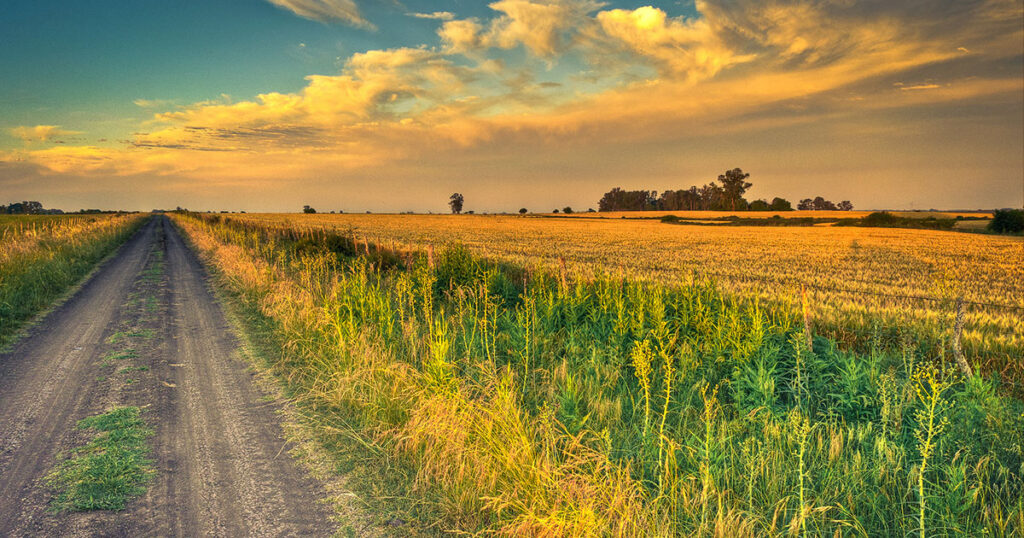
A narrow back road heads west from the end of my street to run along the ridge above the river path, passing behind the high school, two primary schools, and, within shouting distance of the children, a residence for the elderly. The back road—too rough, too overgrown, too crumbling and decrepit to call a lane—emerges from the woods to intersect a main artery out of town. There the camino vecinal, which means a rural route, ends.
If you cross the big road and continue along the city street, you pass the national police headquarters on your right and then the train station on your left, and soon you come to an access road dipping steeply under the tracks to leave you on the river path. The water gurgles, beyond the river the traffic drones, and behind you the town thrums. Birds twitter and flitter beside the glimmering waters.
The territory, crisscrossed by city streets, roads, lanes, tracks, riverside paths and tree-lined trails, is a hodgepodge. It took a number of outings when I moved here four years ago for me to fix the geography in my head, but I now know it well from taking my dogs for a walk every morning. I’m down to one dog, Toby, but we continue on the same beaten tracks.
Toby knows the lay of the land even better than I do because he also gets a walk every afternoon with my son. Not all dogs are so lucky. And yet, I wonder. What does Toby do for the rest of his life? He’s probably waiting for a walk the other 22 hours of the day, lying in the sun on the patio or, on a rainy day, curled into the back corner of his doghouse. Dreaming through the cold nights. He must be lonely, though I am not sure why I think that: His days are much the same as ever, alone in his doghouse. It only seemed different when my black lab Oso was still alive because I knew the dogs had company. What good was company when Toby was curled in his doghouse and Oso likewise curled in his? Were they miserable? Were they relieved? Were they resting? We’ve heard that misery loves company, but I believe that other states of being do, too—the right company. Like Oso’s.
To pick up the river path from my house, I have three options: go through town to the east and turn down past the industrial area, such as it is, and on to the river; take the path straight down to the river, almost from my door; or to take the camino vecinal and from there take the road out of town or continue and pick it up at the train underpass. Until recently, I usually favored the camino vecinal because on that road was a yellow dog on a short chain, and I liked to stop and pet him and tell him that everything would be okay. I wonder if he ever thought the same—that everything would be okay. Maybe everything was okay. He had sun, he had the company of some chickens, he had plenty of food, and he had visitors stopping by most days. A good life? I don’t know, but it was a life. It lasted 12 years.
And now he’s gone. The two dogs at the corner are gone. The occupant of the blue house is gone, the family that replaced him left, and someone new lives there now. Concha, who lived next door to the blue house, has gone, too, to live with her grandson. Before Concha moved, her son was a daily visitor—until one day he died. The man with the sheep across from my house died, but his widow still comes every day, with her son now instead of her husband. My own son came, stayed for a year and a half, and has moved on. My camino vecinal—a dead-end with two-way traffic.