
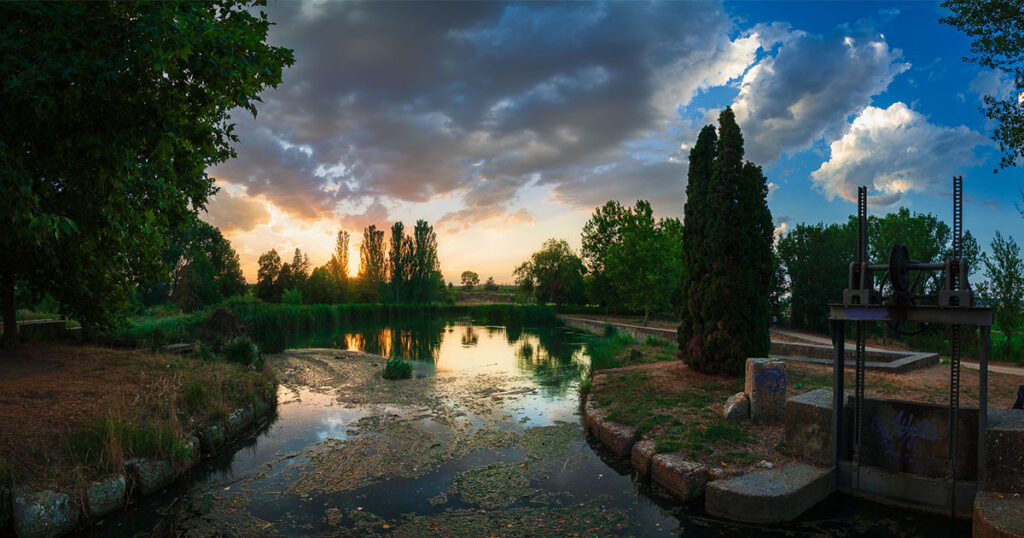
Back in the 18th century, when horses and oxen struggled over roads that were often impassable, Spain needed a solution to the problem of inland transport. Following in the watery tracks of France and England, engineers conceived the plan for the Canal de Castilla—the country’s most ambitious project up to that time.
The canal is more than its name suggests. Rather than a single waterway, it is a series of canals forming three branches and designed to carry wheat and other agricultural products. The hope was to connect the grain-rich northern plateau of Castile to the ports of Cantabria. Could such a system really succeed? The earlier Canal du Midi in France, completed in 1681, suggested that it could. Construction on the first branch of the Canal de Castilla began in 1753.
Why water? Before the steam locomotive, Castile was isolated and transportation was difficult on roads rough and rutted in the summer, often mired in mud in wetter months. On a typical road of the times, a horse pulling a wagon might move one ton of cargo. The same horse on a tow path pulling a boat could move as much as 30 tons. A principal visionary behind the canal’s design was Antonio de Ulloa, a Spanish naval officer, scientist, and Enlightenment figure. Today, a tourist boat bearing his name operates on the Campos branch of the canal, departing from Medina de Rioseco. Planners hoped to finish the project within two decades. Instead, the construction dragged on, interrupted repeatedly by wars and other financial crises. The Peninsular War between 1808 and 1814 was the biggest disruption but not the only one. Also straining the government’s coffers were the American War of Independence, in which Spain backed the colonies against Britain, and a civil war over royal succession, the First Carlist War, from 1833 to 1840.
Eventually, however, after almost 100 years of on-and-off construction, the canal opened in 1849. Two hundred and seven kilometers had been completed, with 49 locks along the route. At Frómista, a set of four locks in close succession forms a staircase, raising boats more than 14 meters. Here, the locks are oval rather than the standard rectangular shape, a design that better withstands water pressure and was considered particularly innovative at the time.
Northern Spain’s mountains made the original dream of connecting inland Castile to the coast at Santander extremely difficult. Though the canal never reached the sea, for a few decades it operated largely as intended, with 49 locks moving boats loaded with grain. But the coming of the steam locomotive changed everything: Railways were faster and cheaper, and soon transport by boat along the canal was mostly obsolete.
So the canal never became the great transport artery its planners envisioned. And yet, with the canal providing steady flowing water, milling became feasible, and water-powered flour mills, grain warehouses, and loading docks were built. A large milling industry developed in towns along the canal, especially near Palencia and Valladolid. The canal corridor became one of Spain’s most important flour-producing regions.
Ultimately, the canal’s economic success came not from transportation but power generation. Yes—the canal built for transport ended up providing industrial power. Today, when you drive through the area around Palencia, you see abandoned mills, some in ruins, that testify to this end. End? Not yet. As tourism grows, the canal built for transport and used for power now has a new life as a place of walking routes, boat trips, engineering displays, and, of course, history lessons. In Medina de Rioseco, a visitors center explains it all: the human ambition, ingenuity, and adaptability. Nothing so nuanced was my first impression on seeing the canal, when I leaned over the murky waters and turned to take in the crumbling building beside the canal at the town of Grijota, near the confluence of the three branches. My impression was of abandonment and desolation.
Abandonment and desolation. They exist hand-in-hand with imagination and renovation. Who’d have predicted that the steam locomotive would arrive to change everything about the canal? And what change to disrupt our times will someone in the future look back on with surprise and say, “Who’d have guessed?”