
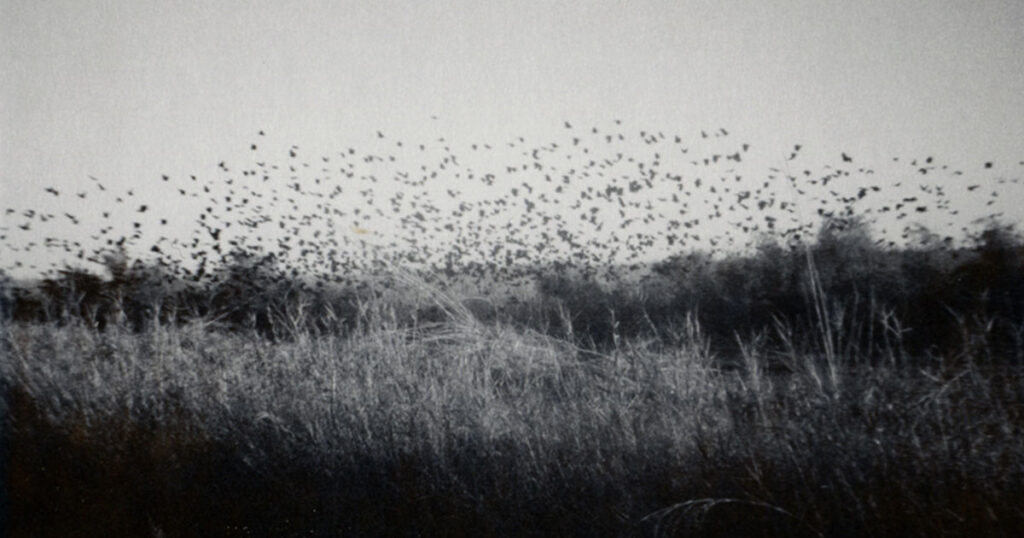
I begin a painting with a series of mistakes. The painting comes out of the correction of mistakes by feeling. … The final picture is the process arrested at the moment when what I was looking for flashes into view.
—Robert Motherwell, Samuel M. Kootz Gallery exhibition brochure, April 1947
How to say milk? How to say sand, snow, sow,
linen, cloud, cocoon, or albino?
How to say page or canvas or rice balls?
Trying to recall Japanese, I blank out:
it’s clear I know forgetting. Mother, tell me
what to call that paper screen that slides the interior in?
—Kimiko Hahn, “The Dream of Shoji,” Brain Fever, 2014
A Bird-while. In a natural chronometer, a Bird-while may be admitted as one of the metres, since the space most of the wild birds will allow you to make your observations on them when they alight near you in the woods, is a pretty equal and familiar measure.
—Ralph Waldo Emerson, journal entry, May 13, 1838
I’m sitting on the train, as I often do, traveling between Odense and Copenhagen. We’ve just pulled from the stop at Ringsted. I look out the window. … I pass cows grazing lazily in the field, and beyond them, a farmer is cutting hay. High above, a hawk searches for mice in the uncut grass. I love this landscape. It reminds me of the Ohio countryside where I grew up. Not spectacular, but somehow comforting and reassuring; an honest landscape not prone to bragging or trickery.
—Donald E. Canfield, Oxygen: A Four Billion Year History, 2014
It is a rule of Shakespearean production that men who eat grapes are definitely voluptuaries and probably murderers.
—Kenneth Tynan, Tynan Right & Left, 1967
Now that I’ve inspired a character in a Godzilla movie, all I really still desire is for several Ingmar Bergman characters to sit in a circle and read my reviews to one another in hushed tones.
—Roger Ebert, review of Godzilla (1.5 stars), Chicago Sun-Times, May 26, 1998
It is always at the back of my mind to be a poet. Lately I had occasion to get out the collected poems of my fellow Pennsylvanian Wallace Stevens. He didn’t publish his first collection until he was almost my present age and didn’t publish another for 12 years more. Yet the total production, in the end, weighs like a Bible … with big print on big white pages, all this verbal fun and glory and serene love—what a good use of a life, to leave behind one beautiful book!
—John Updike, The New York Times Book Review, April 10, 1977
Life is an affair of people not of places. But for me life is an affair of places and that is the trouble.
—Wallace Stevens, Adagia, 1957
There can be no wisdom in the choice of a path unless we know where it will lead.
—Benjamin N. Cardozo, The Nature of the Judicial Process, 1921
This is a vertical world: a nation of birds, a plenitude of leaves. … An enormous spider covered in red hair stares up at me, motionless, as huge as a crab. … Farther along, each tree stands away from its fellows. … And the foliage of each has its own style, linear, bristling, ramulose, lanceolate, as if cut by shears moving in infinite ways. … A gorge; below, the crystal water slides over granite and jasper … A butterfly goes past, bright as a lemon. …
Anyone who hasn’t been in the Chilean forest doesn’t know this planet.
—Pablo Neruda, Memoirs (tr. by Hardie St. Martin), 1977
You ask of my Companions Hills–Sir–and the Sundown–and a Dog–large as myself, that my Father bought me–They are better than Beings, because they know–but do not tell–and the noise in the Pool, at noon–excels my Piano.
—Emily Dickinson to Thomas Wentworth Higginson, April 25, 1862
Love’s dividends came in single bills, but hatred’s comes by twenties. …
… They gave no sign of knowing that the country was in the very depths of an economic disaster. They were men who had been sheltered all their lives and were sheltered yet. …
Brokers and buyers, efficiency experts with private means, personnel managers from banking families, men who had been born to ownership of ships or banks or mines or wells—the whole contented clan of white-collar foxes.
—Nelson Algren, A Walk on the Wild Side, 1956
Absolutely truly and coldly in the head, though,
I know that anyone who dies young after a happy childhood, and no one ever made a happier childhood than you made for your children, has won a great victory. We all have to look forward to death by defeat, our bodies gone, our world destroyed; but it is the same dying we must do, while he has gotten it all over with, his world all intact and the death only by accident.
—Ernest Hemingway to Gerald and Sara Murphy, March 19, 1935
Things I have learned reading about eggs: that chickens have earlobes, and the colour of the earlobe correlates with the colour of the egg: white ear lobe, white egg; red ear lobe, brown egg. What can lay an egg? An orange-peel doris can lay an egg in a tidal pool; a bee hummingbird can lay an egg the size of an aspirin; an auk on a cliff lays a conical egg, which will roll around in a circle instead of forwards and off the edge; a spider wraps her egg in silk, places it on a stalk, then lays another. …
In South Africa, my father scrambled an ostrich egg for breakfast: it was enough for 15 people.
—Helen Sullivan, “An egg: unfertilised, it is one giant cell,” The Guardian, May 15, 2023
It is spring, moonless night in the small town, starless and bible-black, the cobblestreets silent and the hunched, courters’-and-rabbits’ wood limping invisible down to the sloeblack, slow, black, crowblack, fishingboat-bobbing sea.
—Dylan Thomas, Under Milk Wood, 1953
The media. It sounds like a convention of spiritualists.
—Tom Stoppard, Night and Day, 1978