
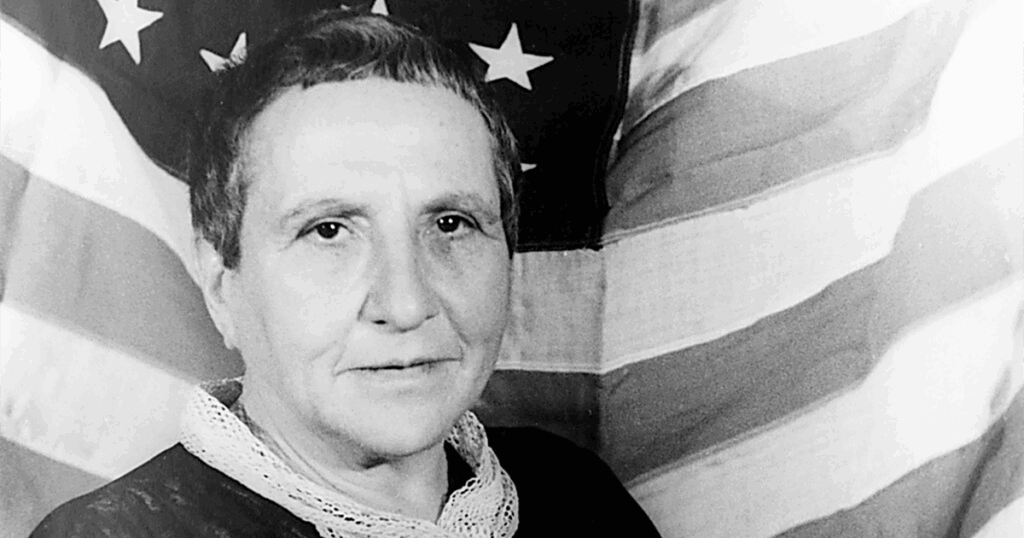
Gertrude Stein: An Afterlife by Francesca Wade; Scribner, 480 pp., $31
At Radcliffe College, Gertrude Stein once wrote to her favorite professor, William James: “I am so sorry but really I do not feel a bit like an examination paper in philosophy today.” “Dear Miss Stein,” James wrote back, “I understand perfectly how you feel. I often feel like that myself,” and gave her the top grade.
Calm effrontery always was her game. Buoyed by family money, Stein headed to France in 1903 to live with her older brother Leo. Leo planned to buy Cézannes; 15 or 16 would do. Gertrude, meanwhile, was a medical school dropout who craved verbal revolution. Six days a week, in a sumptuous apartment near the Luxembourg Gardens, her Blickensderfer typewriter turned language into confetti with questions straight out of a Lewis Carroll text (“Why is a feel oyster an egg stir?”), blithely skewed declarations (“Toasted susie is my ice-cream”), and descriptions like Cubist paintings (“A seal and matches and a swan and ivy and a suit”). On Saturdays, the rebel pair held open house for emerging artists like Matisse and Braque and Pablo Casals. Leo argued visual theory; Gertrude held court as the Sibyl of Montparnasse.
In 1914, the siblings quarreled: Leo left for Florence (he took the Renoirs that he had purchased, she kept the Picassos), but another American expat from the Bay Area, Alice B. Toklas, stayed on at 27 rue de Fleurus as secretary and majordomo—which was fortunate, since most visiting postwar literati craved either a housemother or a fight. F. Scott Fitzgerald was entirely respectful, Dorothy Parker not at all (“Gertrude Stein did us the most harm when she said, ‘You’re all a lost generation.’ That got around to certain people and we all said, ‘Whee! We’re lost.’ ”). Ernest Hemingway was fawning, then poisonous; Sinclair Lewis called her a literary racketeer.
All this is detailed in Francesca Wade’s new biography, Gertrude Stein: An Afterlife, her second book after Square Haunting: Five Writers in London Between the Wars, in which the independent British critic chronicled overlapping female lives from Virginia Woolf to Dorothy L. Sayers. An Afterlife captures another iron-willed modern at her Bernhardt best. “Stretched on a divan underneath her own Picasso portrait, Gertrude Stein was a myth and a monument,” Wade writes, “a larger-than-life figure whom friends and detractors viewed by turns with amusement, affection and alarm. She was at once a celebrity and an enigma: everyone knew she was famous, but no one was quite sure why.” Except Stein, that is. “The longer I worked on it, the more this project began to feel something akin to detective work,” Wade writes. “Biography, like detective fiction, tends to begin with a corpse—but Stein well knew that a writer’s life does not end at death, if their work has the power to survive them.”
“We all feel we know what [modernism] means,” John Updike once observed—“Apollinaire and Gertrude Stein, Bauhaus workers’ housing, the enigmatic and erudite complexity of Ulysses and The Waste Land, the startling distortions of Picasso’s Les Demoiselles d’Avignon … art for its own willful, bourgeois-baiting sake.” But Stein—noisy, needy, trusting—lacked the true mandarin chill of her counterparts, and her plan for posterity was simple: to be misunderstood for years, then embraced as a great talent. Wade patiently diagrams Stein’s halting emergence as fictioneer and poet, especially her magpie recyclings, “as if dropping clues for the reader and linking her texts together.” In Four Saints in Three Acts, for example, Stein’s famous declaration “pigeons on the grass alas” echoes “chicken made of glass. Alas”—a phrase she’d written four years prior in “Mildred’s Thoughts,” then rediscovered in 1927 while preparing the text for an anthology.
Yet her lunges for fame were mocked and sidelined until, in 1932, low on funds, she wrote the deliberately charming Autobiography of Alice B. Toklas in six weeks (“a joke, a myth, an audacious act of knowing artifice,” says Wade), and her homeland went wild. “Gertrude Stein Arrives and Baffles Reporters by Making Herself Clear,” cried The New York Times. Though born in the age of Trollope, Stein was a media natural: On a coast-to-coast tour at age 60, she talked film with Chaplin, took tea with Eleanor Roosevelt, got an Astaire-Rogers shout-out in Top Hat, rode along with police to fight crime, and happily showed off her poodle’s toothbrush. After six best-selling months, Wade writes, “Stein was firmly embedded in American popular culture—she had made modernism mainstream.”
Toklas and Stein remained in France throughout World War II—risky, since both were Jewish—and Thornton Wilder and others persuaded Yale to take Stein’s papers. “Facts of life make literature,” she declared, tossing in dentist bills and rent slips, laundry lists and love notes against the day when both her lesbian life and her daring wordplay might be accepted, even understood.
Stein died of cancer in 1946, but researchers have snarled and grappled over her legacy for decades. Was the definitive Stein an upstart female, a brazen fraud, a philosopher of language, a Vichy collaborator, a gender pioneer? Was Toklas a sinister genius of control, or Stein’s natural protector? From the 1950s on, a cohort of admirers, many of them gay, did their best to keep Stein in the running for greatness—an uphill labor, short on thanks.
Toklas long hoped some talented scholar would confirm Stein as a founding modernist, as Richard Ellman did for Joyce and Hugh Kenner for Pound. Many tried, including the fearsome Janet Malcolm; in our time, the scrupulous, perceptive Wade comes closest, especially in her skilled readings of intricate palimpsest texts like The Making of Americans. And though split-screen treatments pervade cultural history—now beset with studies on the afterlife of sympathy, of the Anglo-Saxons, of digital writing, of the romance hero, of Paradise Lost—here the before-and-after structure wonderfully clarifies a writer whose significance blossomed in death, like Dickinson or Thoreau.
More on Stein’s literary heirs would have been welcome—Margaret Wise Brown of Goodnight Moon fame was a fan—and more American professional context, from experimental poets like Amy Lowell and Muriel Rukeyser to Stein’s exact contemporary, Willa Cather, a committed modernist in another key, with a similar home life. Still, Wade makes the archival grind feel fresh and glamorous. Stein’s courtiers, patrons, and enemies are recovered in all their viperous energy and, once or twice, surprising kindness. The support, then souring, of Leo Stein, who moved from rivalry with his sister to rage toward her, seems all too plausible now, and Toklas bursts to the foreground as never before, first as the capable partner whose protection let Stein’s artistry flower, then as wounded rear guard. (“Without Baby,” she wrote to Fania Marinoff, Carl van Vechten’s wife, “there is no direction to anything—it’s just milling around in the dark—.”)
If Leo Stein had cosigned his sister’s work, what then? Plaudits, praise, and prizes, or so Wade’s excavations strongly suggest. Gertrude the Mama of Dada, it turns out, was also the Rosalind Franklin of modernist literature. It’s her belated luck, and ours, that Francesca Wade knows truth is the daughter of time.