Dan Lynh Pham, who was born in Vietnam but grew up in Tulsa, Oklahoma, has been exploring themes of cultural identity through her prints since she was an undergraduate at Oklahoma State University. “The values and the way [my parents] were raising me was as if they had plucked Vietnam into the household, and I was still in Vietnam,” she says. The competing cultural expectations of Pham’s Vietnamese family and American peers “created a lot of confusion” for her, but everything cleared up when she visited her family’s shrine at a temple in Ho Chi Minh City—and met monks there who had known her grandparents. Seeing for the first time a “collective of my family and my ancestors all in one space,” she says, was “sobering but meaningful.” It inspired Pham to pursue a new direction in her art, using sculpture and installation work to pay tribute to her family. She asked her parents for stories about her relatives, learning that her grandfather was a prisoner of war during the Vietnam War and that her mother’s brothers escaped by boat following the fall of Saigon.
 I Bear the Fruit of My Ancestors, 2024, mixed media installation, featuring a custom built Vietnamese altar and the tradition of lighting the incense. (Photo courtesy of Viet H. Nguyen.)


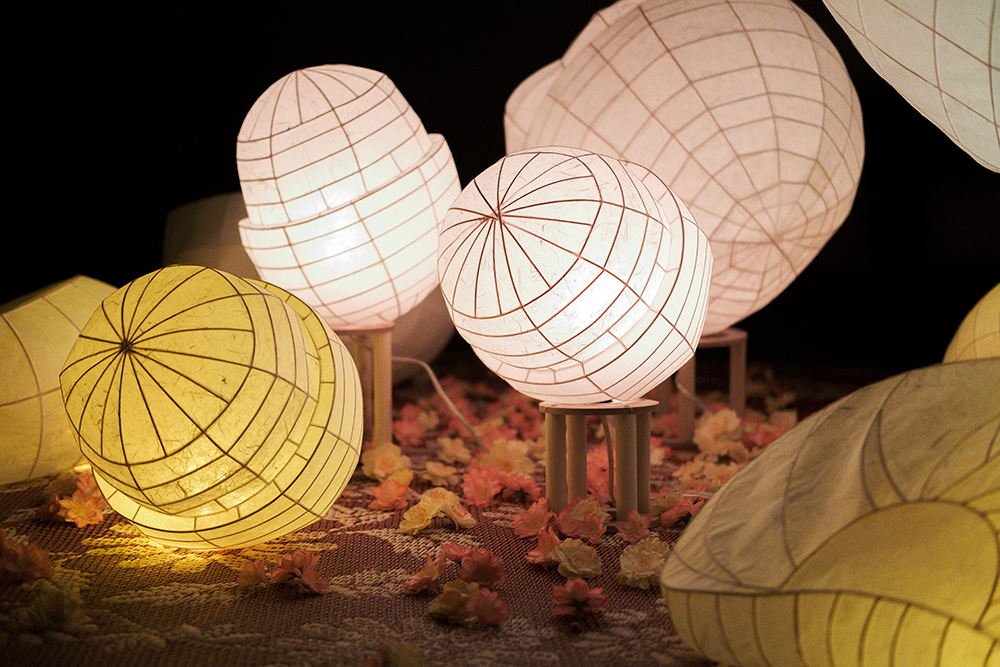
Pham’s newfound knowledge culminated in I Bear the Fruit of My Ancestors, an installation that was shown in Tulsa and New Orleans last year and will be part of a group exhibition at the Oklahoma Contemporary Art Museum this September. “I want people to feel like they’re walking into a memory,” Pham says. The work recreates several components of her family’s ancestral shine: an altar with photographs of her family and lit incense rests on a constructed stage, and a pot of rice cooks in the back of the exhibition space, an aromatic nod to the foods offered on ngày giỗ, or the anniversary of a loved one’s passing. On a rug in the center of the room are several paper lanterns, each meant to resemble a food Pham enjoyed as a child. So far, Pham has created around 27 lanterns for the series, and each takes roughly a month to complete, a laborious process she likens to the work her family has put in to give her a better life. “I know in Asian families, parents don’t typically say, ‘I love you’ or like, ‘I’m sorry,’ or things like that, but they do it through their actions,” she says. “And a lot of times, it’s with a plate of cut fruit … As an adult now, I’ve learned that cutting fruit is a labor of love.”