
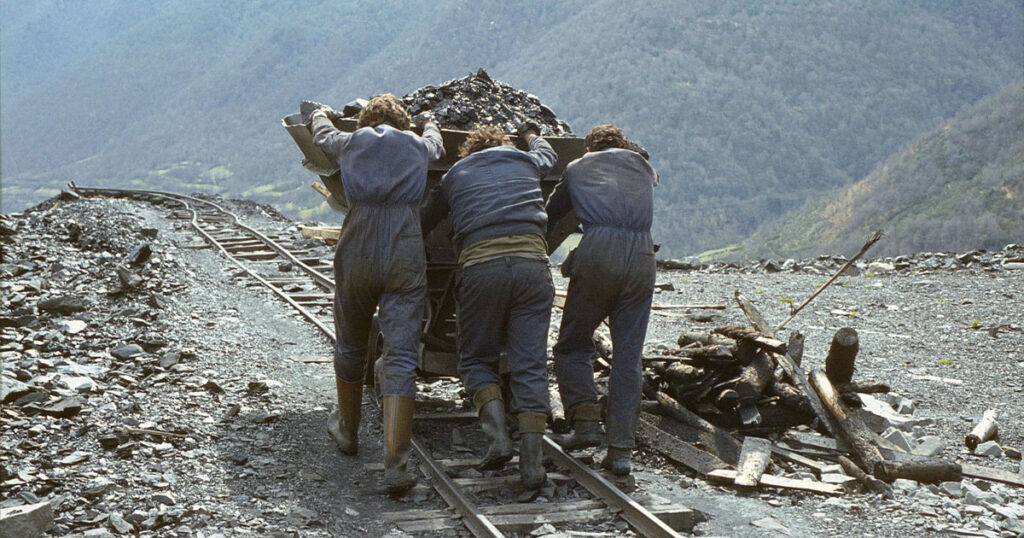
Víctor Manuel, my student repeated, yes, she liked his music. But not his politics, she added with a laugh. A few days earlier, she had mentioned some new scandal involving former president Zapatero and the millions of euros that politicians on the left were supposed to have taken.
“He was a socialist?” I’d asked.
“They’re the worst!”
She was packing up her things to leave, the only student left in class after the other three had dropped out one by one, beginning at Christmas. The most recent had quit three weeks earlier, in May, after injuring his knee in a fall. So my sole survivor had already won “last man standing.” Would she continue until the end of the academic year in June?
Víctor Manuel is a singer-songwriter from Mieres, in mining country, and from his first success in the 1960s through to the present, he has sung about working men and women, their lives and struggles. I saw him in concert in Gijón in the mid 2000s at the Universidad Laboral, when he was already a legend, so he came to mind when my student mentioned the Laboral as architecture she admired. That was how spontaneous our conversation was—she mentioned architecture and I jumped to singers. And yet the connection was stronger than his concert at the Laboral auditorium.
The Laboral, built in the 1940s and ’50s, is a huge complex constructed around a grand courtyard, where a monumental bell tower rises above an oval chapel. Originally conceived as a residential and educational institution for miners’ children, particularly orphaned children, it was instead inaugurated as a vocational and residential school for boys. Partly abandoned in the ’80s and ’90s, it was revived in the 2000s as a cultural complex with the city’s conservatory, a performance hall and theater, and conference rooms and exhibition spaces. All in stone quarried from the mountains of Asturias.
I’d seen Joan Baez at the Laboral, too, I added.
“Joan Baez?” my student asked.
“The ’60s, counterculture, folk singers—Bob Dylan and all the rest?”
She didn’t know Joan Baez. She wouldn’t know “the rest,” either.
She wished me a good weekend and left. Her class was my last. I put my desk in order, wiped the board, and looked out the window. No sign of the neighborhood protest group that met many Wednesdays to march down the middle of the six-lane highway, stopping all traffic. They were rallying against the trucks using the main thoroughfare through their area to reach El Musel, the industrial port at the far end. The residents didn’t like the noise, pollution, and the lumbering weight and size of the semis shouldering through their streets.
Many of the residents of La Calzada are former miners—or people whose families come from La Cuenca, the mining region in Asturias. When the mines began closing in the 1980s and ’90s, many who worked there were given early retirement with good severance packages. The population of La Cuenca dropped as many families left the area. Now they live beside the ocean instead of in a narrow mining valley. Instead of black lung, their worries are the windows rattling when a semi passes. A good trade, though some mourn the lost traditions of generations.
But mining worries were more than gradual exposure to coal dust and the threat to health. In a song he wrote in the late ’60s, “La Planta 14,” meaning the 14th level in a mine, Victor Manuel describes the way a mining accident might play out. The reports, the fear, the miners and families gathering at the entrance to the shaft, the mining officials and government figures, the mine rescue brigade sent in to retrieve the bodies, a boy crying against a tree, and the long wait as one by one, the dead are brought out. In the song, it takes hours to bring up the last body; in real life, it might take much longer. Based on no particular accident, the song is a composite picture from the era. But the conditions in mines hardly changed for decades.
In contrast to deadly accidents, semis rumbling through your neighborhood seems a small thing. Especially since there’d be no trucks without the ships full of cargo, and no cargo without the consumer demand. You can’t have your cake and eat it, too.
But even without the trucks, there’d be other inconveniences and other complaints. There always are. Darse con un canto en los dientes is an absurdly violent saying that means literally, “Hit yourself in the teeth with a stone.” The message is to count yourself lucky that things are not worse. This saying, with its stone suggestive of blasted rock, seems especially well suited to miners. Had the Laboral been dedicated to miners’ orphans, some would likely have seen the gesture as compensatory, to keep people quiet. Even then, you can imagine bashing a stone against your teeth, because labor accidents are a given, and sympathy and recompense are not. It could be worse. Or so it would be said. And in fact, it was worse: That relief from hardship was never extended to the orphans.
Still, be grateful it isn’t even worse. Winning isn’t everything. Surviving is enough. Sometimes it’s the same. So I reflected as I got in my car and maneuvered between cars, trucks, taxis, and buses—everyone changing lanes and changing again, wanting nothing to impede them in their slot in the flow.