

After working in the darkroom for nearly 20 years, David Sokosh began to experiment with earlier photographic methods such as tintype, where an image is directly made on a metal sheet. “My interest in the past—in old technologies and late 19th- or early 20th-century design and art—led me to these historic processes,” he says. “What was photography like for people in 1840, in 1880, in 1910? What was going on in America? How do people interact with photographic technology at different times?” He spent several years practicing with tintypes, even using them to shoot a fashion feature for The New York Times. But when the pandemic struck, Sokosh found himself wanting to create without the cumbersome equipment required by the medium. He toyed with the idea of collodion prints (an early process for developing photographs on glass using ether) but eventually settled on cyanotypes (the same monochrome process used for blueprints) because their requirement of only two chemicals is “certainly lighter on the health of the photographer and on the environment.” This led him to invent a way to combine his love for darkroom photography with the chemical process of cyanotypes: He shoots film with a camera from the 1950s, manipulates the negatives in Photoshop, then develops the photographs onto paper treated with cyanotype chemicals.
 Ophelia with Pansies and Rosemary, cyanotype image on 14 x 11 in. sheet-Hahnemuhle Sumi-e. (Cyanotype by David Sokosh. Photo courtesy of the photographer.)

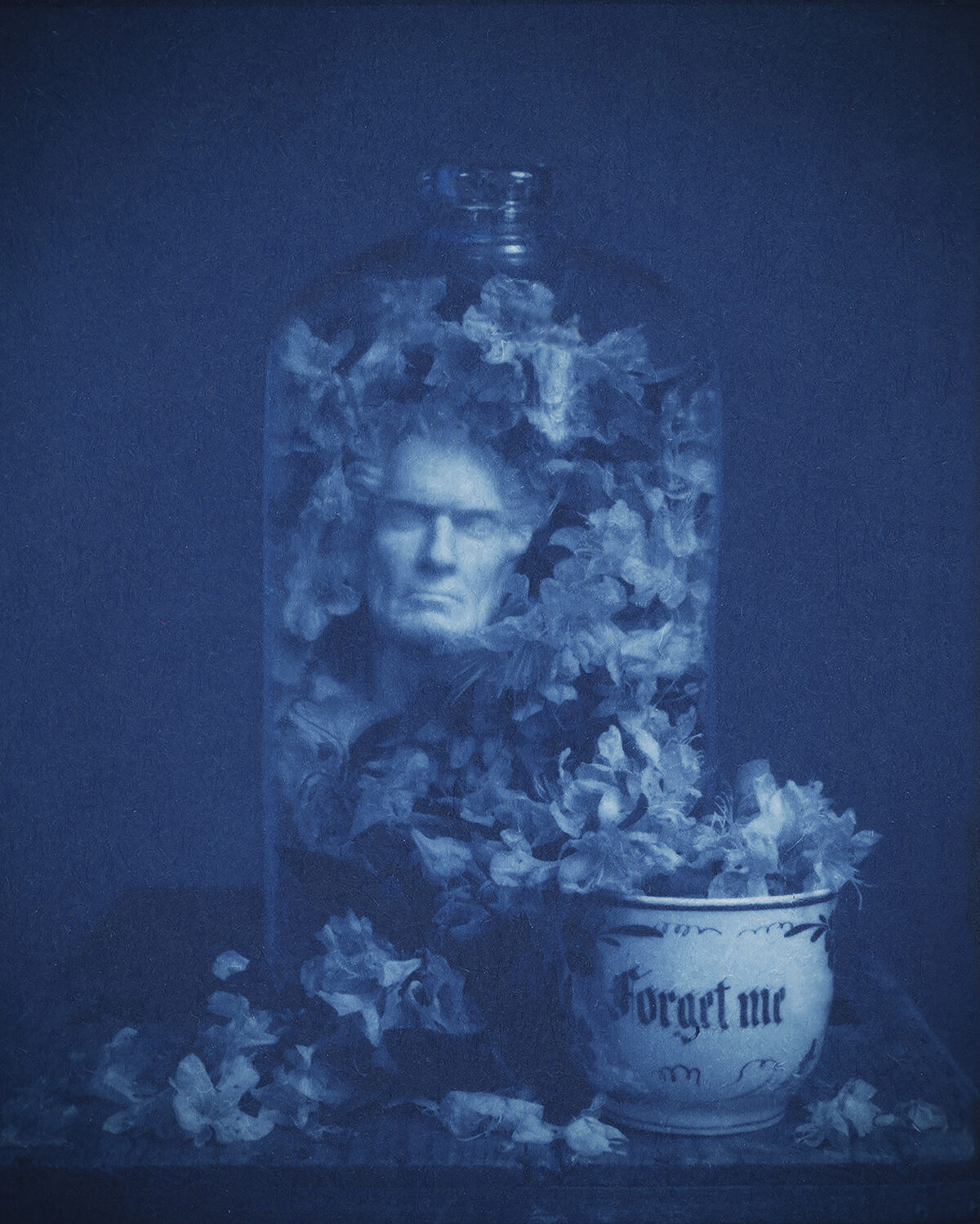

Sokosh’s ongoing series Past/Present-Memory/Loss explores themes of remembrance and nostalgia through still-life compositions, portraits, and self-portraits. The still lifes include daffodils in a glass urn and a classical bust trapped inside a bell jar alongside azaleas and a ceramic mug that reads Forget me. The portraits, meanwhile, nod to literary figures: Ophelia carrying flowers associated with memory and 16th-century abortifacients; Achilles and Patroclus arranged in a pietà composition. Sokosh was inspired by his mother and grandmother, who were both diagnosed with Alzheimer’s, and whose memories Sokosh watched slip away. We live in a culture obsessed with “trying to stay young, trying to stay current,” he explains. “If something that is preserved forever under a dome”—like the bust in the bell jar— “is kind of airless and untouched, it stays young forever. It stays the same, but it’s not doing anything. It’s not all alive. It’s not functioning in the way it was intended to. So what’s better: to live and get used up and die or to stay eternally youthful?”