
There’s a fancy academic term for poems about visual art: ekphrastic. I hate the word, just because of the clunky sound of its first syllables, but I warmly embrace the idea. W. H. Auden based much of his great poem “Musée des Beaux Arts” on the Brueghel painting Landscape with the Fall of Icarus. It’s difficult to look at Parmigianino’s Self-Portrait in a Convex Mirror without thinking of John Ashbery’s poem of the same title, one of his most celebrated works. Emma Lazarus’s “The New Colossus,” the sonnet that graces the pedestal of the Statue of Liberty, is another good example, as is Keats’s sonnet “On Seeing the Elgin Marbles.”
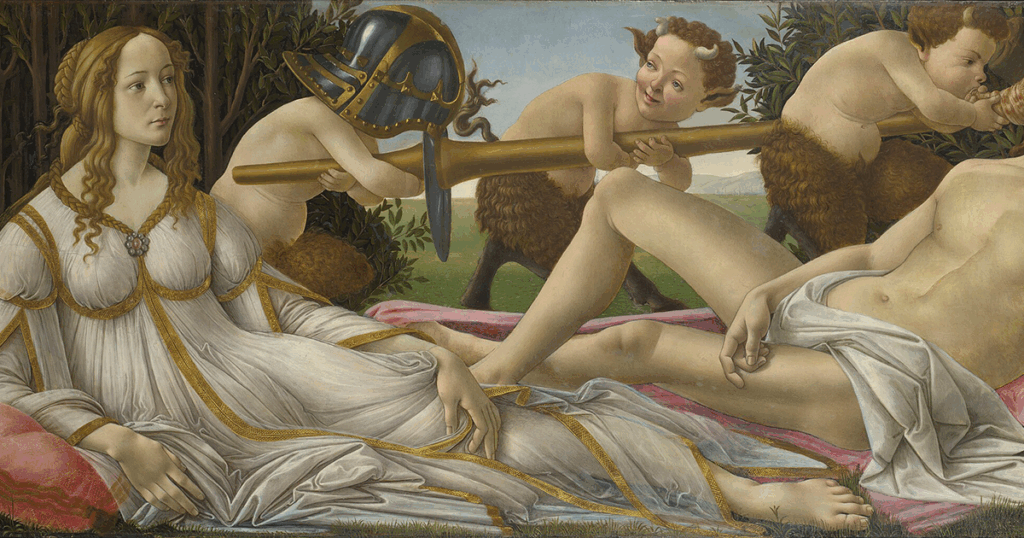
With such poems in mind, I directed NLP players to three paintings in the hope that they would spur the writing of a poem. The three paintings are The Card Players by Cézanne, Chop Suey by Edward Hopper, and Venus and Mars by Botticelli. And my hope was fulfilled: 136 comments filled the field, many of them poems; others were comments that provoked thoughtful discussion and excellent revisions.
Though Cézanne’s The Card Players was not nearly as popular among our players as Hopper’s Chop Suey, it inspired exemplary poems. Emily’s “Poker Face Poem” has a wonderful title and short, staccato lines that come at you quickly. Here’s the poem:
Fair’s fair
A chip and a chair
Dead man’s hand
Your tell’s your au pairBoy band
A one night stand
Clair de lune
Flash in the panRough-hewn
blues room
Four racked pipes
Brown pantaloons
The “Dead man’s hand” aroused the wonderment of more than one teammate. Emily explained that “it was the hand that wild Bill Hickok was said to be holding (2 black aces, 2 black eights) when he was murdered in Deadwood.” Good to know!
Paul Michelsen lived up to his trickster reputation in “The Lab”:
Don’t you know that when you / Play at this level there’s no ordinary venue
—Murray Head, “One Night in Bangkok”Magic can be made in any kind of venue
if one has the wits to invoke Venus,
the panache to order off unofficial menus
Even on awful occasions, imagining minus
a day could keep that cretin King Minos
at bay, but can’t keep clean those bloody manos
or make his teeth less like a mako’s
and more like the soft grin a baby makes
For Elysium’s sake, we’ll have nine sakés
In case the goddess has run out of saves
Or perhaps pray a novena of avés
Heaven knows my sleeve’s run out of aces
Aces, indeed, for demonstrating the secret linguistic links that connect Venus to menus, King Minos to manos, and avés to the most valuable card in a poker player’s hand.
Of the two poems submitted by Christine Rhein, I was particularly taken by “The Card Players,” in which description beautifully unfolds into a tableau vivant:
Three men sit lost in a game, studying
the cards they hold, wagers they should
or should not make, trying to outsmart
luck, fate, greed. The fourth man, too—
standing by the wall, smoking a pipe—
makes sure his face gives nothing away
of the card hand he can see, knowing
he could tip the win away from his foe
in that old brown coat, toward his friend
draped in blue, by giving him a nod, a sign.
These Sunday gamblers, in their church-
like silence, choose not to cheat today,
their bets, doubts, faith—all on the table.
Hopper’s Chop Suey provoked this gem from Heather Newman, a dialogue of two women with “man problems.” Here is “Picking on Chop Suey,” with its arresting opening:
“He says I’m a battleship on a seek and destroy mission,”
and I’m not sure whether to touch her hand or giggle.
“I honestly don’t know what we fight about,” she says.
She stares at the couple behind us. “They make it look
so easy.” She is loquacious duck on a bed of wilt,
whispers as fast as she types. I am Remington Portable,
all mechanical nods and shrugs. Oh, man problems.
I want to slip into her lotus shoes despite the pain.
“You never talk of men. Why is that?” I have learned
a quiet beat drowns out explanation. In time, she will marry
and leave. And like the stir-fry, we shall use whatever
meat and vegetables are on hand.
Anna Ojascastro Guzon’s “Chop Suey” pleased and puzzled readers:
I never tried chop suey before
I grasped the beauty in a choice
of overcast and light shining sideways.
It’s unexpected. The walls bloom; a lonely
gaze. And hues convey a plot or a psychological ruse. Who can let go
of those ochres juxtaposed with blue?
What is it that you cannot possibly get
enough of? What luck if your reply is
chop suey; leftovers, everything between what’s contained and what you
throw out.
Why the unusual line breaks and the long last line? Questioned on the point, Anna revealed her method: “I played a game when writing this poem, attempting to place an ‘interspersed’ anagram of the words chop suey in every line. Thus, I ended up with the long lines. I also found some end rhymes that were too sing-songy so I chopped lines to hide the rhymes.”
In “With my Back Towards Them,” linda marie hilton introduces what she calls the “slantgram,” an “anagram with one letter more or less, or one letter changed”:
He always brings her here
In the morning he hangs his brown coat
She sees it while having her juice and worn toast
She wears stoat, he buys her dinner elsewhere
Then they come here for the cheesecake
Always he’s said: “my job is sending me out of town”
It has become his trite wont
Along with his combed hair
Always when our boy is bullied and my car won’t start
Once home he demands berry tarts
With yerba cocktails: how he maddens me,
Wearing me down like a windup clock.
Sometimes the poem you meant to write ends sooner than you had planned. Such was the case with Pamela Joyce Shapiro’s lovely “Tasseomancy”:
It’s the tea I’ll remember—
lifting the small ceramic pot,
feeling its weight as I poured,
watching the deep amber stream
fill the sipper cup, inhaling
the fragrant steam before bringing
the cup, hot in my palms, to my lips.
Pamela initially had more in mind but realized that no further lines were needed. Her title refers to the practice of reading tea leaves for fortune-telling.
Dr. Atar J. Hadari’s “The Coat” concentrates on an easily overlooked detail in Hopper’s painting:
The coat between the two women
Hangs yellow on the coat standWhich is invisible, in fact
It hangs on nothing at allSimply swaying where the window
Alcove casts a yellowMaking shadow
Before the pallorOf the girl’s face
Makes her forehead ochre.Nothing but a coat
But with the two girls talkingIt hangs and listens all
The world is a yellow stocking.
The title of Michael C. Rush’s poem, “Ladies in Mercedes,” is hard to beat:
To write of class, they say,
(should one write of class),
write of frustrated, hungry failures,
and of overdressed (which often
requires being underdressed)
ladies in Mercedes.
What is wanted is an ostentation
of presentation, not of origination.Aspiration may be the only absolution—
Quand même! Consider the asymptosis of the
asymptomatic suffering from insufficient
exposure; take a digressive approach to
transgression while regurgitating outmoded
pan-aestheticism. There should be a wealth
of opportunities for misinterpretation,
for inconsequential consequences.To write of class, they say,
(and one should write of class),
adopt the posture of a posture-adopter.
As for first lines, in “Getting Lucky,” inspired by Botticelli’s Venus and Mars, Josie Cannella hits the jackpot:
Hey, Venus, I been there—
pissed that your Mars passed out
rather than snuggle after getting lucky,
while playful messages pour in for him.Or he’s with the card players at Cézanne’s, hoping for
a different kind of lucky, hiding his hands,
sucking on a pipe, losing the hard-earned money
you planned to save for the holidays.So why not meet me for a cuppa down at Chop Suey?
We can talk, or not talk, you and me, while some guy
lights a Lucky Strike, hoping his wife stays clueless,
‘cuz Venus, I been there.
In “Theatrics,” Charise Hoge alliteratively imagines “Botticelli on Broadway”:
Someone has a ghastly idea
to put Botticelli on Broadway,
via “Vamp & Vampire”—
a play based on Venus and Mars,
his exquisite painting. Must
we modernize?Take “Six,” a musical showcasing
wives of Henry VIII, those Tudor
queens who tried their best to bring
forth the male heir, bedded and beset
by annulments, beheaded. They sing!On the other hand, does shmaltz
behoove us in modern times?Botticelli’s satyrs staged as keystone
cops–imagine it–bumble around
with bloodletting tools, misplacing
them. Vamp is nobody’s fool, while
Vampire sleeps like a cherub.
I love the rhyme and alliteration that enliven the lines about “those Tudor / queens who tried their best to bring / forth the male heir, bedded and beset / by annulment, beheaded.”
I would argue that the commentary on Venus and Mars by J. Randall Brett improved his effort about “the secret passageway” that links the Uffizi Gallery to the Pitti Palace in Florence.
On the Ponte Vecchio this March
your eyes were the secret passageway
between Botticelli’s painting of you –centuries before you were born –
and my Medici heart: its plots, usurpers,
Popes, and excommunications.How could he have known you always
turn on the light and read, after,
while I snore into the ear of gods.Did he have Sir Paul’s cherub Wings
on his playlist, earbuds spattered with gold?
“Venus and Mars are alright tonight.”
“How about leaving off the last stanza?” Charise Hoge asked. And Josie Cannella wrote that “stanza 3 needs a question mark.” With those changes, the poem reads:
On the Ponte Vecchio this March
your eyes were the secret passageway
between Botticelli’s painting of you –centuries before you were born –
and my Medici heart: its plots, usurpers,
Popes, and excommunications.How could he have known you always
turn on the light and read, after,
while I snore into the ear of gods?
You know it’s a terrific week if you quote as many poems I have and run out of space before getting to the always dependable Millicent Caliban’s poem, named for the Stephen Sondheim song “Ladies Who Lunch.”
The Jack Benny impromptu award goes to this poem inspired by Millicent’s comment, “Michael, Pamela, Josie. / Thank you all for your kind words,” to which Michael C. Rush replied,
The kind words cluster
under the street lamp,
smiling at one another
with their hands on their wallets.Out in the night, unseen,
the other words
hoot savagely and howl
at the nude moon …
In my original prompt, I reminded people that their poems could depart far from the painting they chose as a point of departure. This freedom is on full display in “pure of heart” by Darah Spar, a name new to our NLP enterprise.
a squirrel comes across your path and you
feel like snow white. you wash the windows
as dutifully as cinderella. when a bird sings
you understand. you get a nuzzle from
a dog on the street, a wave from a baby on
the bus, a smile from an old woman in the
window. it seems you are pure of heart and
the world can see it. or maybe you are good
just by being. you tell a tale until it’s true.
If you can figure out which of the three paintings triggered this charming venture into Disney’s fairyland, please let me know.
“Immature poets imitate,” wrote T. S. Eliot. “Mature poets steal.” For next time, I suggest we take a line from someone else and run with it. Here are a bunch of lines that strike me as promising. I won’t say where they’re from, and I believe the writer would be wise not to ask the Internet to help. That would be cheating, and there is, I solemnly aver, a difference between stealing and cheating. I’ve modified or abbreviated some of the lines. Use any.
“If I am out of my mind, it’s all right with me”
“Give me money. Friends you can keep.”
“As I rowed down the indifferent river”
“She wore her gems and nothing else.”
“He had it: the talent which is death to hide.”
“Money is as beautiful as roses.”
“We love the place because we were children there.”
“There’s a man inside me that’s mad at me.”
“I wish I were a girl again, half-savage and free.”
Limit: 14 lines. Deadline: two weeks after this post goes up.