
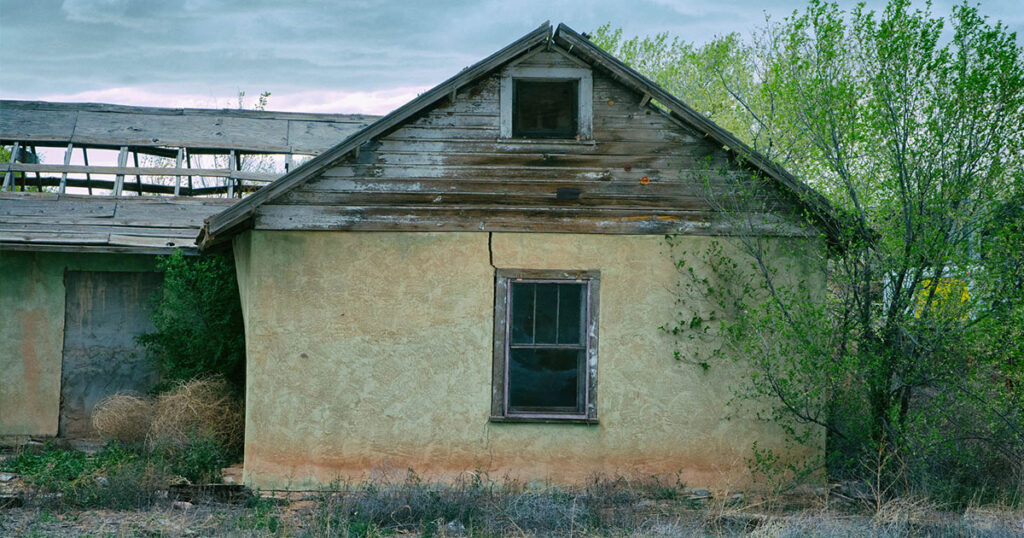
Standing on Kelly Road, in Magdalena, New Mexico, are a number of abandoned buildings on some open, grassy, weedy acres. These 14 buildings form a loose cluster, as if called together for a dance they hadn’t rehearsed and left there. Around them, to the east, west, and north, sit a few houses, and open fields rise to the south. Half the buildings are terracotta, with standard windows; the other half are midcentury modern, one story, with yellow Transite panels and flat roofs. In the 25 years I’ve been visiting Magdalena, these rundown buildings have appeared exactly the same—tired at first acquaintance and equally tired year after year. Every time I see them, I ask myself the same questions: What might be done with these buildings? Why doesn’t someone do it?
Out for a run one morning this past August, I stopped to ponder them again. Along with my usual fondness for the buildings and my notion that they could be awakened into a useful second life, I felt something new—that the buildings themselves, so long in place, so much a part of the landscape, were joining me in my question of who would save them and for what end. The early morning wind shook the weeds and the flaking paint flaked infinitesimally more, and the buildings on their foundations sank a fraction of a fraction, resigned to further waiting. It was summer, but soon the wind would be chillier, the snow would blow.
The complex was built by the U.S. Bureau of Indian Affairs beginning in the late 1950s and expanded over the following years. The original yellow buildings served as dorms, kitchen, and dining facilities for the Navajo students from the nearby Alamo reservation who lodged there while attending the Magdalena public schools. Later additions included more dormitories, another kitchen, and living quarters for staff. The complex was called the Magdalena Dormitory, and it operated from the late 1950s into the 1980s, when a new school was built on the reservation and Navajo students could live at home.
In accounts of Indigenous boarding schools, I have read about the neglect, the abuse, the misappropriation of funds, the hardships, the deaths. Babies born to children. Small cadavers buried under a rosebush. Fear, despair, anger, shame. But these are just words, and reading them is not enough. We want pictures, images to confirm our worst fears, to haunt us.
But I saw no ghosts here. Perhaps any suffering was the common homesickness of children away from home, and perhaps the staff comforted unhappy children. Could I imagine such a scene if I saw the rooms? I would have looked in the windows, but they were boarded. The doors were locked. Eventually I came to one long building of garages and found that all six garage doors had been busted open by vandals. Across an open lane, the facing building of living quarters had had the doors knocked in. What a shame, I thought. But also, What an opportunity.
And so I ventured into one of these spaces, stepping gingerly across the threshold, pleased with the modest proportions of the rooms, how easily one could move between kitchen, living room, back hallway, bedroom, bathroom, and storage room. Built-in cabinets were more or less intact. In the short back hall, a light fixture hung from the ceiling, and inside the dangling bowl of the shade was a swallow’s nest.
I was wary of critters that might live there but saw no spiders or snakes. Even the nest appeared empty, now just a remnant from some previous time.
I went back outside, into the morning. What a huge job to rehabilitate this collection of buildings. Someone could do it, someone who knew whom to approach, where to find funding and collaborators, how to inspire interest in a big project. Meanwhile, what might I find out about these buildings?
It was 6:45 a.m. and the sun was rising over the mountains to the east. Golden light covered the decrepit yellow building at the south end of the area, the trees beside it, the long grasses growing up, the scrub beside the road, and the gravel, too, which shone almost white in that light. Glorious, I thought. I turned away to continue my run. Which is when I saw a small snake on the gravel, five feet in front of me. I stopped.
Long before I bent over to examine it, I realized it was dead. Poor snake, dead on this glorious late-August morning.
But it didn’t have to be dead in the middle of the lane. I used two skinny sticks to lift the snake from the dust and transport it the two feet to the edge of the road, where I curled it comfortably under a branch of a scrubby bush. On my way back from my run 50 minutes later, I slowed to a walk, searching for the small body. There it was, right where I had put it, under the sheltering twigs of the bush. It was not alone. Several ants were busy around it. I entertained the thought that maybe the ants, working over the snake, would inadvertently bring it to its senses, as the small Lilliputians had with Gulliver. But the snake did not stir.
At home I looked up this striking snake, about as big around as my pinkie, moss green on the back and bright orange with black specks on the underside turning red near the tail. It is the regal ring-necked snake, a small harmless snake with an important-sounding name. Now resting (as they say) across the street from a decrepit bunch of buildings with an important-sounding name: Bureau of Indian Affairs Magdalena Dormitory, full of asbestos and lead paint and slated for demolition by the village for future development of the land. It could not withstand many more winters. It does not need to.