
When the Forest Breathes: Renewal and Resilience in the Natural World by Suzanne Simard; Knopf, 336 pp., $30
A tree farm is not a forest. A clearcut “restored” according to government-approved logging industry specs is not a forest either.
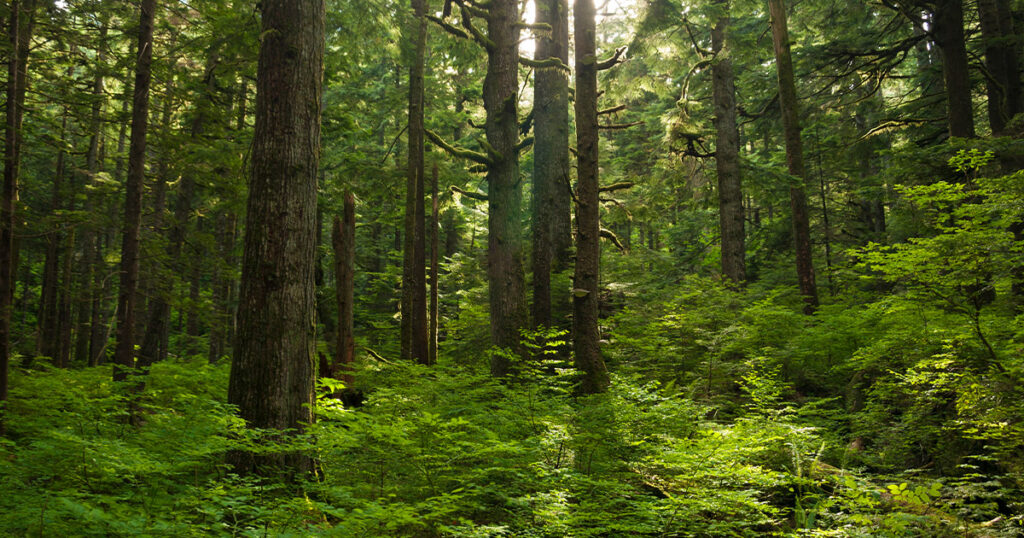
A forest is a profoundly complex network of relationships among water, air, soil, and life forms—trees and other plants, fungi, soil microbes, and animals. The floor of an undisturbed forest, along with the trees, is an immense carbon sink. It stores carbon built up for hundreds or thousands of years. Thus held, the carbon is not warming the air, not aggravating our climate emergency.
In When the Forest Breathes, scientist Suzanne Simard lays out the intricacies of forest dynamics in exquisite detail. This is both an account of the discoveries she and her team are making and a memoir of their lives in the forests of British Columbia, including a mad dash to escape a wildfire and various encounters of the bear and snake kind.
It is a family story, the family comprising her mother, her grown daughters—ecologists-in-training—as well as her colleagues, her beloved graduate students, and members of First Nation peoples (including scientists) such as the Haida. These ancient peoples managed Northwest forests sustainably for thousands of years; ecologically minded non-Native foresters have begun adopting their traditional work processes such as controlled burning and selective logging.
In Simard’s lexicon, trees relate to one another in familial ways (thus the title of her first book, Finding the Mother Tree, diction disparaged as anthropomorphic by some of her fellow scientists). How it works: Interconnected trees depend on mycorrhizal fungi that use extensive hairlike cilia to take carbon from tree roots for their own nourishment but also to pass to other trees. Meanwhile, these fungi carry nutrients from the soil to tree roots.
In nature, trees form neighborhoods and maintain particular interarboreal relationships but not others. For example, in the forests that inform Simard’s work, cedar, maple, and yew transfer carbon back and forth among themselves. But they do not share carbon with fir, hemlock, or pine, which are entangled instead with different fungi.
And consider this: Nutrient-rich paper birch transfers carbon to nutrient-poor Douglas fir. Old Douglas fir transfers carbon to young Douglas fir, more intensely if the saplings are kin. So, familial.
As Simard informs us in her engaging and often personal prose, current industrial logging practices shatter these relationships.
We humans need wood, and Simard does not suggest that logging should cease. But there are better and worse methods. Clearcutting is the worst. And the worst has gotten worse as the logging industry has come to use heavier machinery and more efficient techniques. In the old way of logging, “bole-only” or trunk-only harvesting, hand fallers first delimbed the tree, leaving the branches and crown on the forest floor. Only then was the trunk cut down. Unused logs were also left on the forest floor. They slowly rotted, helping to retain and restore carbon. Also, in the old days, logging machinery was lighter. The system resulted in an
11 percent carbon loss from the forest floor.
Today, forests are more thoroughly cleared, and huge “skidders” haul out entire trees, with unused branches cut off and heaped onto slash piles that are left to rot or burned or processed for the (not necessarily eco-friendly) biofuel industry. Wildfire prevention is part of the rationale. The 50-ton machinery by itself destroys the forest floor, killing (pretty much forever) mosses and lichens and plants. Thus, modern industrial clearcutting results in a 61 percent carbon loss from the forest floor and a 95 percent loss of the aboveground carbon stocks of a mature forest.
And where does this carbon go? It is a greenhouse gas.
There’s even worse news. Simard and her team visited an old-growth cedar and hemlock forest that had been logged in the mid-1800s. In the mid-1990s, the second-growth forest was logged. This clearcut was replaced with a monoculture Sitka spruce plantation, which is now 30 years old. In this “restored” forest,
the understory was too dark for vascular plants, mosses, or lichens to grow. Absent were the slender beaked moss and large leafy moss we’d seen in the old-growth patch earlier that day, as were the ferns and wintergreens. Rainfall could barely penetrate the crowns, leaving the ground dry and covered in bristly brown spruce needles. In the middle of the plantation, the blade of my shovel immediately hit mineral soil [the non-organic soil that lies below the organic soil of a forest floor].
Simard and her colleagues were stunned. Lab tests confirmed that the carbon content of this plantation’s forest floor was a pathetic 20 percent.
Added to such ecological errors is the extensive spraying of glyphosate to kill native shrubs and herbs to make way for more efficient logging. These insults are delivered to forests already struggling with drought and beetle infestation. Biodiversity—from bug to bear to lichen to liverwort—is not even a consideration.
These are grim findings, but there is also news of successful environmental campaigns and ecological progress. Simard’s new book makes for a satisfying read, an essential one for anyone who cares about the future of life on Earth, including our life on Earth.