“Our House,” a 1970 song by Graham Nash, is an ode to the simple, innocent pleasures of domesticity. The house, he sings, is a very fine house, with two cats in the yard. “Life used to be so hard / now everything is easy, because of you.” And how long did that last, you might wonder? Lasting is the hardest thing. Unless it’s a cold—then lasting is assured.
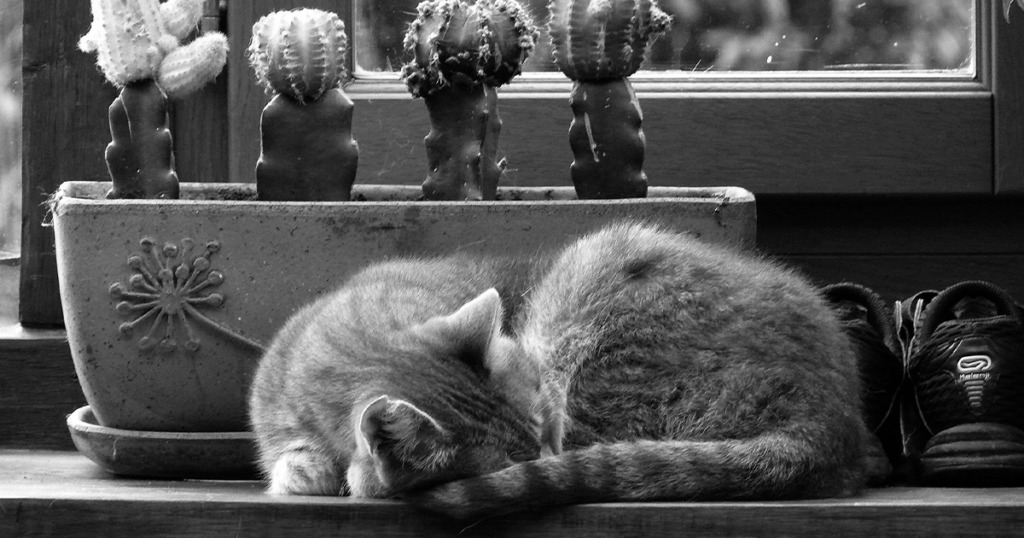
You might also ask yourself—many people do—Now, how many cats was that? Two. Frequently, however, people mishear the number as four, and in questions about the song that appear in online forums, four turns up as often as two. Why is this? Four and two sound enough alike for a person to mistake the two words in a song lyric. But when talking about cats in your yard, isn’t two more common? More expected? More sensible? Yes, which makes four better. I know—I had four cats in my yard, and every night on hearing me drive into the lane and park the car, the four of them appeared from different directions to wait for me. One from the back of the row of houses, one from behind the blue house on the other side, one from the field, one from among the neighbor’s outbuildings.
How many cats have you got? one neighbor or another would ask from time to time. Two? Three?
“Four!” I’d say, pleased with myself, as if I’d had quadruplets when the obstetrician had predicted twins. Fooled everyone! Not two, not three. I had four cats in my yard, and I was proud of that.
If I had set out to acquire this many, not pride but discomfit would have described my demeanor. Why so many? Is that necessary? is what I would fear my neighbors might wonder. The way people with four children might field looks from couples with more modest broods. “But we didn’t ask for four!” the harried parents might say. No—four was visited upon them, almost in the way of a test. God does not give you more than you can handle, such parents might have to remind themselves at difficult moments. “We can do this.” In Spain, which offers aid to familias numerosas, meaning essentially big families, you can do it more easily than other places. But cats are not kids. For gatos numerosos, no help at all, just the surprise of neighbors, to which I would respond that I did not choose the cats—they chose me.
Besides, what trouble are they? Give and give, and it’s never enough for the children. But the cats? They make you want to tempt them with your tasty goodies, your trinkets. And then they barely acknowledge the offering—a toy, a spoonful of yoghurt in a bowl, a soft pillow for a nap. They yawn and turn aside.
The sight of four cats emerging from their various redoubts to meet me was like a perfect dream. It lasted all one spring. As I strode along the quiet lane to my house, the cats in tow, I felt not like a queen but like an explorer home from the hills, ready to report to the troops left guarding the camp. “Everything calm here?” I questioned. One rubbed against my leg, one waited at the door, one skittered back and forth between a flower pot and a lawn chair, and one crouched on the metal table in the patio while I brandished my key. Not exactly a family, not just pals, more than neighbors. A detail, perhaps, each cat given its own food bowl and assigned its spot in the sun to guard. “Here we go,” I said, and let us all in.
But by the following fall, one of the troops was sick, the last comer, a slinky black cat I named Blackie. He had appeared the fall before, a young male, vociferous in his demands to be noticed. (So much for my assertion that the cats never asked for anything.) At first, it seemed like he had a cold, but then he lost his appetite. I took him to the vet several times, but nothing helped. Finally, Blackie tested positive for feline leukemia, a death sentence, as I could see from the vet’s heavy sad face. Gentle as always, he stroked Blackie’s head and told me different cats suffer the disease differently. He shrugged helplessly. “We’ll see,” he said. But by then, it was clear Blackie was not the kind to shake it off. He died the following February, on a gray winter’s day, from an injection the vet gave him.
Charlie was my orange tabby, my young prince, my rescue cat. I literally pulled him from the jaws of my two dogs after they found him hiding in the bushes along the river trail, far from any house. He was a kitten but soon became a ravenous cat, eating up the others’ food if they didn’t watch out. Ella and her brother Louie were the other two—older, more measured in their play and their sleep than the two youngsters, who were the same age and great friends. Charlie also got a cold and lost his appetite in the fall, but recovered. Seemingly saved by his own sturdy constitution.
Then one January morning, I opened the door to him, and instead of hopping over the sill, he maneuvered over it, half crawling, half sliding. He came in backwards because he was dragging something with him. I was slow to understand, but then I saw what he was pulling over the threshold—his own shoulder and leg, crushed and loose in his skin, like sticks in a sock. He did not meow or complain, not even when I gathered him up. My poor Charlie. The vet was alone in the clinic when I went in. How could this have happened? The vet’s guess was Charlie had probably been hit by a car. He said a young cat with no front leg and no shoulder was at a terrible disadvantage, and he showed where he would have to amputate. If Charlie had been otherwise healthy, we might have gone ahead with the operation, but he had also contracted a serious virus, so we put him down. He was the first of the four cats to die, but Blackie soon joined him. I was back to my original two cats.
From the moment I came home after burying Blackie, Ella seemed to sicken. It was hard to understand—after six months of frequent vet visits with Blackie and, in the middle of that saga, the disaster of Charlie’s accident, I had forgotten that I had two other battle fronts to protect, Ella and Louie, and here Ella had already suffered an attack by the time I was brushing the dirt from my fingers and putting away the shovel for the second time that winter.
What’s wrong with her? I asked the vet. Again he gave a sad shrug. It turned out she had the same virus as Charlie, and it had struck her hard, affecting her gums and teeth. Pain killers and corticoids helped, temporarily, but had their side effects. Ella held on, from treatment to treatment, for a year and a half. The last visit to the vet was on a Saturday morning in September. The other vet, Sonia, was there, not Claudio, and she nearly talked me into pulling all of Ella’s teeth in a mad attempt to save her. But save her for how long? Then blood tests revealed that it was too late for that. Her organs were essentially destroyed from the previous treatments.
Three cats down, one left.
Cuatro gatos—a Spanish phrase to talk about some random people, no one of consequence. Just four cats. My cats were by anyone else’s judgment just four cats, animals of no significance. A few nobodies. Except no—not just a few but a detail, a team, almost as good as a family. Not nobodies at all. How I miss my troupe of four, emerging from the shadows along the lane to join me center stage. How briefly they played their parts. As my mother said of the deaths of three partners, with each one it gets a little easier. But does it, or are we just a little less likely with each loss to complain about our pain? A little more likely to shake our heads, as if it were all a dream. (Such a dream!) A little more resigned to suffer like Charlie—as quietly as possible, just glad, one last time, to be home again.