
Fractured Odysseus
The psychiatrist Jonathan Shay’s books on Homer are the key to Christopher Nolan’s Odyssey
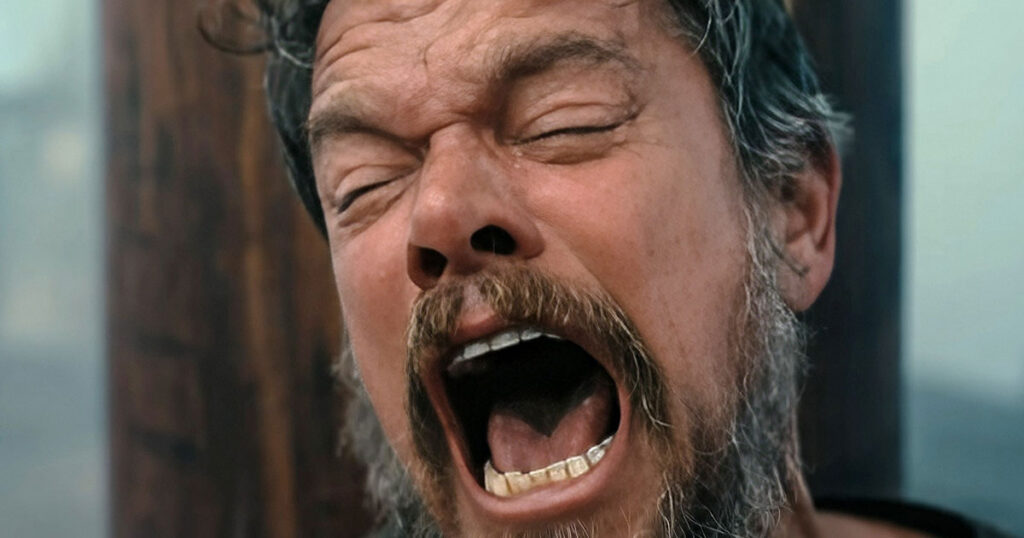
Why does Odysseus weep? Seated as a guest of the Phaeacians, the wandering hero in disguise is treated to a feast, followed by entertainment: a bard regaling the audience with the story of Trojan War. As the singer tells of Odysseus’s heroism and his creation of the fabled wooden horse, the Phaeacian king Alcinous notices that his guest (in Daniel Mendelsohn’s translation) has “dissolved into tears that drenched the cheeks beneath his lids. Just as a woman would weep while embracing a beloved husband.” Stopping the bard, Alcinous proclaims of Odysseus that “some terrible anguish must have overwhelmed his heart”—but what? Is it grief for his fallen comrades? Longing for his home Ithaca, for his wife and son? Or horror at what he witnessed at Troy?
If there is a striking (and, for some, unexpected) aspect to Matt Damon’s portrayal of Odysseus in Christopher Nolan’s adaptation of The Odyssey, it is his explicit embodiment of Post-Traumatic Stress Disorder (PTSD). Hardly the unflappable mythical hero many of us remember, Damon’s Odysseus is haunted by what he’s seen in war, and haunted by his own culpability.
Of all the Homeric translators and commentators over the millennia, Nolan seems most explicitly in dialogue with Jonathan Shay, a psychiatrist who discovered the therapeutic value of reading The Iliad with Vietnam veterans. Through his clinical practice, Shay came to believe that Homer’s Achilles is suffering from all the symptoms of complex PTSD as we now recognize it. But unlike the American military, Greek culture had numerous cultural means of treating this trauma that have since been either lost or actively suppressed.
From that experience came Shay’s 1994 book Achilles in Vietnam: Combat Trauma and the Undoing of Character. Shay pinpoints the beginning of Achilles’s suffering—what he would come to call his “moral injury”—to when Agamemnon betrays him (paralleling how many Vietnam vets felt betrayed by their government). “When a leader destroys the legitimacy of the army’s moral order by betraying ‘what is right,’” Shay writes, “he inflicts manifold injuries on his men. The Iliad is a story of these immediate and devastating consequences.” Numbed by wrath, Achilles turns his back on the fellow Greeks for whom he formerly cared deeply. In this compromised state, the death of Pátroklos destroys him, engendering a berserker rage in which he desecrates the corpses of his fallen enemies, unable to control himself or observe the traditional laws of war.
For Shay, “The Iliad is the tragedy of Achilles’ noble character brought to ruin—moral ruin in his own terms … Achilles’ moral unluckiness, his tragedy, was that events—simply what happened—created the desire to do things that he himself regarded as bad.” It is something he found again and again in the American veterans he was treating. One of Shay’s patients, for example, was horrified by the barbarity he saw when he first arrived in Vietnam, but soon found himself participating in those same atrocities, benumbed and broken. Another became totally focused on revenge, even after returning home (“I lost all my friends, beat up my sister, went after my father,” he confessed.) While at war, they were taught to channel whatever emotion they had left (grief, sorrow, self-loathing) into a kind of berserker rage to be turned against a dehumanized enemy.
Unlike these men, Achilles at least has the means to cope with some of this trauma. “An American soldier who wept for a fallen friend was warned not to ‘lose it’ and to ‘get your mind straight,’” Shay relates, unlike the Greeks who openly weep and perform elaborate funeral rites throughout Homer’s epics. The contrast proved illuminating for many veterans. Walking traumatized soldiers through a reading of The Iliad, Shay found, helped them work through much of their own trauma by emphasizing mutual respect toward the enemy, recognition of the damage done by unjust superiors, and the importance of active griefwork for one’s fallen comrades.
In 2002, Shay published Odysseus in America: Combat Trauma and the Trials of Homecoming, which focused on the perils combat veterans faced reintegrating into civilian life. It was something the ancient Greeks seemed to understand well: After all, of the great Greek heroes who see combat in The Iliad—Achilles, Odysseus, Agamemnon, Ajax, Menelaus, and Diomedes—only the last two make it home unscathed and untroubled. Ajax was famously second only to Achilles as the most powerful fighter in the Greek army, but upon his return went mad and ultimately committed suicide—as clear an indication as any that the experience of war had irrevocably damaged him (in Hades he’s still traumatized, refusing even to speak to Odysseus). Homer’s audience, in other words, was acutely aware that homecoming—nostos—was a fraught endeavor, and the reintegration of the soldier into peacetime life was not to be taken lightly. If The Odyssey has survived and endured while so many other oral epics were lost, it is in no small part because it was—and still remains—the work of literature most seriously engaged with the question of how to reintegrate a damaged, troubled soldier back into civilian life.
Shay reads Odysseus’s fantastic journey, with its monsters and goddesses, as an allegory for the series of problems that beset returning veterans. Odysseus’s first act after Troy is to raid Ismarus: Unable to let the war go, Odysseus, like numerous vets, “simply remains in combat mode, although not necessarily against the original enemy.” From there he and his men engage in numerous self-destructive behaviors, from drug addiction (amid the Lotus eaters) to sexual dependency (with Circe and Calypso), to thrill-seeking behavior (the needless risks they take on Polyphemus’s island). “I see the adventure with the Cyclops as an emblem for combat veterans’ attraction to danger,” Shay writes, “an attraction that has cost so many of them their lives after returning home, and tortured those who love them with untold hours of fear for their safety.”
And yet, Odysseus himself does not exhibit any of the symptoms that Achilles does. He shows an almost complete absence of moral pain, guilt, or self-reproach, and seems to lack any real sense of self-criticism. He is not beset by unwanted memories or flashbacks, nor does he exhibit avoidance behavior. At least according to the diagnostic criteria set forth by the American Psychiatric Association, Shay concludes, Homer’s Odysseus does not qualify as traumatized. His actions are haunting, but he himself seems unhaunted.
Matt Damon’s portrayal of Odysseus in Christopher Nolan’s adaptation brings the hero’s internal psychological state in line with his actions: He is explicitly scarred by his participation in the Trojan war and his later war crimes. His subsequent wanderings become more explicitly symptomatic of a man whose mind has been broken by the horrors of war. The rapid back-and-forth timeline cuts characteristic of Nolan’s work are here more akin to flashbacks, even as key memories are suppressed until later in the film.
Odysseus’s behavior in Nolan’s film, too, is more explicitly aligned with the actions Shay describes his patients exhibiting. In Homer’s epic, it is Polyphemus who refuses to host Odysseus and his men as guests, breaking the laws of hospitality and attacking them instead; the ploy to blind him as a means of escape is thus both justified and crafty. But in Nolan’s film, once they’ve escaped, Odysseus turns one last time and fires an arrow into the Cyclops’s already wounded eye. Arbitrary, churlish, and entirely devoid of any emotion, Matt Damon shoots his bow like a bored child trying to hurt a stray cat. The scene echoes an anecdote from one of Shay’s patients who, upon returning from Vietnam, punched his sister’s husband in the head while passing him in the house. As he told Shay, “I just wanted to see what happened.”
In Nolan’s film, nearly every heroic or crafty action by Odysseus is countered by a mean or pointless one. He is constantly castigated for his failure to honor the dead, for which he offers only self-serving justifications and dismissals. (“He died helping us escape,” he says of one fallen comrade. “We honor him by escaping.”) His is less a hero’s journey and more the antisocial wanderings of someone ill-prepared to return to civilian life. The encounter with the Laestrygonians is rendered briefly in the film, but it captures the flip side of Odysseus’ heroism and cunning, showing a directionless leader who takes his hungry, wasted men into slaughter without any sense of purpose or even awareness of what’s happening. Flailing, lashing out without reason or direction, and entirely at war with his own mind, Odysseus is a protagonist with whom we are invited to identify and empathize, it seems, only so that his failures sting more deeply. Every decision he makes is another version of Scylla and Charybdis: there is no correct choice, only a question of how much damage will be inflicted.
In following Shay’s advice to listen to combat veterans as a way of making sense of Homeric epics, what also emerges is a more complicated reading of Nolan’s film itself. What Shay became most known for was the concept of “moral injury” (which contributed to his winning a MacArthur Foundation “Genius” grant in 2007), and it is this idea of a breakdown in the moral order that drives much of his reading of Homer. As Shay writes in Odysseus in America, “I regard the ethical use of power to be one key to prevention of psychological injury, particularly complex PTSD and deformed thumos [“spirit”]. Simply, ethics and justice are preventive psychiatry.”
As noted by Amy S. Badura-Brack, a psychologist at Creighton University who studies PTSD and works with recovering veterans, not everyone with PTSD “experiences moral injury, and not all types of moral injury induce PTSD. But the two can overlap, particularly when someone violates their deeply held moral beliefs in a way that’s connected to a profound sense of guilt or shame.” In her reading of the film, Badura-Brack argues that although Damon’s Odysseus clearly suffers from both, it is his sense of moral injury (perpetrated not by his commander Agamemnon, but by himself) that chiefly drives the arc of the film. His wanderings are not a fantastic journey driven by the gods but a self-imposed exile that’s evocative, she observes, “of the social alienation that’s so prevalent among sufferers of moral injury”—a social alienation born of an overwhelming sense that the world before Troy is gone for good.
It is this breakdown in moral order, and the subsequent moral injury of its protagonists, that seems to define Nolan’s film above all. In her review in the London Review of Books, Emily Wilson knocks a number of internal contradictions in the film, arguing that its “own values and vision don’t hang together,” and its characters’ “motivations don’t make sense on their own terms.” She criticizes Nolan for sending mixed messages about, among other things, Odysseus’s fabled trickery (“Slaughtering people with the help of trickery, technology and weapons is presented as bad when the Greeks are killing the Trojans, who have violated xenia, but good when Odysseus is killing the suitors, who have violated xenia”), hospitality (“Strangers in Ithaca are to be treated with gracious kindness, as possible gods in disguise; but strangers in foreign lands are usually monstrous, to be blinded, robbed and slaughtered”), and divinity (“Defying the gods is noble and brave when Odysseus blinds Polyphemus, son of Poseidon; it’s stupid and greedy when Eurylochus eats the Cattle of the Sun”). Wilson argues that any one of these “moral contradictions could make for an interesting and generative theme in a movie, but Nolan lets the fragments of an incomplete set of big ideas spin around in the epic whirlpool, with no plank of solid, specific human experience to which we might cling.”
But reading the symptoms of moral injury in Achilles and Odysseus suggests how even Homer’s audience understood that the Trojan War resulted in a fundamental breakdown in comprehensible order. Via Shay’s reading of Homer, in other words, one might see Nolan’s Odyssey as less the result of confused filmmaking and more filmmaking that depicts a confused world. There is no solid plank to cling to because the world Odysseus moves through has broken down almost entirely—not unlike our own in 2026. The message is incoherent and fractured in no small part because the moral stability of the old world has failed.
None of this to say that Nolan’s film is without flaws. (Nolan’s female characters remain, as always, embarrassingly underwritten, to choose just one example.) But it seems perhaps counterproductive to pick The Odyssey apart for being incoherent when we’re adrift in an age of incoherence, and what we need now more than anything are the tools to help us make sense of how to act during such confounding times. Betrayed by leaders, made witness to an endless litany of crimes and atrocities that many of us feel powerless to stop while still being racked with guilt—ours is a world of near-constant moral injury. Art that responds to such times cannot succeed by presenting a solid vision of the world or characters whose actions are uncomplicated. Enduring art does not give you easy answers; it poses impossible problems and gives you the strength to attempt to answer them, knowing full well any possible solution will be inadequate. It’s by this criteria—rather than any kind of internal coherence—that a work like The Odyssey should be judged.
No one was more aware of this than the poet himself. One of Shay’s most illuminating comments in Odysseus in America is his reminder of what song the Sirens actually sing in Homer’s epic. It is not, as we so often assume, a song of sexual seduction. It is instead the true story of the war, the thing that Odysseus (and every veteran) wants most—a meaningful narrative of what has happened. For they know, in Pietro Pucci’s translation, “everything that the Greeks and Trojans did and suffered in wide Troy.” It is this full and complete knowledge of the war that the Sirens use to try to entice Odysseus to their shores and to his own death. The Sirens offer everything, the complete and total picture—and this is precisely the most alluring thing one can be offered, and also the most deadly. They offer, in Shay’s words, “truth as deadly addiction,” showing us “that returning veterans face a characteristic peril, a risk of dying from the obsession to know the complete and final truth of what they and the enemy did and suffered in their war and why.” The trap here is not in erotic longing, but in longing for narrative coherency, finality, closure.
But as Tim O’Brien wrote in his 1990 collection of Vietnam stories, The Things They Carried, there is no such narrative closure, not when it comes to war. “A true war story is never moral,” he writes. “It does not instruct, nor encourage virtue, nor suggest models of proper human behavior, nor restrain men from doing the things they have always done. If at the end of a war story you feel uplifted, or if you feel that some small bit of rectitude has been salvaged from the larger waste, then you have been made the victim of a very old and terrible lie.”
To demand of a war film that its values and visions must cohere together, then, is to succumb once again to that old and terrible lie. In times of increasing lawlessness, when the moral order has broken down, Homer’s epics show not uncomplicated heroics, but rather how heroic individuals respond to moral injury and the waste of the world. And by being honest about that reality—showing us these great figures angry, confused, and broken, making poor choices as well as strong ones—they wrestle with how to act and how to live in uncertain times.
And perhaps this is the reason we always return to The Odyssey. As O’Brien writes, “You can tell a true war story by the way it never seems to end. Not then, not ever.” Odysseus’s story, too, never really ends: He’s still out there, along with an endless mass of other combat veterans, all trying to find a way home. And this is why we keep telling versions of that story over and over, again and again: to help them return. We argue over who got it right, who got it wrong, and then we try to tell it one more time—a little differently, a little better—hoping to bring them a little closer.