
God on the Syllabus
A century after Bryan took on Darrow, battles over public school curricula rage on
The Hundred Years’ Trial: Law, Evolution, and the Long Shadow of Scopes v. Tennessee by Alexander Gouzoules and Harold Gouzoules; Johns Hopkins University Press, 337 pp., $32.95
In 1923, the U.S. Supreme Court heard oral arguments in Meyer v. Nebraska, which considered a law that banned all non–English-language instruction in public schools prior to eighth grade. In a seven-to-two ruling, the Court struck the statute down, on the grounds that it violated the right of educators to teach as they saw fit.
Although the case touched on hot-button topics like immigration, almost no one remembers Meyer today. In contrast, consider a case that arose two years later and hinged on the same issue—the pedagogical freedom of public school teachers. Despite never reaching the Supreme Court, this case became the subject of worldwide fascination. Even today, it’s probably the most famous nonfederal case in American history. And as Alexander and Harold Gouzoules demonstrate in The Hundred Years’ Trial, the so-called Scopes Monkey Trial remains depressingly relevant.
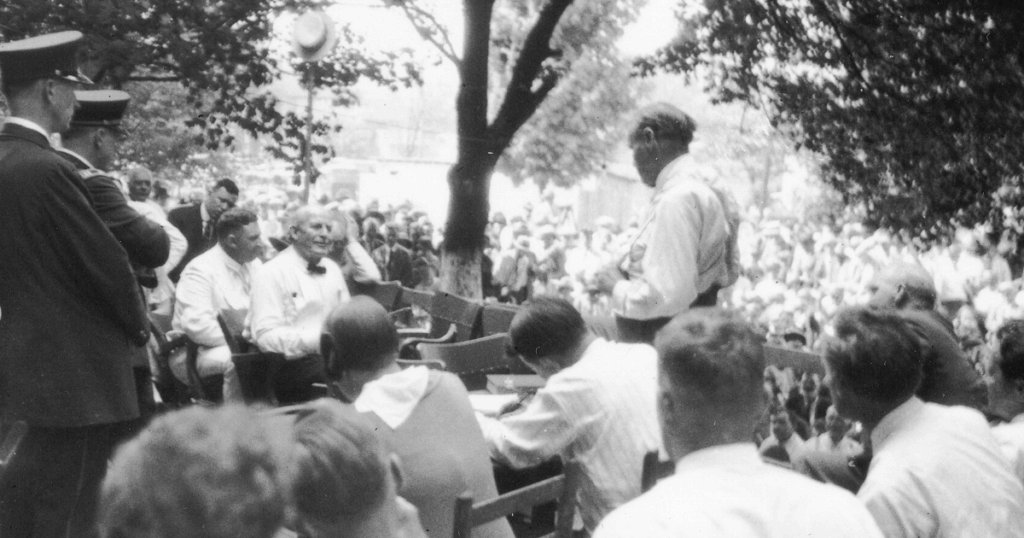
The case began when John Scopes, a 24-year-old teacher in Dayton, Tennessee, violated a state law banning the teaching of evolution in public schools. Local officials decided to prosecute and brought on the fundamentalist Christian and three-time presidential nominee William Jennings Bryan to help. Scopes’s team countered with the famed litigator and religious agnostic Clarence Darrow.
Rather than present a blow-by-blow account of the trial, Alexander Gouzoules, a University of Missouri constitutional scholar, and his father, Harold, an Emory University biologist, analyze the legal strategies used during Tennessee v. Scopes, as well as its outsize legacy. It represents “a crucial juncture in the American narrative,” they argue, a clash over “morality, democracy, education, and the role of religion in American life.”
The book’s opening chapters rehash familiar stories about the fraught reception of Charles Darwin’s On the Origin of Species and the rediscovery of Gregor Mendel’s laws of inheritance after decades of neglect. More originally, the authors demonstrate how foes of evolution took advantage of turbulence among biologists in the 1920s to advance their agenda. It’s often forgotten today, but many biologists at the time had lost faith in Darwin, whose theory of natural selection seemed too slow and clumsy to account for the abundance of complex life on Earth. Mendel’s theory of genes—which emphasized mutations and big leaps—seemed to offer a better explanation. To be sure, no biologists denied the reality of evolution per se. But they bickered, heatedly, about the pace of evolutionary change and the mechanisms driving it.
Unfortunately, the public misinterpreted these arguments, casting them as “uncertainty or weakness in the foundational principles of evolution,” the Gouzouleses write. This gave a handful of southern legislatures the cover to pass anti-evolution laws. If biologists themselves didn’t understand evolution, how could they justify forcing it on children?
Scopes was ultimately found guilty and fined $100. But the conviction proved pyrrhic, as Dayton was roundly mocked in the press. Plus, in the decade after Scopes, biologists reconciled natural selection with Mendel’s genetics, an achievement known as the modern synthesis. And with biology in harmony at last, foes of evolution beat a retreat: They mounted no other legal challenges to teaching it over the next three decades. By 1960, two legal scholars could crow that the days when “religious group[s] could muster political power for an outright suppression of the teaching of science” had passed.
If only. In the 1960s, the consensus over the modern synthesis began to crack. A theory called punctuated equilibrium, which proposed that evolution proceeds by jumps, reignited arguments about the tempo of biological change. (The opponents in warring camps referred to each other’s positions as “evolution by jerks” versus “evolution by creeps.”) Fights over the theories of symbiogenesis and sociobiology caused even more uproar. Again, no biologists denied the reality of evolution, but outsiders seized on disagreements over the details as fatal flaws in the very concept of human beings’ evolving from apes. A flood of challenges to the teaching of evolution followed, and every decade since the 1950s has seen legal showdowns on the topic.
Still, these cases were not simple sequels to Scopes. Rather than make the teaching of evolution a criminal act, foes invented the “science” of intelligent design and passed laws that required teaching it in parallel to evolution. Ironically, despite the lack of criminal penalties in these laws, those who challenged them faced far more danger outside the courtroom than their counterparts did years earlier. Litigants in one case received death threats, and one judge required protection from U.S. marshals.
In addition to the historical inquiry, The Hundred Years’ Trial surveys the status and role of science in the judiciary today. It’s a disheartening picture. The authors speak of an outright estrangement between the fields, given that justices regularly rule against scientific consensus if not ignore science completely. The Supreme Court also recently gutted a 1971 legal test on separating church and state (the Lemon test), a ruling that helped strike down most challenges to teaching intelligent design in schools in the past.
Worse could be coming. The most influential branch of constitutional law today, originalism, analyzes issues through the lens of what the framers of the Constitution intended in penning certain passages. Since for all intents and purposes, neither public schools nor evolutionary biology existed in the 1700s, the court could, the Gouzouleses write, rule that no “meaningful restrictions [exist] on a state’s legislative power to inject religion into public schools.” (Reading this, I found myself hissing, “Don’t give them ideas!”)
In some ways, however, it’s spurious to blame the courts. However poorly the judiciary handles science, its conclusions simply reflect what many Americans desire. “For significant progress to be made,” the Gouzouleses conclude, “it is ultimately the general public that must, somehow, receive the message. Until then, the hundred years’ trial will continue.”