
‘In the Presence of People No Longer Here’
Historians in the Ukrainian city of Lviv are documenting the horrors of the past while living in the shadow of war
The city is an architectural gem, almost a stage set. Unlike much of Europe, it suffered no major damage during either world war. Proud rows of 19th-century buildings line cobblestone streets that wind through low hills, past leafy parks and dozens of sidewalk cafés. Modern apartment blocks ring its outskirts, but most of the city looks much as it did when it was part of the Austro-Hungarian Empire.
The walls of a restaurant near City Hall are hung with dozens of brilliant caricatures—profiles captured in a few skillful strokes: a pot belly, an oversize cigar, a long beard, a fastidious hand poised on a tabletop, a preposterously upturned mustache. The subjects were all members of the provincial legislature, which in the last decades of Habsburg rule met here in an august chamber that is now a university auditorium. On the dial of a tall iron radiator in a downtown office building, the writing is in German. A grand opera house is topped with winged statues, and an array of churches and cathedrals—Roman Catholic, Greek Catholic, Armenian, and Orthodox—still look much as they did when listed in an 1887 Baedeker guidebook. So does the palatial railway station that, for many travelers , was once a departure point for the long journey to Ellis Island. On the heights of these buildings is a wondrous galaxy of turrets, spires, gargoyles, and finials. Below them are wrought-iron balconies, from which one imagines men in top hats and women with parasols looking down through pince-nez or lorgnette at plumed lancers on parade. At the four corners of City Hall (1835) are fountains (1793) with statues of mythological figures like Adonis and Neptune. They serve as rendezvous points: “I’ll meet you at Neptune at five o’clock.” But today Neptune and his companions are boarded up, the cathedrals have sheet metal over their stained glass, and the ground-floor windows of City Hall are sandbagged. For this is Lviv, in western Ukraine. Although an occasional building is scarred by a drone strike, Lviv has so far been largely spared the nightly attacks raining destruction on other parts of this beleaguered country.
There is one somber difference, however, between Lviv and similarly well-preserved cities in Western Europe. When you see such splendid older buildings, you assume that many of the people living in them are descendants of those who lived there a century or two ago. But not in Lviv. During and just after the Second World War, almost the entire population was slaughtered, was deported, or fled the advancing army of one side or the other.
Over the course of the 20th century, Lviv found itself in four different countries. As part of Austria-Hungary, it was known as Lemberg. Between the wars, it was Lwów in newly formed Poland. In 1945, the Yalta and Potsdam agreements moved Poland (“a country on wheels,” the Poles say) several hundred miles west, and the city was absorbed by the Soviet Union. Since 1991, it has appeared on maps as Lviv, in independent Ukraine. And that’s not even counting its seizure by Stalin’s Red Army from 1939 to 1941, followed by three years of Nazi occupation. Conquerors imposed their own place names (Adolf Hitler Square, Gorky Street) and time zones: The city ran on Berlin time under the Nazis and Moscow time under the Soviets.
Some who once lived here had a foreboding. “We were like ants bustling in an anthill over which the heel of a boot is raised,” wrote the Polish science-fiction novelist Stanisław Lem, who grew up here in the 1920s and ’30s. “Some saw its shadow … but everyone, the uneasy included, ran about their usual business until the very last minute.”
When that boot heel came down, the city’s buildings remained, but its people did not. Until Hitler invaded, just over half of its inhabitants were Polish, roughly a third Jewish, and some 15 percent Ukrainian. But after the Nazis arrived in 1941, they killed almost all of the Jews. Lem—himself Jewish but carrying forged “Aryan papers”—later described the streets of a Jewish neighborhood that “one day were empty, silent, their windows open and curtains moving in the wind.” On one street, Jewish bodies hung from those wrought-iron balconies.
Once the war ended, millions of people in Central and Eastern Europe were forcibly moved. Stalin expelled almost all Poles from his expanded Soviet Union, and newly Communist Poland did the same for almost all Ukrainians. The Poles who lived in Lviv were sent hundreds of miles away, to a swath of Germany given to Poland after the war, from which Germans were expelled. Meanwhile, Lviv and its surroundings were repopulated with hundreds of thousands of Ukrainians.
And yet, during the time Lviv was part of the Soviet Union—nearly half a century—there was almost no public discussion of all this. “I was born in 1979, so I remember those typical lectures about history in Soviet schools,” says Inna Zolotar, a public history educator in Lviv. “We were told about the great battles of the Red Army, nothing about local history. But between people, you know, very quietly, we understood that something happened that you are not allowed to talk about.”
Soviet schools ignored the Holocaust: The Nazis were mass murderers, teachers explained, but their victims were brave Soviet patriots of many ethnicities. And those massive postwar deportations were merely a matter of “repatriating” different peoples to their historical homelands. Much else went unmentioned as well—including, for instance, Lviv’s unusual place in legal history. In his intriguing East West Street, British author Philippe Sands tells how two of the greatest figures of human rights law—Raphael Lemkin, who developed the concept of genocide, and Hersch Lauterpacht, who did the same for crimes against humanity—both began their careers here.
“We are living,” says Sofia Dyak, a Lviv historian, “in the presence of people no longer here.”
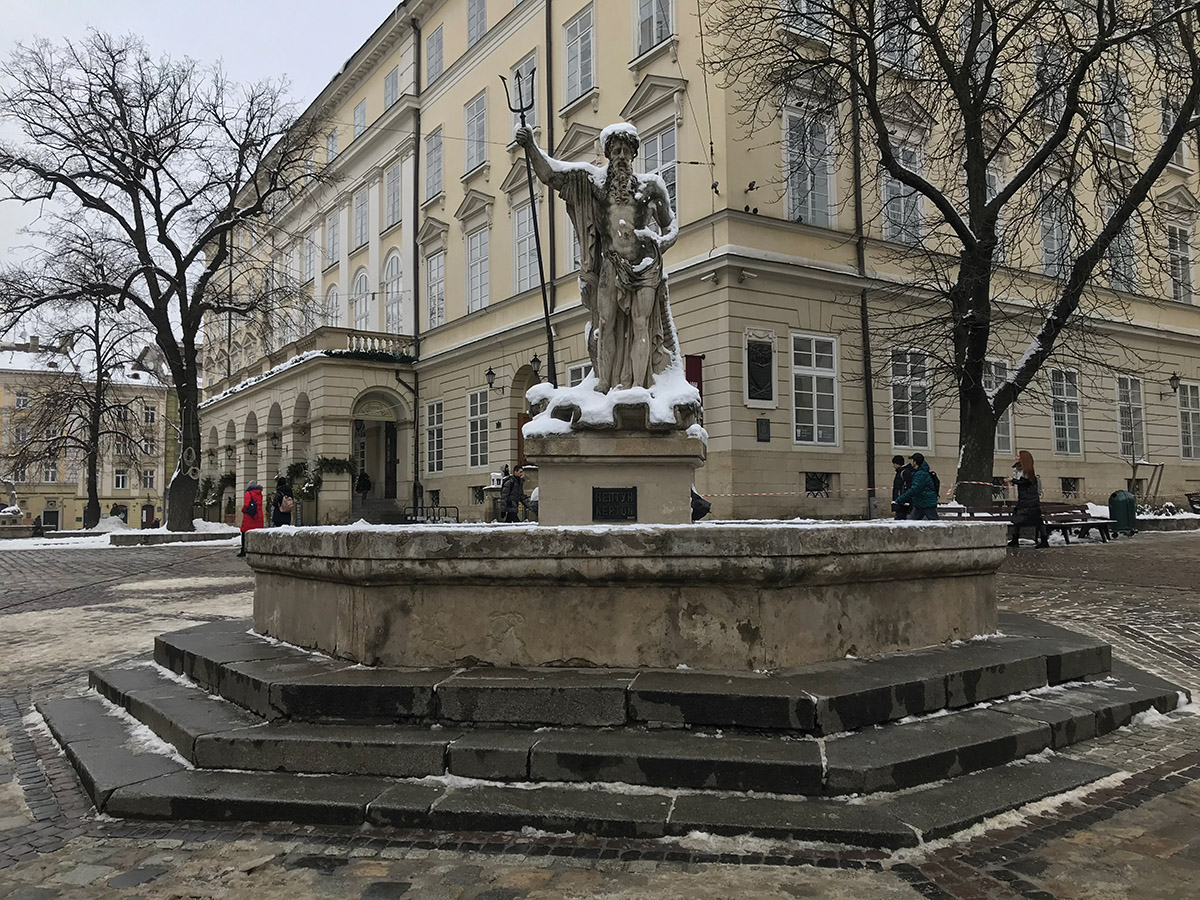
In central Lviv, a 1793 fountain featuring a statue of Neptune, which, since the Russian invasion, has been boarded up (Courtesy of the Center for Urban History)
Both Zolotar and Dyak work at Lviv’s Center for Urban History of East Central Europe. In a world full of people actively suppressing history—whether Vladimir Putin’s whitewashing of Joseph Stalin or the wiping of references to the civil rights movement from U.S. government websites—the center’s work of dealing with thorny parts of the past has a relevant echo for us all.
Dyak, a thoughtful woman in her mid-40s with immense energy and an infectious laugh, is the executive director. Like many of her colleagues, she is at home in English, Polish, Russian, and her native Ukrainian, and she reads one or two other languages as well. The center’s 32-person staff consists largely of women, since Ukraine’s army has taken many of the men. In its quarters on a quiet side street, a resident cat is curled up in a box at the receptionist’s desk. The center was opened in 2006 by Harald Binder, a Swiss philanthropist, who continues to support it; it also receives grants from Ukrainian and European Union sources.
The members of its staff write scholarly books and articles, but they are equally devoted to doing public history. They help design plaques and museum exhibits, prepare lesson plans for high school and university classes, and train guides to lead walking tours of Lviv. Above all, they have put a stream of skillfully presented material on the center’s website. Several hundred thousand people a year visit this online museum, which features oral histories from across the decades, old newsreels, underground poetry from Soviet times, testimonies from veterans of Ukraine’s 2004 Orange Revolution and 2013–2014 Euromaidan uprising, and a chart of where Lviv’s writers lived in 1939, before they were imprisoned, deported, or killed. There are directories of long-vanished newspapers and magazines and a map that lets you click on hundreds of buildings to see who lived there in decades past and what work they did. You can view all these tens of thousands of pages in both Ukrainian and English.
One electronic gateway into the past, for instance, is a richly layered portrait of the city more than a century ago, as seen through the lives of three women: a post office clerk, a housemaid, and a pianist and conductor. Photographs show streets full of horse-drawn carts, solemn family group portraits, and stairwells in a wealthy household—a wide staircase for the family, a narrow one in the back for servants. Letters, diaries, infant mortality data (the pianist lost a baby), and newspaper pages of the matrimonial advertisements that the postal worker joked about flesh out the lives of the women.
The maid left no words of her own, but a picture of her emerges from the diary and letters of her employer, who complains about the “fanatical piety” that makes her neglect her household work to sing in her church’s choir, sometimes twice a day. His mention of the maid’s many “admirers” suggests additional motives for singing in the choir. A map shows her route from house to church. The pianist married into a well-off family and left more of a record; the section about her includes a recording of a piano piece her musician son composed in her memory.
All three women probably considered themselves to be Ukrainian, but their lives show how inadequate such distinctions are. The postal worker’s father was a Ukrainian Greek Catholic; her Polish-speaking mother was a Jewish convert to Roman Catholicism. The pianist spoke Ukrainian with her husband and children, but her parents were apparently more literate in Polish—the language, under the Habsburgs, of the provincial government and upward mobility. It is no wonder that the novelist Joseph Roth, who was born nearby and lived here briefly, called Lviv a city of “blurred boundaries.” Perhaps, at their best, all cities are that.
How else do you remember the “people no longer here”?
Some are remembered in stone, a few minutes’ walk from the center. You have to think carefully about what you engrave, Dyak warns, with a smile and raised eyebrow, because it will still be here 50 years from now. The smallest public square in Lviv is a lovely, quiet space where old buildings look down on chairs, shrubbery, and shade trees. At its center is a fountain. More than a century ago, this was a well for people in nearby houses or apartments with no running water.
Who were they? Working from city directories from the 1880s onward, researchers gathered the names and occupations of several dozen people who lived within a block or two of this square. These are engraved on a broad stone bench that surrounds the fountain. Just the first name and job: Abraham, theater director; Mykhailo, tailor; Valenty, printer; Marja, laundry owner; Rozalla, midwife. Other professions range from dentist to teacher to seamstress to chimney sweep. Usually, to have your name engraved on a monument, Dyak explains, you “have to be either famous or killed.” Possibly some of these people were later killed by the Nazis or Soviets, but none were famous. Many names are Jewish, since this square is in what was once the Jewish quarter. But some are Ukrainian or Polish—and the latter, too, of course, are no longer here. Strikingly, these names and occupations are engraved in all three languages spoken in Lviv a century ago—Polish, Yiddish, and Ukrainian—which means three alphabets: Roman, Hebrew, and Cyrillic. It is hard to imagine a more graceful, understated elegy to the city’s rich multicultural past.
It is a past with dark chapters, however, and not all of them can be blamed entirely on Berlin and Moscow.
After Hitler and Stalin divided up Eastern Europe in 1939, the Soviets occupied Lviv. When Hitler attacked his former ally in June 1941, German troops advanced so rapidly that Stalin’s secret police had no time to evacuate the several thousand political prisoners held in Lviv. Before retreating eastward, Soviet forces executed almost all of them. The stench of rotting bodies filled the air.
The arriving Germans then forced Jews, at gunpoint, to carry the corpses from the prisons into the street, where local people could identify the dead. The Nazi occupiers blamed “Jewish Bolsheviks” for the killings. Then, appealing to long-prevalent anti-Semitism, they encouraged the city’s Ukrainians and Poles to join them in shooting and beating to death thousands of Jews over the course of several days. And all this happened even before the Nazis set up their usual extermination apparatus: a ghetto and a death camp. These would soon follow.
The Center for Urban History has meticulously documented this horrific episode online, with material from victims, eyewitnesses, and perpetrators. The 1941 Lviv pogrom is one of the most abundantly recorded episodes of the Holocaust. The German army was sweeping toward Moscow as Soviet soldiers surrendered by the millions and the triumphant Nazis were eager to demonstrate that people in the areas they conquered shared their venom toward Communists and Jews.
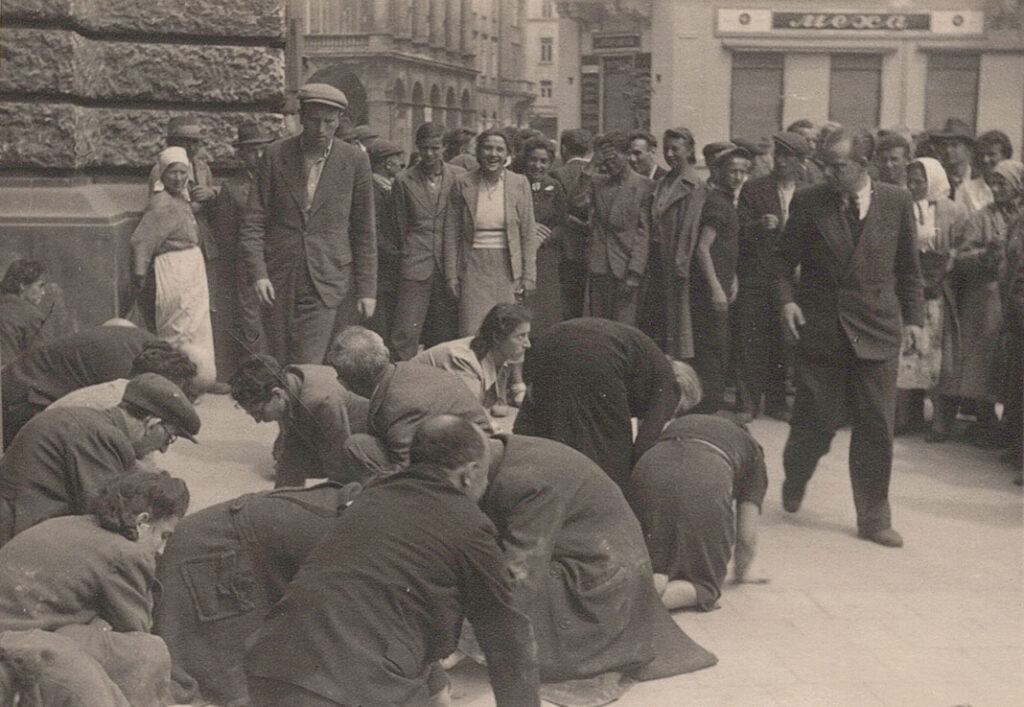
Dozens of German photographs and newsreels show civilians abusing Jews on Lviv’s streets, tearing off their clothes, pawing a woman’s breast, pulling another woman by her hair, or laughing at crouching men and women made to clean the street with a handkerchief or toothbrush. The images flaunt an appalling brutality, but in one, perhaps unnoticed by the photographer, something else is visible: While a mass of people jeer at Jews on their hands and knees cleaning the street next to the opera house, a single man in the crowd has covered his eyes with his right hand and turned partly away.
The center’s interactive map for smartphones will take you to more than a dozen locations where these events took place. Many of the same buildings remain. The main prison, for instance, Brygidky, a long, low, forbidding structure of tan concrete, a place of execution under various regimes for two centuries, is still there, although no longer used as a prison.
For several months after Russia’s 2022 invasion of Ukraine, the center’s pages about Lviv’s 1941 pogrom were the part of its website that received the most traffic. Was it because people wondered what might happen under Russian occupation? Or were they checking Putin’s absurd claims that today’s Ukraine is run by “Nazis”? We do not know.
The center also tells stories of rescuers in Nazi-ruled Lviv. Metropolitan Andrey Sheptytsky of the Greek Catholic Church, for example, hid Jews in monasteries, preserved Torah scrolls, and successfully hid a rabbi friend in a concealed space in his own library. The manager of the local railway workshop protected a Jewish employee on false papers by standing in for him when he was called for a medical examination—which would have revealed that the employee was circumcised. A gentile Polish doctor did the reverse, donning a Star of David armband so that he could assist Jewish colleagues in the Lviv ghetto.
Part of doing public history is training others. One new center project is a collaboration between its researchers and a class from Lviv’s Catholic university. It documents, in every dimension, daily life in the wartime Jewish ghetto before its occupants were killed. Photographs show buildings as they are today, and from 1942, trolleys pulling gondola cars jammed with Jewish forced laborers. A map pinpoints the factories where they worked. There are official notices from Nazi authorities in multiple languages, as well as paintings by a survivor of her memories of ghetto life. As you look at them, aerial photographs of these districts of the city today transform into maps of exactly the same areas under Nazi rule.
The most extraordinary Holocaust story the center tells was assembled, in part, by two visiting American Fulbright scholars, Jack Wright and Rachel Stevens. Ten Jews, with help from three Poles, braved rats, worms, cobwebs, and dysentery to survive for an astonishing 14 months in Lviv’s sewers. Their chief helper, Leopold Socha, was a former petty thief who hoped that saving them “would redeem him in the eyes of God.” Socha and two friends worked for the sewer system and could direct the fugitives where to go. He knew that an underground pipe feeding the Neptune fountain had a leak; that supplied the group’s drinking water. Through manholes, Socha lowered meager supplies of onions, beans, and other food (often stolen), a small gas stove, and a Jewish prayer book to those in hiding. He thought no one was looking, but one day, Socha was lowering sacks of potatoes through a manhole when a German police officer saw him. “Why are you throwing those away?” he asked. Socha replied, “They are spoiled. I have been instructed to dispose of them.” The policeman then walked away. Suspicious German soldiers sometimes removed manhole covers and dropped grenades. When Soviet troops finally pushed the Nazis out of Lviv in 1944, Socha called through a grating, “Everyone out! You are free!” The story inspired a 2011 film, In Darkness, an Academy Award nominee, by the Polish director Agnieszka Holland.
You can follow this story, too, on your phone, across the city from one manhole cover to the next, to the Neptune statue, and finally to that grating. The page on the center’s website ends by asking readers, “What would you have done back then if you were a Ukrainian? A Jew? Socha?”
People steer clear of difficult history for many reasons. Sometimes it’s a matter of business.
On a hilltop with a panoramic view of Lviv is the Citadel Inn Hotel and Resort. Its five-star accommodations include a restaurant, a hookah bar, conference rooms, a sauna, a gym, and a cellar of “collectible wines from around the world.” The hotel occupies an immense circular bastion of red brick, with ivy climbing the walls. Crenellated ramparts surround the top floor. The structure was built by the Habsburgs, advertisements explain, as part of a 19th-century fortress. The only clue on the hotel grounds that this majestic building might once have had another use is half-hidden in a grove of bushes to the side of a path, unlikely to be seen by anyone not looking for it. On a tiny monument the size of a tombstone is an inscription in Latin and Ukrainian: “In Everlasting Memory.” Nothing indicates who is being remembered.
Apart from the Holocaust, the biggest mass murders during the Second World War were of Soviet and Nazi prisoners of war. To be captured by either side on the Eastern Front was usually fatal. Of the more than five million Red Army prisoners taken by the Germans, for instance, some 3.5 million died. An estimated 40,000 to 50,000 of those deaths, between 1941 and 1944, occurred in a Nazi prison called Stalag 328—the old fortress on this hilltop, including the building that is now the hotel.
The Nazis worked the prisoners to the point of exhaustion in the fortress, then loaded them onto trucks and drove them, stripped naked, hands tied, to a nearby forest to be shot. Locals called the fortress the Tower of Death. The hotel is not eager to tell its guests about this. Nor, during Lviv’s long decades under Soviet rule, was the Kremlin ready to discuss why such huge numbers of Red Army soldiers had surrendered. The majority of them were captured in the first six months of the war—a direct result of Stalin’s bizarre refusal to believe that Hitler would attack him and of his catastrophic purging of the Red Army’s leadership. The period, therefore, became yet another piece of history discussed only in whispers.
There are hundreds of Holocaust memorials around the world, but almost none to those 3.5 million dead POWs. With support from Lviv’s city council, the Center for Urban History has created a virtual one. Photographs show German guards marching POWs through the cobblestone streets en route to the Tower of Death. The men’s ashen faces suggest that they knew what lay ahead. More photos show the searchlights and double rows of barbed wire surrounding the prison camp. There are testimonies from survivors, and from neighbors who saw prisoners eating dogs and cats that wandered onto the Stalag grounds. The center is building a digital map of the camp and a database of all the names it can gather of POWs—Russian, Ukrainian, French, Belgian, and others—who lived and died here.
Particularly haunting is a collection of messages scrawled by prisoners on the Stalag’s walls:
“I found myself here on 30/05/44. I am from the Vinnytsia oblast, Ilyintsi rayon, village Yablonovytsia. Filimon Artemovych Diatsenko, born in 1922.”
“22 people left on 18/06/44 in an unknown direction.”
“If you haven’t been, you will be, Once you’ve been, you won’t forget it.”
Oral histories remind the viewer that the minority of Soviet POWs who managed to survive German captivity were, after the war, treated as traitors and shipped off to Stalin’s gulag. Those who survived were released only after his death in 1953. Soviet prisoners who agreed to serve in special German army units were given decent food and allowed to live. Can you blame them? History in this part of the world is often a record of impossibly painful choices.
“Dealing with the past is difficult, messy, and complicated,” Sofia Dyak reflects, sitting at a table in the center’s library. “Especially when you have a narrative scaffolding around history as something heroic. The problem with the type of history telling [which is] almost like a fairy tale, is that even if it’s a dark fairy tale, it does not necessarily help you to explain the human condition. Truth is a process, and a process with many corrections.” Descendants of people who once lived here eventually began visiting Lviv, especially after the Soviet Union’s collapse in 1991, and they had memories of an extremely different past from the one taught in Soviet schools. Getting at the truth became easier, she says, but the truth was still often contested.
Moreover, history is not just what’s narrated by historians and schoolteachers; it’s life as recorded by ordinary people. The center has called for residents to bring in old home movies for digitizing. Parts of these will be posted online with annotations from members of the families they depict. And now, amid a war being fought with social media as well as bullets, the center is archiving posts by both Russians and Ukrainians appearing on Telegram.
The Soviet heroic scaffolding may be gone, but Ukrainians sometimes build their own. For example, the nationalist leader Stepan Bandera (1909–1959), who for a time collaborated with the Nazis in hopes of forging a Ukrainian state, now has a major street named after him in Lviv. He was, however, an anti-Semite, and he disliked Poles almost as much as Jews. His followers took part in massacres of both. When the local government of Zhovkva, some 20 miles from Lviv, allowed a huge mural of Bandera to be painted on its city hall a few years ago, a town in Poland angrily canceled a sister-city relationship.
Such currents still flow below the surface, for Ukraine has a racist far right—although one notably smaller than those in other major European countries. Last September, for example, the center was scheduled to host a presentation of a new Ukrainian book about the Black Lives Matter movement, by a writer who had spent several years in the United States. Then a Ukrainian refugee in North Carolina, Iryna Zarutska, was murdered by a Black man, her killing followed by a blizzard of enraged tweets from Elon Musk. The author and her publisher received a cascade of death threats by telephone and social media. The book presentation was canceled.
Across the world, people battle over memory. The Smithsonian has incurred the wrath of President Trump for focusing on “how bad slavery was.” Belgian protestors deface statues of King Leopold II, whose forced-labor regime killed millions in the Congo. Protests in Cape Town have toppled a statue of another colonizer, Cecil Rhodes. New York City saw a fight over the equestrian monument, outside the American Museum of Natural History, to Theodore Roosevelt. The battles rage on, raising the question: How can we remember the past honestly and inclusively, face it squarely, even the ugly parts, without sugarcoating?
For Ukrainians, dealing with history takes place in the shadow of war. Lviv may not be near the front lines, but reminders of the fighting are everywhere. For months in 2022, the Center for Urban History repurposed several of its office rooms as refugee housing. Today, every morning at nine a.m. comes a minute of silence throughout the city. Pedestrians, sidewalk vendors, a legless veteran in a wheelchair, cars, trucks, buses—all stop in place. When the minute ends, many people cross themselves. In Lviv’s vast military cemetery, thousands of immaculate graves are blanketed with fresh flowers, surrounded by lanterns with candles, each grave showing, behind glass, a large photograph of a soldier. A middle-aged woman tending one explains softly, in English, “My brother.”
History is as much a battlefield in this war as the devastated towns and cities of Ukraine’s east, where most of these soldiers died. Vladimir Putin has justified the invasion with his own view of the past. In 2021, he published a strange, rambling essay, “On the Historical Unity of Russians and Ukrainians.” The two are “one people—a single whole,” Putin declared. They all are descendants of Ancient Rus, “the largest state in Europe.” He attacked “those forces that have always sought to undermine our unity.” The Ukrainian language evolved as merely one of many “dialects” of Russian. Ukrainians today have been taken away “from their historical motherland.” The “true sovereignty of Ukraine is possible only in partnership with Russia.” Months later, his tanks and troops poured across Ukraine’s borders and the largest conflict in Europe since 1945 was under way.
Few Ukrainians have any interest in Putin’s vision of mystical racial unity. After all, President Volodymir Zelensky is Jewish; his national security council chief is Muslim and Tatar; his former ambassador to the United States is part Armenian. Whatever Ukraine’s problems—everyone agrees that corruption remains one—nothing has unified the country as much as Russia’s ruthless invasion. The kinship Ukrainians clearly feel is not a tribal one with Ancient Rus but a political one with Western Europe. In Lviv, you see almost as many European Union flags as Ukrainian ones. And what, after all, is the European Union but one of the most successful multicultural projects of all time? No better image exists of the cosmopolitan future that so many Ukrainians hope for—and of the world we all might hope for—than the engraved names surrounding that fountain: people of different tongues, faiths, and cultures, all sharing water from the same well.