Inner Demon Hunters
Could a hit animated movie hold the key to healing generational trauma in Korea?
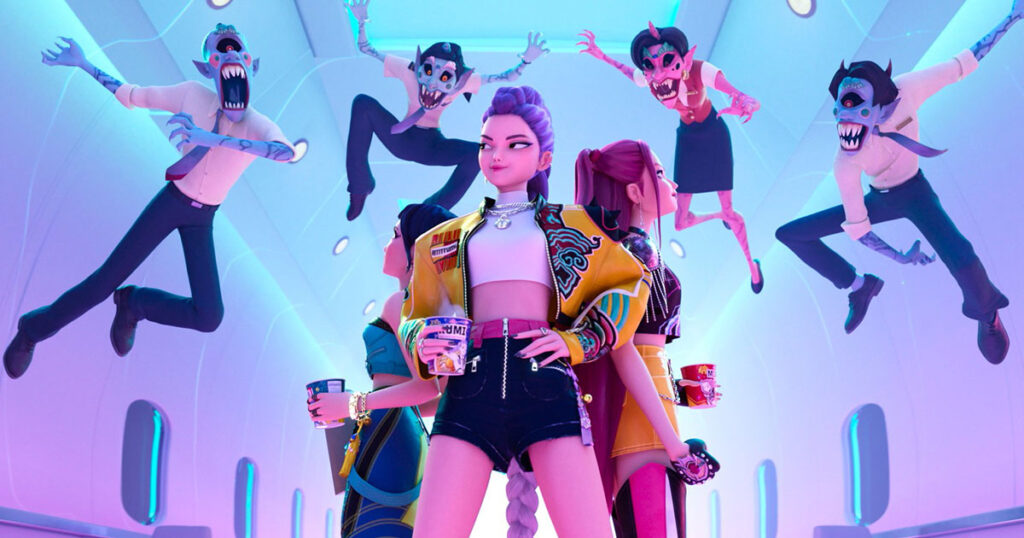
The animated movie KPop Demon Hunters has become a global pop culture phenomenon, overtaking another Korean show, Squid Game, as the most-watched program ever on Netflix. Several songs from the movie have dominated the Billboard Top 100 charts, and people of all ages have flocked to cinema singalongs. The movie focuses on an all-female superstar trio, Huntr/x, which secretly protects Korean society from thousands of demons. Its music creates a magical barrier—the Honmoon—that protects the human realm from the demon world. But the Honmoon faces grave danger when the demons send in a rival K-Pop boy band, the Saja Boys, to steal Huntr/x’s fans and drain its power.
Like Squid Game, KPop Demon Hunters wasn’t expected to become such a monster hit. Sony Pictures produced the movie, then essentially gave up on it by selling distribution rights to Netflix. But through word-of-mouth, ease of streaming, and clever TikTok marketing, the movie caught fire. Many viewers have discussed its strong connections to the worlds of fandom and social media, or the way it successfully melds its youth-driven sensibilities with bits of traditional Korean culture. But what has really made the movie more than just a cute fad is its moving message, captured by the climactic song “What It Sounds Like,” which brought me and some of my other Korean-American friends to tears. As the lyrics say:
We broke into a million pieces, and we can’t go back
But now we’re seeing all the beauty in the broken glass
The scars are part of me, darkness and harmony
My voice without the lies, this is what it sounds like
Running beneath the movie’s catchy pop surface is a surprising and psychologically deep awareness of the intense stress of both past and present Korean society, and how this stress can affect the self-esteem of the most vulnerable population—young people. KPop Demon Hunters, although an American production led by several second-generation Korean-American and Korean-Canadian creatives, is reportedly also a huge hit in the motherland, where the story takes place.
Mainland Koreans have expressed fondness for the movie’s accurate nods to their culture—such as the food (Huntr/x’s meals are shown in delicious detail, including steaming bowls of sullongtang next to colorful banchan), the scenic backdrops (key scenes take place at Seoul’s Naksan Park, with its picturesque remnants of historic city walls, and at another major landmark, Namsan Tower), and even the homages to Korean shamanism and symbols (like a traditional tiger and magpie duo from Korean folk paintings, here in the form of lovable animal sidekicks Derpy and Sussie). These cultural touchstones open a necessary dialogue between cultures. How, for example, do concepts and metaphors related to mental health, as interpreted by Western-influenced writers, play out in a South Korean society that still struggles to talk openly about the emotional effects of generational trauma?
The psychological fallout of a war-torn 20th century was paved over by rapid 21st-century modernization. To cope, South Koreans are drawn to superficially perfect exteriors. The country has the highest rate of plastic surgery worldwide, formal dress codes require neutral shades, and airline flight attendants must look like models. Meanwhile, hypermodern cafés and malls with contemporary design are ever present features of the urban landscape. Though South Korea’s “Miracle on the Han River”—as the post–Korean War economic boom is known—is a deserved source of Asian pride and now worldwide trendsetting, all that modernity comes at the expense of disconnecting from ancient traditions and a spiritual past. Demons do lurk beneath the glass skin proffered by K-beauty products and the precision dance moves from K-pop stars like BTS and Blackpink.
Depression and suicide rates are skyrocketing to crisis levels, especially among young people. Per a joint study by the newspaper Chosun Ilbo and Seoul National University’s Health Culture Research Group, the rate of self-reported depression among a sample size of 1,000 adults aged 18 and older surged to 49.9 percent in 2025, up from 26.2 percent in 2021 and 11.5 percent in 2018. Per the Organization for Economic Co-operation and Development, South Korea has had the highest suicide rate among developed countries since the mid-1990s—particularly in the age range between 18 to 29. It is this key demographic that KPop Demon Hunters can perhaps speak to the most, as its twentysomething protagonists endure emotional struggles despite their superstardom.
Huntr/x’s lead singer, Rumi, has been hiding her skin “patterns,” evidence of a lifelong secret that she had a demon father. She connects with Jinu, who leads the rival Saja Boys (the Korean word saja means both “lion” and “angel of death”). Rumi learns of Jinu’s guilt for selling his soul a century ago to the leader of the demons, Gwi-Ma—Jinu became a well-fed royal musician but abandoned his starving family in the process. A demon horde threatening Korea’s communal identity is a pretty clear metaphor; in the 20th century, Korea was both occupied by Japan and tragically split in two after the Korean War. South Korea survived several dictatorships on its way to democracy, and now the nation has astonishingly become the 10th-largest world economy. But what’s more interesting to me as a clinical psychiatrist are the demons eating up people like Rumi and Jinu from the inside.
The word demon comes from the Greek daemon, a mythological guardian spirit whose meaning and intention somehow became malevolent over the centuries. The demons are also rooted in Korean shamanism, an ancient Korean spiritual belief that humans live in concert with spirits, ancestors, and ghosts, some of whom may linger among us with unresolved grievances or suffering—like demons. Through reconciliation and purification with these spirits via shamanist rituals called gut, the demons and the living can find peace together. Huntr/x’s performances are a modern K-pop interpretation of gut, which traditionally includes singing and dancing. Instead of reconciliation, however, Huntr/x’s goal is to protect the Honmoon.
But reconciliation with inner demons hasn’t been a goal for modern Korean society. We can see this in a conversation between Rumi and her mother-figure Celine, a retired star who has helped hide Rumi’s secret for years. After Rumi’s markings are revealed to the world, Celine frantically tells Rumi to lie until “we can fix everything. … We can cover those up and put everything right again. … Our faults and fears must never be seen.” This conversation is painfully familiar to many Korean kids (those who were raised in South Korea and those who grew up in diaspora communities, including myself) who hear similar things from their parents: that it’s more important to keep things quiet, to keep up appearances and save face. But as many know, lies beget more lies, secrets beget more secrets … and the truth festers until it inevitably breaks out. The demons are hidden, not vanquished.
Youth raised under this mindset suffer from tremendous social pressure. They often feel trapped into taking out these pressures on themselves, with no place to safely discuss vulnerability. Instead of addressing such inner feelings, too many South Koreans decide that shame and imperfection are socially unforgivable, leading to fallout like workaholism, abuse, depression, and suicide. To cope with psychic pain by maintaining façades of perfection is a deadly game.
Western-style psychotherapy and mental health constructs have been slow to catch on in South Korea, due in part to stigma and Confucian taboos about discussing emotional issues, both publicly and privately. There are small signs of societal change in that regard: members of BTS, the most popular K-Pop band, have shared their struggles with anxiety and depression both in interviews and in some song lyrics. The latest Netflix Korean dating show, Better Late Than Single, features socially awkward young people—including one woman who discusses her abusive father—opening up to counselors on camera. Peter Jongho Na, an assistant professor of psychiatry at Yale originally from South Korea, has become a popular internet blogger and host featured on KBS World. That South Korea’s main broadcasting station would sponsor a show discussing the country’s mental health crisis—let alone advocate for psychological help and suicide prevention—would have been unthinkable even a decade ago.
That’s why I was surprised that the healing message at the end of the movie—accepting and showing yourself, painful scars and all, and becoming more honest and whole in the process—has been such a hit in South Korean society. The message of radical acceptance is one psychiatrists like myself often preach these days. Ironically, despite its more recent Western therapeutic popularity, radical acceptance comes from Eastern spiritual traditions like Buddhism, which once dominated Korea. Now common psychotherapeutic approaches such as mindfulness and dialectical-behavioral therapy (DBT) encourage you to accept reality as is, including painful and difficult situations beyond your control. It is not a form of denial or further entanglement; it is a way to shift your mindset toward one of mature acknowledgement of suffering, which can lead to growth and self-acceptance.
The Korean concept of haewon referenced in the movie also helps connect Eastern and Western methods for inner spiritual recuperation. Haewon in Korean shamanism is a process of relieving resentment from the past in order to heal from injustice and achieve harmony with humans and nature. It beautifully expresses, centuries before the birth of Sigmund Freud, the underlying precepts of psychodynamic psychotherapy and psychoanalytic theory. Psychotherapy encourages one’s unburdening of past traumas through open discussion and subsequent acceptance and absolution of past guilt and self-blame—a “talking cure” version of the aforementioned gut ritual.
The movie boldly covers the internal psychological fallout of hiding one’s demons—the generational trauma that drives both the push for achievement and success and the creation of glittering exteriors—and also the necessity of radical acceptance. Toxic perfectionism will not mend Korea’s demons, but reconnection with Korea’s spiritual and philosophical traditions—and thus, with the healing practices that inform modern psychology—just might.
Perhaps KPop Demon Hunters’s most powerful legacy is to show the world that Korea and its people are far from perfect, and that’s okay. That brave acknowledgement of the Korean people’s pain and history and own original spiritual heritage is what will give them greater strength, emotional resilience, and an even more loving fandom in the years to come.