The Savage Landscape: How We Made the Wilderness by Cal Flyn; Viking, 384 pp., $32
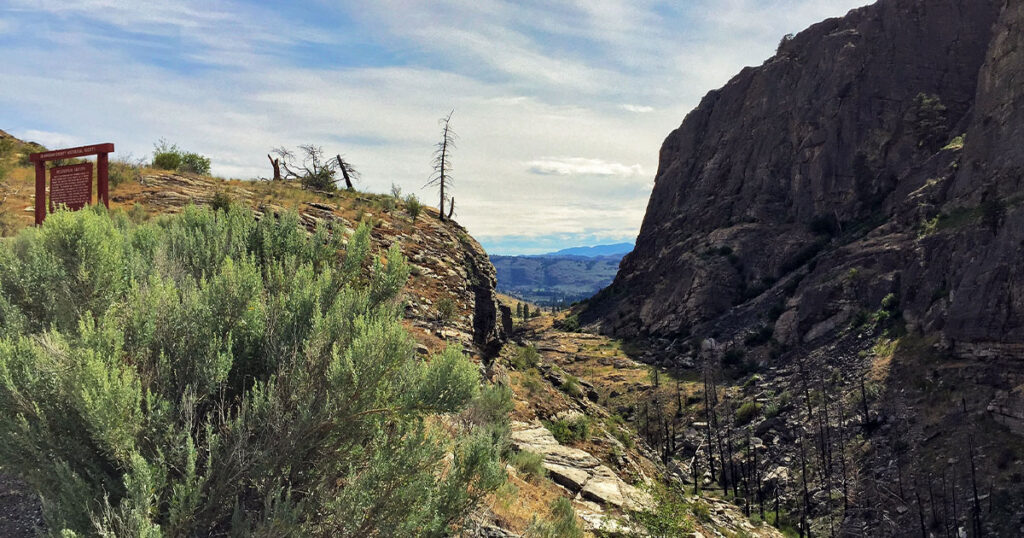
In this country, wilderness is codified by what is excluded from it—namely, us. The 1964 Wilderness Act defines wilderness as a landscape “where the earth and its community of life are untrammeled by man, where man himself is a visitor who does not remain.” This concept became a physical reality for me the summer after my sophomore year of college, when I took a job on a two-woman trail crew in Idaho’s Frank Church–River of No Return Wilderness, the nation’s largest wilderness area outside Alaska. Our job was to hike mile after mile through the most beautiful landscape I had ever seen in my life, all the while clearing trees that had fallen across the trails. Because of federal restrictions, we couldn’t use chainsaws or power tools of any kind; in official wilderness areas, you can’t even use anything with wheels. So my crew partner and I would each take one end of a six-foot-long crosscut saw and cut through any trunks that blocked our trail. Then we’d hike on to the next.
We in the United States tend to define wilderness as something set apart from us, but in her new book, The Savage Landscape, Scottish writer Cal Flyn uncovers broader stories about humanity and history, probing the things we seek in wild places, among them beauty, remoteness, spiritual experiences, brushes with wildlife, proximity to the sublime, and opportunities to hunt. Flyn early on acknowledges the paradox of her quest. As she trails Cape buffalo across a game reserve in Mozambique, hikes into bear-thick woods in Romania, backpacks across Yellowstone, ambles through Antarctica, and tiptoes to the edge of a volcanic crater in Iceland, she confesses that “the very attempt to define wilderness, to itemise it, delineate it on a map, seemed to make it slip from my grasp.”
So opens a book that grapples with the complexities and downright cruelties of wilderness. Digging deeper, Flyn reveals the brutal contradictions of wild places. Across the world, many conservation areas were established by violently evicting Indigenous peoples from their lands. Flyn tells the story of the Batwa people, for example, who were brutally forced off their territorial lands by Ugandan authorities to make way for national parks. The United Nations estimates that about 90 percent of the 87,000 Batwa people living in the Congo Basin lost access to their homeland. Like many other Indigenous groups worldwide, the Batwa have become “conservation refugees,” people severed from their ancestral territory in the name of landscape protection and who now lack both home and a means of subsistence.
Flyn also ventures two days by boat on a muddy river in the Brazilian jungle to visit a community of Yanomami people, the largest of 300 Indigenous groups that make their home in the Amazon Basin. She is distressed when a local leader announces the price of her visit: a chainsaw. “Hadn’t it been their lack of chainsaws, their repudiation of chainsaws, that was the reason I was so keen to come?” she laments. This is a dilemma, she acknowledges, that gets at a central question of wilderness: Who is allowed to use it—and how? “What level of human interaction ‘spoils’ a wilderness?” she asks.
These are the tangled trails Flyn blazes, and I found myself an eager follower, reminded of that summer in Idaho, which I count as the best of my life. We were prohibited from using a chainsaw, but our groceries were flown in every other week by small bush plane. Bicycles were forbidden, but pack horses, which can introduce weeds through their feed, were welcome.
The questions get even knottier when we consider how climate change is leaving its indelible footprint on all lands and waters on Earth. By one estimate, Glacier National Park will be glacier-free as early as 2030. The challenges are confounding. What if wilderness restrictions put wild places at greater risk of devastating wildfires? What do official wilderness boundaries mean as rising sea levels swallow coastal lands and as species—and even whole ecosystems—head to higher latitudes?
Flyn’s book found me at just the right time. I was nearing the end of a three-month-long stint at the computer to complete the manuscript for my second book. I craved time away from my desk, and even more, I craved time outside, time in a wild place. But it was mud season here in Alaska, not a good time for an outdoor adventure. When a friend told me there was one seat left on a five-day rafting adventure she was organizing down the Yampa River in Colorado, all the conundrums of “wilderness” floated out of my mind. I’d spend days with water, canyon walls, and sky. I’d see rock art made by people who’d lived off the region for generations. I’d pitch a tent every night under a dark sky. “Yes,” I said. “Yes!”