
It’s a Wonderful (Falling Apart) Life
In the disrepair of our everyday world are suggestions of life’s burdens and consolations
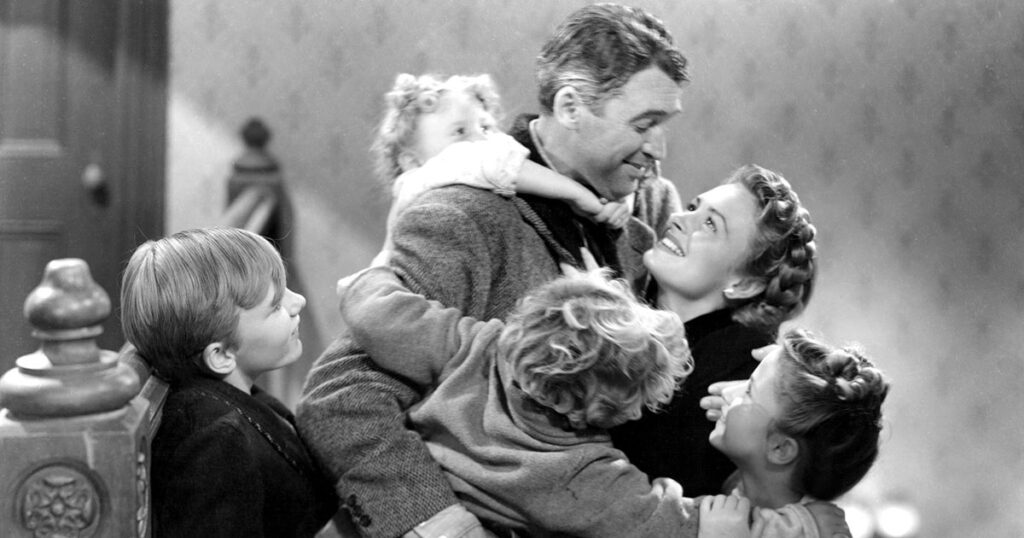
For me, as for so many, Frank Capra’s It’s a Wonderful Life is still a beloved thing. The 1946 holiday classic is sentimental, fantastical, and painfully dated in a few places, but watching it always feels like succor. The triumph of friendship and community, the condemnation of heartless greed, the irresistible Jimmy Stewartness. Every age probably needs its statements of moral longing. This one certainly does.
The movie’s “feel-good” effect might in fact be so prized that we lose track of its quirky abundance—how fully it includes, for example, bits of chaos and the incidental erosions of daily life. Consider George and Mary Bailey’s broken banister knob, repeatedly featured and never fixed, like a piece of stubborn reality smuggled onto the set. What’s that doing in this elaborately engineered movie? Maybe a lot.
As fans of the film will remember (spoilers hereafter), the Baileys’ house is utterly broken down when they begin their married life. Mary’s cheerful determination to fix it up herself, “remaking the old house a home,” as the angel Joseph puts it, is a sign of her goodness, part of the movie’s fablelike contest of values between generous domestic love and the shrewd materialism of Mr. Potter, the banker. The disrepair of the Bailey house advertises the family’s prioritizing of people over things. (Potter’s childless mansion, we can be sure, needs no fixing.)
George’s first encounter with the banister knob arrives in this context. Midway through the movie, as Joseph summarizes the Baileys’ early years together, we see George coming home late from the struggling Building and Loan, beginning his weary climb up the staircase—when the wooden finial atop the newel post comes off in his left hand and George puts it back, fitting its little peg in the post’s hole. It’s an innocuous sight gag, a small inconvenience that comes with the home’s heartwarming dilapidation.
Later, when George and the knob meet again, things have gotten much worse. Catastrophically, Uncle Billy has lost $8,000 of the Building and Loan’s money, raising the prospect of “bankruptcy, scandal, and prison,” and of course Potter is closing in. George comes home from work late and coatless on this day of crisis, Christmas Eve, and displaces his terrible fear and anxiety through an eruption of bitterness—about being stuck in “measly, crummy old” Bedford Falls, living in “a drafty old barn of a place,” even (shockingly) having a big family. Climbing the stairs to check on sick little Zuzu, his daughter, he freezes three steps up, realizing that the knob has come off in his hand again. He looks at it, disgusted, puts it in his right hand as if to slam it down, then just wiggles it back into place.
In its third and final iteration, George’s encounter with the knob again conveys his swing of fortune and feelings, this time euphorically upward. He has run home through the snow, returned to life after the terrors of nonexistence and everything is beautiful because real—the blood on his lip, “this wonderful old drafty house,” the grim bank examiner waiting in the foyer. His children call out from the top of the stairs, “Merry Christmas, Daddy!” and up he runs, again three steps up before freezing, knob in hand—he’s forgotten again! He kisses the knob and puts it back with a cackle. The knob is newly precious, not a token of broken ambitions but a trophy of his conversion to the joy of life, which makes material worries puny, immaterial. Blessed be the janky knob.
In real life, it’s hard to be romantic about home disrepair, especially if you’re poor. Transcending material concerns is tough when it’s January in Buffalo and the radiator in your apartment doesn’t work. Of course, things fall apart for everyone. We all have stuff that’s entered the realm of the janky, and most of us, most of the time, just live with some of it. The perfectly functional microwave at my family’s house inexplicably, annoyingly, buzzes after we use it. Our remedy is to bend an old potholder in half and wedge it under the closed microwave door. Silence! Our not-new toaster works great, too—unless you’ve turned it upside down to shake out the crumbs, at which point the little handle you push down to lower your bread (the “bread lifter” in toaster parlance) will only stay down, and the toaster function, if you find something (or someone) to hold down the handle. A chopstick wedged into the slot just above the handle does the job. (Our temporary fixes depend much on wedging.)
I’m lazy. Also unhandy and somewhat cheap. But what homeowner doesn’t just make do with at least one piece of the world’s entropy, the bureau drawer that won’t close without just the right kind of upward or sideways pressure, the crack in the ceiling or wall that comes back no matter how often you’ve caulked and painted? You can buy a new microwave, you can get things fixed. But you don’t always do so, at least not for a good long while. We pick and choose our hacks and workarounds—the shim under a chair leg, the slap to the side of the tv (“percussive maintenance,” it’s called)—while tolerating much else. A carpenter friend assures me that to secure a loose banister knob in the 1940s, all you might have needed was a couple of shaved wooden matchsticks added to the newel post hole to snug up the knob’s peg (a trick we use on loose drawer knobs).
The quiet tide of disrepair is relentless. Heraclitus was right: Everything’s impermanent; everything’s in flux. Wooden décor dries and warps, Zuzu’s flower petals fall away. On George’s fateful visit to young Mary at the Hatch family home, he can’t get the latch on the front gate to work and finally kicks the thing open. The driver’s-side door on the Baileys’ old car is worse. Near the end of the movie, it won’t open at all, and later still, after George crashes into the tree, it won’t close.
At one level, the disrepair in the movie is in keeping with Frank Capra’s career-long, affectionate focus on everyday people and their everyday lives, what George memorably calls their “working and paying and living and dying.” If the jankiness produces sight gags, it also connects to darker burdens. George Bailey, a thwarted architect, does not aspire to a life of workarounds and making-do. Disrepair is part of the “measly, crummy” circumstances he’s stuck in. And the film treats George’s entrapment with dead seriousness, a thing easily forgotten in the bright light of his celebrated altruism. When he and Uncle Billy pick up Harry at the train station and learn that the young woman with him is his wife and that her father has offered Harry a job, the camera closes in on George’s face and we watch him register, in a moment of terrible aloneness, the suffocation of his dreams. He will not hand off the Building and Loan to Harry, as expected. He will not get to college. He will never escape.
The ultimate problem here is time. Unlike God, Joseph, and Clarence, George is trapped in it. When Uncle Billy banters with Harry on the train platform about “nobody ever changing” in Bedford Falls, he’s mouthing the same nostalgic myth the movie exploits: that small-town America is a place time forgot. George knows the real story and feels it—the working and paying and living and dying. Born older, as his father says, George has felt the window of his opportunity forever closing. He will wear out. Like the rest of us and banister knobs everywhere.
The movie’s final scene changes everything, of course, and lifts this darkness. Or so it would seem. I have an artist friend who adores the movie, watches it every year, and cannot watch the ending. I watch it and always cry, now harder than ever. At the age of 66, I can’t tell how much of this reaction comes from the joyous scene itself and how much from its close proximity to the darkness it breaks, from the miracle of reprieve.
Storytelling, with its tricks, its smoothing, cobbling and evading, may be our oldest hack. But if it gives us something we keep needing, it outlives the storyteller and all the décor. For me, the staying power of It’s a Wonderful Life comes from its two gifts. It keeps faith with human goodness and doesn’t pretend the world isn’t broken, that we don’t need help.
So my George Bailey abides, and the “Buffalo Gals” and Uncle Billy’s squirrel and Zuzu’s petals and Clarence’s wonderful eyebrows. All the humor and dearness and love. And the Baileys’ banister knob will never get fixed, and we will always have it at hand, an ornament of truth for every Christmas season.