
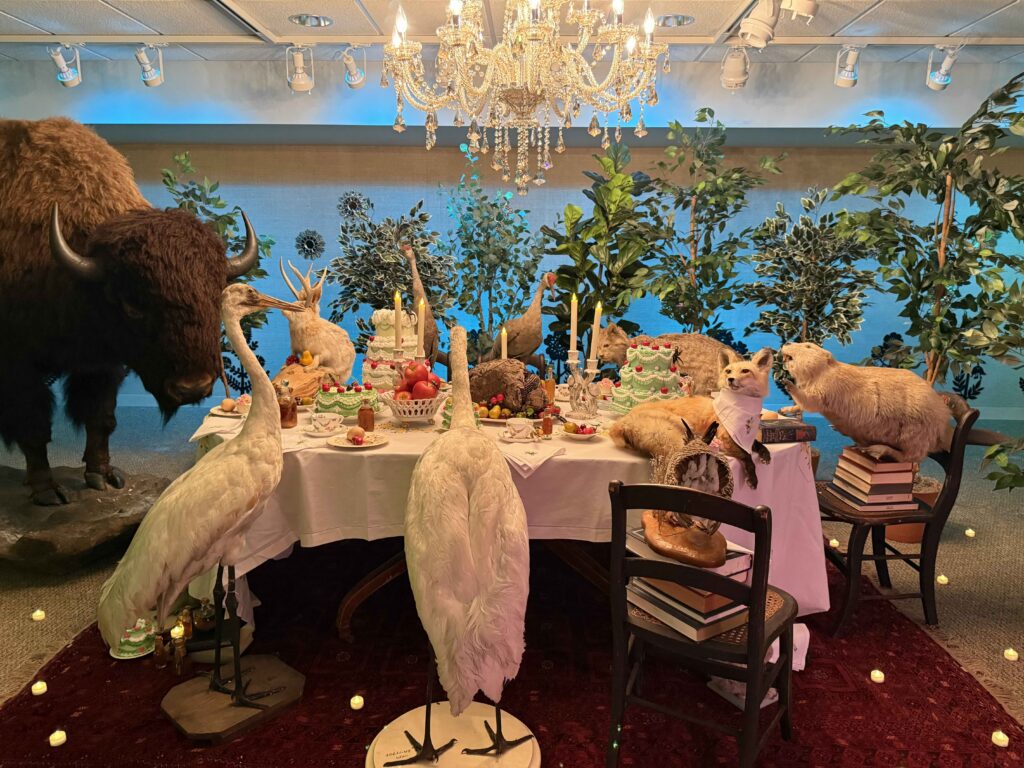
Jennifer Angus has been turning dead insects into art ever since taking a trip to Thailand more than 20 years ago. There, she came across a version of a singing shawl made by the Karen hill tribe, with green metallic beetle wings used for its fringe. Before that moment, she “had never thought of insects as being beautiful beyond butterflies,” she says. “I like shiny things—I have these magpie tendencies—and I was just blown away by these beetles. I found myself getting more and more interested in insects.” Last year, Angus—who is perhaps best known for her 2015 installation Wonder at the Smithsonian’s Renwick Museum—collaborated with the University of Nebraska’s Community for Arthropod Research, Education, and Materials Innovation, and the Great Plains Art Museum to create a site-specific installation combining animals from the university’s taxidermy collection with insects that are native to the Great Plains region. The exhibition, Like a Moth to the Flame, is meant to bring awareness to habitat loss, species extinction, and the negative effects of pesticide use on the environment. But most of all, Angus hopes her art can get “people to talk and think about things they may not want to think about.”
 Detail of Like a Moth to the Flame at the Great Plains Art Museum. (Photo courtesy of Loren Rye / Pixel Lab.)
She exercises great caution and care when sourcing the insects for her installations. “When at all possible, I used farmed insects,” she says. The insects “have been accumulated over a period of nearly 20 years now, and they’re reused from exhibition to exhibition.” If a piece breaks, Angus repairs it, then places it well out of viewers’ reach when she next displays it. As she planned out the Great Plains Art Museum exhibition, she thought about how to turn Victorian-era taxidermy—something she calls “horrifying” and “arrogant,” demonstrating how “people probably weren’t aware that one day these large mammals would be fighting for their lives”—on its head. What if the animals, instead of being consumed, were invited to a dinner party together? “Predator and prey would sit side by side,” she says, along with insects who not only act as pollinators but are essential links in the food chain for other creatures. The whooping crane, for example, migrates through the Great Plains region, feasting on insects and crabs, but has stayed on the endangered species list for 56 years due to over-hunting and environmental degradation. “When we see fewer birds, fewer reptiles, is it because there are fewer insects?” she asks. And if so, “why are there fewer insects? Loss of habitat, climate change, pesticides. So let’s create this empathy. Let’s educate people about pollinators. We have to stay hopeful. If we don’t have hope, we don’t have anything.”