
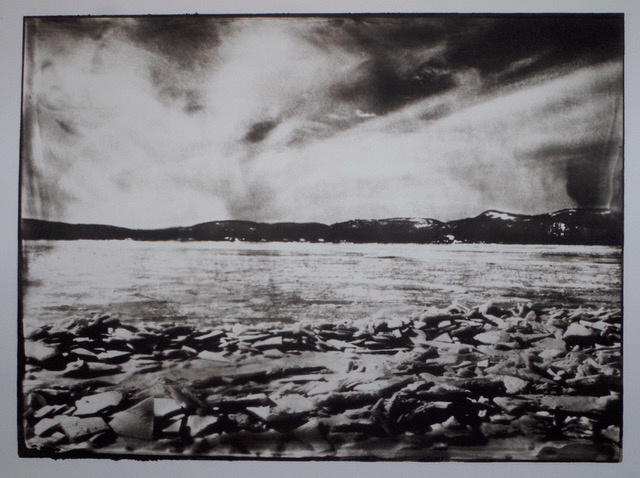
Photography runs in Jill Enfield’s family. Her ancestors owned and operated camera shops in Frankfurt, Germany, for nearly a century until the Third Reich forced them to flee to the United States in the 1930s. The Leitz family, who founded Leica Cameras, sponsored the Enfields’ visas and helped them resettle in Miami Beach, Florida, where Jill was born. Growing up, “we always had cameras,” she says. Mom and dad “would bring us home all the silly little-kid cameras like the [Polaroid] Swinger and the [Kodak] Brownie. So I always was into photography, but never thought of it seriously. I didn’t even take pictures in high school.” As an undergraduate at New York University, however, Enfield began taking photography classes and experimented with darkroom techniques, culminating in a degree in fine art photography. Today, Enfield lives with her husband in Upstate New York, but she commutes to the city to teach experimental photography at Parsons School of Design. To pass the time on each hour-long train ride, Enfield takes digital photographs of the view outside of her window, later processing them to look like 19th-century tintypes. These works now comprise a solo exhibition, Visible Evidence, at the Albrecht Kemper Museum of Art in Kansas City.
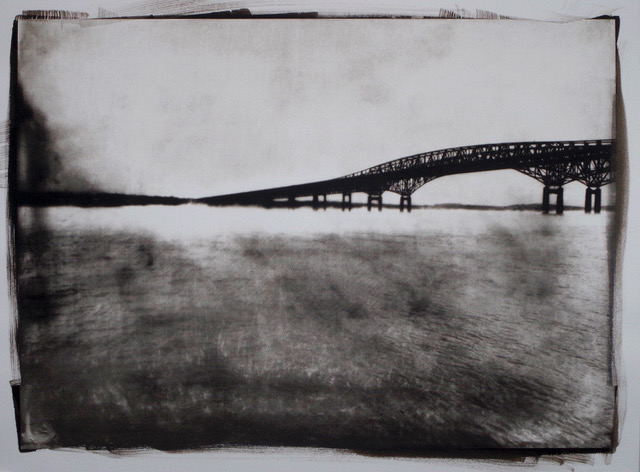 Beacon Train Station View of Newburgh Beacon Bridge, 2026, palladium print on paper. (Photo courtesy of the artist.)
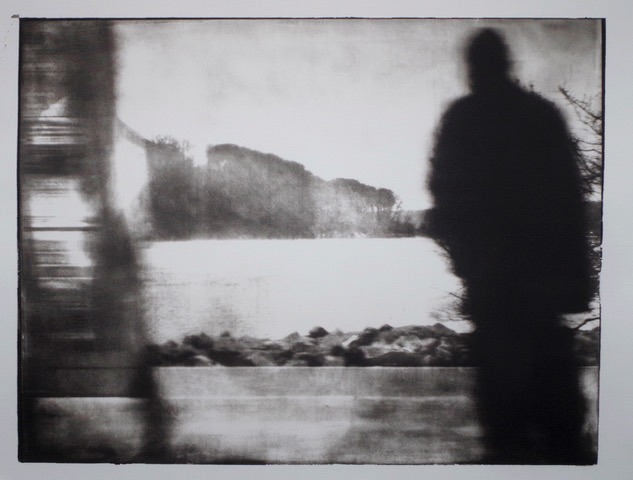
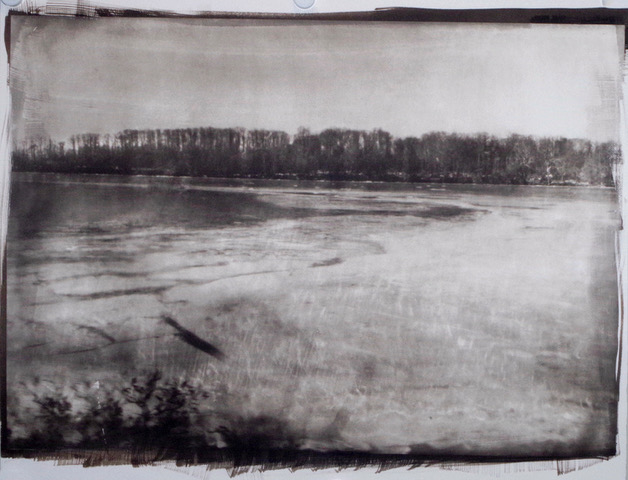
For these works, Enfield merges 21st-century techniques with 19th-century media to make each photograph look as if it has been plucked from the pages of a history book. She uses a slow shutter speed when capturing her views of the Hudson or the train tracks along it, then makes an ambrotype—a wet plate collodion on glass—of the photograph before hand-printing it on watercolor paper. “With any one of my projects, technique and meaning are closely connected,” she says. “The processes are not simply a way of producing an image; they are part of the subject itself.” During the Industrial Revolution, several paper, textile, and ironworks mills sprung up along the Hudson’s riverbanks, their runoff and pollution rendering the river toxic to humans for decades; it only recently became safe to swim in again. Enfield wants to capture these environmental consequences and fluctuations, as subtly as possible, provoking in viewers a sense of wonder about the river’s history. “It just amazed me how, during that industrialization, they didn’t even think about what the pollution would do as they put chemicals in the river,” she says. “Still now, we have to fight it.”