
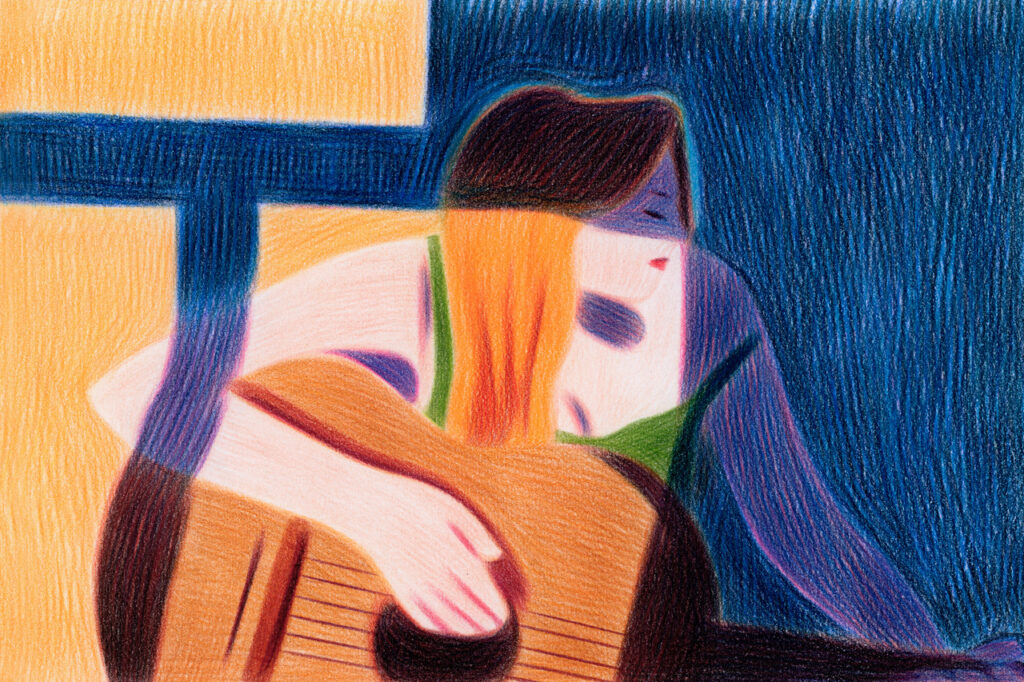
i. (2002–2003)
Grave.
The room is dark. The alarm clock’s numbers taunt you, flashing red in 4/4 time: 2:42. 2:42. 2:42. 2:43.
You are awake, much too awake, alone in that enormous bed in that enormous room, in a house on stilts buried deep within the forest. The night’s cold pushes itself through the windows and burrows deep into your lungs, twisting itself into tortured knots as you turn away from the clock and close your eyes. You are thinking of her. You always are.
Under the sheets, your fingers contort themselves into that emphatic opening chord, your left thumb and your right pinkie rooted on those mournful doubled Cs. Your fingers press hard into the mattress.
You leave your hands there, lingering, just as they do at the piano, the eight-note span as engrained in your fingers as holding a pencil or clenching a fist. That aching chord resonates in your mind, merging with the image of Catherine: the way her hair falls in loose, sweaty tangles onto her freckled shoulders, her fingers dancing along the taut neck of her guitar. She is strumming the melody of a song she’s heard somewhere, her crystalline voice crescendoing into the drafty basement air.
It swells again: the urge you’d felt, deep in your chest and in your throat, to trace your fingers slowly—so, so very slowly—along her flushed pink collarbone, along her throat and across her ruddied cheek. You push your fingers hard into the mattress as the second measure continues in your head.
And then the question, the question that’s been churning through your mind, every other minute, for two years now, maybe three. You open your eyes. And then you shut them quickly.
It’s not conscious, this playing. You’ve been working through the piece for so long that the music has woven itself into your consciousness: Its patterns have become the patterns of your life. Or maybe it’s the other way around.
Translated directly, Pathétique means “pathetic.” But that’s not right. “Full of feeling,” perhaps. Beethoven’s beloved sonata of pathos.
And then: those plaintive ascending octaves, and then, from that teetering height, the tumbling descent. There’s no loss of control—not quite. But almost.
And for that one fragile moment—fermata—a hopeful alighting, an inhale.
𝄁
Allegro di molto e con brio.
On Tuesdays and Thursdays, orchestra is the last period of the day. You pretty much never play with the orchestra, though. For one thing, Mr. Tsingaris doesn’t really choose pieces with a piano part. And also—and this brings you so much shame—you really suck at following along with the orchestra, and also at sight-reading in general. You’re okay at reading notes, but you’re terrible at reading rhythm, especially in the pieces you love most: not just Pathétique, but also pretty much everything Beethoven ever wrote for piano, and also preludes by Gershwin and Chopin and all the crazy weird stuff by Mozetich and Brubeck and Glass. Maryliz taught you how to compensate: First you listen to the music on CD over and over and over, until you’ve pretty much got it memorized. And then when you play something wrong during your lessons, which you pretty much always do, she corrects you, error by error, note by note, and you scribble reminders in the margins of the music.
trip-uh-let
HOLD
Recently, though, you’ve been thinking about the piano teacher you had in elementary school, a guy who called himself Dr. Ira even though he definitely was not a doctor. Dr. Ira was basically the person that made you fall in love with piano in the first place. He was kind of weird: His head was covered in lumps the size of golf balls, and he carried around a bag of silver dollars for you to fish from when you played particularly well. When a piece of music was slow and sad, Dr. Ira blew his nose honkily into his handkerchief, and when a piece was loud and scary, he covered his ears and ran screaming from the room. He gave you bizarre, imaginative directives: Play like you’re a raindrop, and you’re dancing on a rainbow. Play like you’ve drowning, and nobody can hear your cries for help.
Dr. Ira had taught you a few basic things about music, that  means silence, a break between notes, and 𝄇 means to go back and play everything again from the beginning. But overall Dr. Ira hadn’t really believed in teaching music the traditional way. Basically the main thing that you’d learned from Dr. Ira was that music was about instinct, and that being good at piano meant unlocking feeling.
Dr. Ira had retired when you were in fourth grade, and your mom hadn’t gotten around to finding you a new teacher after that. And then freshman year, finally, your mom had signed you up for lessons with Maryliz.
In general, Maryliz is pretty chill, but she can be pretty intense about music stuff. She picks your pieces for you—pieces she thinks you’ll like, and also that will teach you to play music the right way. Maryliz has taught you about key signatures and tempo markings and the basic elements of sonata form. You’ve learned, for instance, that sonatas take just a few themes and then hash them out over and over throughout the course of the piece, repeating and remixing them in a way that’s interesting and actually kind of beautiful.
On the days he isn’t there, though, you get straight to practicing. You warm up with scales: C major, both hands, from the clanging bass up to the tinkling high octaves, up and down and up and down and up. Then syncopated scales—the right hand twice as fast, then three times: up, down, up, down, faster and faster and faster. And then you do the whole thing again as you make your way around the minor keys on the circle of fifths: A then D then G. And then, finally, you are home: C minor, the key of so much of Beethoven’s best work, including Sonata Pathétique.
As your fingers move through their routines, your mind skitters. Yesterday you’d been sitting cross-legged across from Catherine on the lumpy brown couch in her family’s basement, listening to her work through the octave-spanning first few lines of “Help Me.” Her voice is as exquisite as Joni Mitchell’s, as lucid and elastic, but it also has a different quality—it’s a little bit earthier, a little bit sadder. As she’d sung, her eyes, those heavy-lashed eyes, with their indigo rims and irises the color of patinaed copper, had lingered in the middle distance, sparkling.
When she’d finished, she’d placed the guitar in her lap. And then she’d asked whether she could read you something she’d been writing.
You’d nodded, of course. Catherine is an amazing writer. No matter what she writes—song lyrics or short stories or papers for American history—it is always amazing. Lately, she’s been into writing parody articles in the style of Seventeen and Teen People. (Is your crush *tOtAlLy dRoOliNg* over you—or does he just have hantavirus?) And your thing these days is playwriting. Actually, Catherine was the one who’d given you the idea to submit this one-act play you’d written to a bunch of playwriting contests. You’d known the play was pretty good, but also that it definitely wouldn’t win anything. But you’d actually won an award, and also gotten a letter from one of the judges, a famous playwright who’d said that your command over genre allows for its playful subversion, that you excel at using the language of music to express what words cannot. The judges probably had to come up with compliments for all of the plays, even the ones that weren’t even that great, but still—it gives you a little hope that you could maybe become a professional writer one day. And all of that is thanks to Catherine.
Catherine is really into classic literature, and also has a habit of reading textbooks about super esoteric topics, like philosophy and politics. And because of that, her vocabulary is insane. Last year she’d been interviewed for the school newspaper about what students thought about the new cafeteria lunch options, and she’d gone on this really long monologue about how the guy who wrote Gulliver’s Travels argued that everyone should be eating babies for the sake of the economy or something. And they’d refused to quote her because, for one thing, they’d thought that no one would believe that a 16-year-old could actually speak like that, but also because they’d kind of figured out that she’d been fucking with them. And of course she definitely had been. Not a lot of people know this about her, but Catherine is actually hilarious. And not like in a dumb teenage way—in a super clever, mature way. It’s one of your favorite things about her.
After she’d finished the song, she’d put the guitar down. For a moment, the two of you had sat in silence. Catherine is the only person you can do that with: where you can just sit there and enjoy each other’s company, where it’s not awkward and it’s actually really nice. And then her eyes had lit up. Had I heard about this thing called ekphrastic poetry? You’d shaken your head, and then she’d explained: Ekphrasis is a piece of art that is inspired by another piece of art. Traditionally, she’d explained, the inspiration is visual art: Think about “Ode on a Grecian Urn,” which you’d learned about in social studies. But she’d been thinking: She didn’t see any reason you couldn’t do ekphrasis with a short story, or a movie, or even a symphony. She’d looked at you, her eyebrows raised. You’d nodded.
Her eyes were sparkling by this point, the way they did when she was lit up by an idea. “So, like, you know that song, on the CD you made for me? The one that starts, A long, long time ago …” She’d imitated Don McLean’s super low voice, the way he drew out the longs. “I can still remeeeeember …”
“American Pie.” Your mom and the horrible man she’s married to are obsessed with that song. They’ve made you listen to it so many times that you know every single random verse, even the ones about Satan and moss growing on rocks.
She’d smiled. “Okay, so.” She’d sat up slightly, then pushed her hand into the pocket of her jeans. She’d fished out a crumpled-up piece of lined paper, opened it up and smoothed it onto her thigh. Then she’d sat up straight, affected a professorial tone. “Ahem. So. Ode on a Song About Pie.”
Now, as your fingers are doing their thing in C minor—up and down and up and down and up—your mind’s eye is on Catherine’s hands. It’s not like you hadn’t been listening to her—you’d been taken by the song’s wordplay and its overall cleverness, the way it had been structured like the song itself. And also, Catherine’s spoof had definitely been more layered than the original song: On the surface her song had been about, like, pie filling, but it had actually been about George W. Bush and the war in Iraq. But here on the bench, in this bare drafty room in the back of the music building, what you are thinking about is her hands: the gentle way they’d held that sheet of paper, as if it were fragile, as if it were beloved. And as you’d sat there, watching her, listening, what you’d realized was that Catherine would never touch you with that same tenderness.
You’d had that thought, you realize now, and then your focus had continued to drift: to the rainbow crocheted quilt draped across the back of the couch, the stack of Beatles records, the wood-paneled walls with protest posters from the 1970s.
But now, when that thought comes back to you, you realize something else: Even thinking that thought—it means that you’d wanted her to touch you. And also: It meant that you’d wanted to touch her, too.
You feel the heat rise to your cheeks, the quickening thump-thump of your heart. And then: that question again, the one that keeps you awake, that bombards you five, 10, 100 times an hour, every single hour of every single day. You pull your hands back from the keys.
You take a deep breath, and then another. And then: You place your right thumb on middle C, slowly stretch your left hand onto the Cs one and two octaves below. After a moment, your heart rate ritardandos into quarter notes. Your attention stills. You take one breath, and then another. You start to play.
This second section—which Beethoven tells you to play swiftly, and with spirit— is fun. The melody is simple and dramatic. But that left hand, oh man: those magnificent rumbling octaves. Over and over, over and over, obsessive to the point of frenzy.
For the next few minutes, you study the page: the left hand’s double-octave ascent, and then its simple quarter notes. The same pattern, again and again and again and again: ascent, quarter notes, ascent, quarter notes. And the right’s staccato declarations—in treble clef, and then, in flights of fancy, bass—and how they alternate with its delicate warbling cry. The volume at baseline is forceful but restrained, the tempo vigorous without losing control. But you throw force into it, sending currents of energy from one finger, from one group of fingers, from one hand to the other, alternately building intensity and then quickly seizing it back. When you were first learning this piece, you would bang with abandon, delighting in the power you felt in fortissimo. But that was a false power, you’ve realized, forced and artificial. Now you play with more subtlety, emphasizing relationship: harmony, disharmony, harmony. The two voices are aware of each other always, reacting and responding. The beauty of the piece lies in their tension.
You play this same section over and over for 15 minutes, maybe 20, stopping each time at measure 88. And then you stand up, pluck the sheet music from the stand, and slide it into your open backpack. You zip it up, sling it over your right shoulder, and tiptoe out of the room.
The orchestra is practicing, Mr. Tsingaris busy waving his baton. As you shut the door to the music building, nobody sees you go.
The route zigzags over the mountain. It’s hot as hell, and your backpack weighs a fuck-ton. As you climb, the piece’s rhythm echoes in your head. And then you remember that Maryliz told you to slow down here, to keep yourself from getting carried away by the momentum. You swallow, hitch your backpack a little higher on your shoulders. A few weeks ago, you’d played this first movement for a Saturday morning recital Maryliz had had for a few of her advanced students. All of the other students had been adults, women who had returned to the piano after many years away. They were fun, these women, relaxed and self-possessed. They each had their own style, swishy skirts or pink high-tops or big earrings made of clay, and they’d all made easy small talk before the performance had started. These women probably had lots of friends and as much sex as they wanted.
And they had complimented you. One had told you that your performance was articulate. Another had said that she’d admired how delicately you played, how you’d somehow coaxed vibrato from the keys, as if you were bowing a violin’s strings. You play with such command, one had said. And you look so beautiful while you play. All the boys must be lining up for you.
They’d obviously only said these things out of obligation, or maybe some misplaced maternal instinct. You’d noticed that some moms felt like they had to automatically flatter kids, especially girls, even if what they were saying definitely wasn’t true. And Maryliz is always doing stuff like that, too. She’s always asking how things are with your mom, saying things like, You know I’m always here for you. And she’s always complimenting you on being multi-talented and a brilliant young woman with a very kind heart—the kind of things that a person would say to someone who isn’t those things, like how parents tell toddlers that they’re strong or smart or brave.
You come to a flat stretch of road. You stop for a moment, your heart pounding. Then you shrug off your backpack and let it thud onto the asphalt. The back of your T-shirt is sweat-wet; exposed, suddenly, to the air, you feel a shock of cold. You hook your forefinger through the elastic on your wrist and pull your hair into a ponytail. Your mom has told you that you shouldn’t wear your hair up, because it makes you look severe. You should wear it down, blow it dry so it stays straight: That way you look so much more feminine.
Last night, you’d been on the phone with Catherine, tearfully relaying a fight you’d had with your mom and that horrible man, when your mom had thrown open the door to your room. Seeing the phone, she’d hesitated for a moment, then rolled her eyes. “Oh, you can talk about me all you want,” she’d said, shaking her head. Then she’d lowered the pitch of her voice, mimicking you. “‘Oh, my mom is such a horrible person. My mom is just the worst mom in the whole entire world!’” She’d shaken her head, laughing ruefully. “Well, you just go ahead and say whatever you want. But I’ve got to tell you something. Because someone’s got to say it.” She’d narrowed her eyes, her face contorting with rage. “The way you carry yourself these days, it’s so … so masculine. It’s like … like a butch lesbian. You’re like a Mack truck, is what you are.” The way she’d looked at you—it had something in it, something like hate. “No one else is going to say this to you, because they act like the fact that you get good grades, that it makes up for other things. Well, let me tell you something: It doesn’t. Just because you’re smart doesn’t mean you’re a good person.” She’d swallowed, stared at you for a moment, breathing heavily. And then she’d turned around, slamming the door behind her.
You’d looked down at your phone. Sometime while your mom had been screaming, Catherine had hung up.
You’d swallowed. You’d taken a deep breath, set your phone down on your desk, and walked into the closet, softly closing the door behind you. You’d sat down on the floor, hugged your knees tight against your chest. You’d sat that way for a moment, your heart pounding, your eyes blurry and burning. And then you’d heard your phone vibrate. After a second, it began to sing out with the ringtone you’d assigned to Catherine.
You’d scrambled out of the closet and reached for the phone. The sound of her voice was a warm pond, a clear resolving chord. “The way that she talks to you,” she’d said slowly, in that gentle high voice. “No mom should ever talk like that. Especially to you. You deserve so much better.” She’d paused. “You know that, right?” You’d listened to her breathing, saying nothing.
Now you pick your backpack up and heave it over your shoulder, contorting your arm through the strap. You keep walking, the route as familiar as the melody in your head. And then, finally, you dart across the street, look quickly in all directions, and duck through a hedge of thorny bushes. Crouching low, you scramble downhill through a garden, twists of ivy snatching at your ankles.
You trip: over exposed roots one day, an overturned flower pot the next. You stand up, dust yourself off, put your backpack back on. You take a deep breath, exhale—a quarter rest, and then another—and then climb the two flights of rickety wood stairs. You open the door.
She is sitting on the tattered brown couch in the living room, strumming her guitar. She’s wearing a forest-green tank top, the tops of her breasts exposed, freckled, flush against the smooth curved body of the instrument. You can feel the heat rise to your cheeks. She looks up at you. She smiles.
Tempo I.
The thought is back, the question. If you were—if you were, let’s just say, as a thought experiment, let’s just say you were into girls—
Would your life ever be okay?
Allegro di molto e con brio.
Over the next few months, you play the same measures over and over: the rumbling, the rise and fall, the plaintive, declarative chords. But as the air gets cooler and the days get shorter, the music begins to feel different, even as the patterns remain the same: the practice room, the crotchety brown grand, the scales, the question, the question.
One cold, dark day, as your hands tread and re-tread the same measures, it comes to you, suddenly: that conversation when Catherine had told you about ekphrasis.
When she’d finished, she’d put her guitar in her lap, then taken a breath. “Are you happy?” she’d asked, her indigo eyes wide. “I mean—are you happy, with your life?” When you think of it now, what comes to mind is the way she’d looked at you. Her vulnerability, her desire to hear, truly, what you’d had to say: It had been overwhelming. “Because—” she’d paused, then swallowed. “Because I don’t think I am.”
And then the two of you had talked, for a very long time. You’d talked about her life, about the way that everything had changed since someone she knew well had tried to kill himself. And you’d talked about how both of you could understand why he’d tried to do it. In fact, you think about it all the time: why people choose to stay alive. Just making it through, night after sleepless night, that question ricocheting in your mind: It takes everything you have and then some just to not give in. After he had tried the first time, he hadn’t tried again. You don’t know if you’ll make that choice every single day, every single week and month and year for the rest of your life.
But you don’t say all that. You respond more simply: No, you are not happy. You haven’t been happy since you were in middle school, which feels like a different time, a different life, when you were a different person altogether.
Now, your fingers running through the minor scales, it occurs to you that maybe what you’d said to her that day hadn’t been completely true. Nearly every night, once you finally fell asleep, you dream that you were drowning. And when you wake up, the feelings linger: the dark, the cold, the terror.
Ninety-nine percent of the time, all you want to do is to let the force of the water pull you deeper. But also: There’s that feeling. That feeling that you’d had that day, sitting on the couch with Catherine, watching her watch you. She understands you, and you understand her. And the way she looks at you: as if she’s looking for something, and she knows that you are looking for that very same thing.
Your scales are in C minor now. Your fingers are moving up and down the keyboard, faster and faster. In your mind’s eye, you can look at her for as long as you like.
In the fall, you enter a classical music competition for high school students. You play a piece you’ve developed, a kind of jazzed-up, funkified version of Beethoven’s “Für Elise.” You’d come up with it one day when you’d been playing it for fun. You’d sped up that tee-tottering opening melody, made it hop around the octaves. You’d liked that: It sounded like a little girl skipping. And then you’d played around with breaking up the chords that follow, tumbling them backwards into the rumbly low registers. And ever since then, you’d gotten really into playing “Für Elise.” Every time you played, you combined the elements differently. And every time, whatever you wound up with was recognizably Beethoven’s, but it was also something else entirely.
At the competition, when you finish, you turn around to look at the judges. They are silent. And then, after a very long moment, one of the judges, this uptight-looking lady with a thin pearl necklace, speaks first. Her voice is clipped. “That is not how this beautiful piece of music goes.” Ludwig van Beethoven cannot be remixed.”
A few months later, you perform the first movement of Sonata Pathétique at the winter concert. And then, soon after that, you decide to stop playing the piano. In your last lesson, you tell Maryliz that you’ve decided that you need to focus on your writing. That’s your true art form, you say, the way that you express yourself best. You tell her that at this point, you’ve gotten everything you can get out of your relationship with the instrument, and that playing is more of a burden than a joy. You believe that you will not regret this decision.
Grave.
Under the covers, your body feel claustrophobic, hot. The clock blinks insistently, on that cruel staccato rhythm: 3:02. 3:02. 3:02. 3:03. The way you carry yourself these days, it’s so masculine. You force your eyes shut and take a deep breath, then slowly let it out. You do it again, and then again. You’re like a Mack truck, is what you are.
You inhale.
Allegro molto e con brio.
In June, before you graduate, you drive out to the ocean with Catherine. It’s a beautiful day: sunny and blue-skied, with a gentle caress of warm salty wind.
Now, on the shore, facing away from each other, you strip off your shirts, your shorts, your bras and underwear, then shimmy into tight nylon bathing suits. As you pull the straps over your breasts, your shoulders, you can hear her body squeaking.
When you’re finished, you turn around. You look at each other for a long, silent moment. Then she asks if you want to jump into the ocean.
You nod, turning to face the water. And then you run.
ii. (1999–2000)
Adagio cantabile.
A few minutes ago, Zack M. had been super brave. He’d crossed over to the girls’ side of the gym—during “Tearin’ Up My Heart,” so people were jumping around like crazy—to ask your friends a question: Would Emily be interested in dancing with Nathan two songs from now? You could barely even hear him, and also his voice had been cracking super bad, but still: oh my god. Obviously you’d said yes, because Nathan is actually already your boyfriend.
The whole thing started over the summer, only a few weeks after your bat mitzvah. You and Nathan had been seated next to each other at Alisha’s bat mitzvah party. Obviously that had not been an accident, because everybody knew that Nathan majorly liked you. But the only thing was—you weren’t sure if you liked him. So you’d asked him a bunch of questions, like what he was playing on piano—after the talent show, everyone knew that Nathan was crazy good at piano—and what kind of camp he went to and also what his favorite color was. Sam C. had overheard the favorite color one, and made fun of you for asking a little kid question. But that actually didn’t really bother you that much, because, first of all, you knew it was a good question, and second of all, questions like that can really tell you a lot about a person. Plus, you’d liked his answer, which was iridescent clear. That had told you that Nathan was definitely more than just a hunk. Also he’d asked you a lot of really good questions, like if you could be good at one thing what would it be, and also what was your favorite song.
And so when he’d come over to your group’s table during lunch and asked you to be his girlfriend, you’d obviously said sure. And now your arms are reaching up around his neck, your head hovering just an inch or two from his shoulder, while the DJ blasts Savage Garden.
I want to stand with you on a mountain
I want to bathe with you in the sea
I want to lay like this forever
Until the sky falls down on me
This is one of the reasons why Nathan is an amazing boyfriend: Not only did he remember that “Truly Madly Deeply” is your favorite song, even though he’d asked you more than a month ago, but also he’d timed his request perfectly—not too early, when hardly anyone was even there yet and kids were too nervous to act weird and random, but also not too late, when kids would be super tired and act way too weird and random.
Now he’s gently clasping your waist with those amazing arms, those amazingly strong arms with those super strong muscles he gets from all those hours at the piano. You sway in gentle unison, adagio. Time is slowed: The eighth notes hold as long as quarters often do, the melody as tender as a lullaby.
You lay your head gently on his warm chest, feel the beat-beat beat-beat beat-beat of his heart. Your whole body feels different: like it’s magnetized or something, buzzing. You want to press your body into his, make it get closer and closer until there’s no space between you at all—and then, somehow, to get even closer still.
You look up at him, swallow. And then … And then you feel something. Like something is … This is so fricking weird. Something—between your legs—something is poking you.
And then: You realize. You realize what is actually happening right now. Nathan has a boner. And then you realize something else: Nathan has a boner because of you.
And then you realize something else. Your body—it likes being poked by Nathan’s boner. This tightening between your legs: It’s weird, but it’s not bad weird.
You loosen your arms from around his neck. You don’t let go completely, but you take a step away from him, create a small barrier of air between your bodies. He looks at you for a moment, like he’s going to ask you a question, like he’s disappointed. But he doesn’t. All of a sudden, the song sounds super loud.
I want to stand with you on a mountain
I want to bathe with you in the sea
I want to lay like this forever
Until the sky falls down on me
You continue to hold each other, swaying back and forth, back and forth, back and forth.
Dear diary,
Guess WHAT!!! Today something huge happened!!!
Today after school I had a date with Nathan!!!
After school he picked me up at my locker and then we walked to the park. First we went on the slide and then we went on the swings. After that he asked if I wanted to walk to the creek and I said, “Sure.” And then after about one minute of walking he asked, “So, have you ever been kissed before?” And I said “no.” And then we kept walking for about one more minute.
And then we were standing by the creek and HE KISSED ME!!!!!! So now I officially have a boyfriend AND had my first kiss!!!
Right when I got home I called Vivian and said “Can you sign onto AIM?” And she did. Celine and Lucy were already signed on, so she only had to call Charlotte and Lex.
When everyone was on I told them. They were all happy for me. I am actually the first one out of all of us to be kissed so now I have experience and can prepare them.
I guess the next thing to do is make out. I don’t know when that is going to happen but obviously I’ll let you know.
Love,
Emily
A few days later, you’re at the park with your friends after school, like pretty much every day. You’re in a pretty bad mood because Nathan broke up with you. Actually what happened was that during the math quiz, Zack M. had passed Vivian a note saying that Nathan was breaking up with you and then Vivian gave you the note during lunch. So now everyone is trying to cheer you up. But the thing is is you’re actually a little bit relieved, because kissing Nathan was nasty and now you don’t have to make out with him.
You’re on the middle swing, and Celine is on the one to your right. Lucy is on the other one, and Vivian, Charlotte, and Lex are sitting on the tambark. As she swings, Celine is telling everyone about some article she read in Teen People.
“Experts say that there’s actually a method proven by science for finding your next boyfriend,” she announces. She is gripping the swing’s chains with both hands, rocking lightly back and forth. “So the first thing that you have to do is decide who you want to have a crush on. Then the next thing you have to do is find an excuse to be near him. Like, find a way to be in a group project with him, or sit next to him on a field trip. And then you pay attention to him, but not too much attention. Like only a little. And then…” She pauses dramatically, stops her rocking. “And then you ignore him. Completely. For at least two months. Maybe even three.”
You look at everyone else. Lucy and Charlotte are nodding, taking it in. Then you look at Vivian. She looks back at you, raises one eyebrow.
Lex stops chewing, swallows. “But if you ignore him, wouldn’t he think that you’re mad? Or that you don’t like him?”
Celine sighs loudly. “Ugh. No. Exactly the opposite.”
Vivian chimes in. “And who said all of this, again?”
Celine shakes her head and sighs. “I already told you. Experts.”
Recently, you’ve been realizing that Celine is actually super annoying. She always talks in like this really confident way that makes what she’s saying sound true even when it’s really stupid or totally made up. And another thing is that Celine has actually been getting kind of mean. Like last week, when you told everyone that you couldn’t go to Baskin-Robbins after school because your mom had said that you needed to go on a diet. Celine said that that was crazy because, for one thing, you are actually really skinny, and two, everyone knows that your mom has issues. But that time everyone had agreed with her, so you’re not sure if that was a case of Celine being mean or whether what she was saying could actually be true.
But she definitely has been being a jerk about a lot of other things, too. Like there’s this new girl at school named Eve who you’ve started being friends with, like even going to hang out at each other’s houses, and you’ve been trying to get everyone to include her in your group. But Celine has been saying that she doesn’t want Eve to be part of the group and is even doing things like not inviting her to her birthday party. And the unfair thing is that she did invite this girl named Catherine who she knows from French club, who’s quiet and kind of weird and always wears a giant sweatshirt that says DENIAL: Not Just A River In Egypt. You have nothing against Catherine, obviously, but it’s not like she just moved here and needs new friends. Plus, Catherine has never even eaten lunch at your table or hung out with your group even one time.
Celine is still talking about these supposed experts. You grip the swing’s chains and, keeping your butt in the seat, you scoot one step backward, and then another and another. Standing on your tippy-toes, you lean back as far as you can, your head dropped all the way backward, squinting up into the afternoon sun. And then—inhale, exhale, whoosh: You let go.
Eve’s mom is super different from your mom. For one thing, she has kind of a loud voice, and she’s always bossing around Eve’s dad. Also, she’s always talking about things in the news, like the president getting impeached, and also how it’s super important for girls to be feminists, which means looking out for lies from society. That’s actually one of the very first things that Eve told you when you first met her: that she’s a feminist, and that she definitely does not believe that girls are not as strong as boys, or that girls have to be skinny, or that girls should always have to be thinking about how to get boys’ attention. Eve is short and muscular, and you’ve noticed that she doesn’t shave her legs. Also, her eyes are this really crazy blue, like the color of the sky, and it’s hard to make eye contact with her because a lot of the time she doesn’t look away.
You’ve started going to Eve’s house at least once a week, and sometimes on hikes out to the marshes with her family. Sometimes you spend the whole weekend at Eve’s house, sitting by the side of the pool as Eve takes swim lessons, talking with Eve’s mom.
Eve’s mom likes you a lot. She gives you compliments on all of your columns in the school newspaper, and is always giving you and Eve books that you should read together. One time, Eve’s mom asked you what you planned to be when you grow up, and you said a novelist or a professional book reviewer or maybe an English professor, or probably all three at the same time. And she’d nodded, and gotten super quiet, and then said, You know, Emily, it is not an easy thing to be an intelligent woman in this world, and then looked kind of sad. Eve’s mom is super weird.
After dinner, Eve’s parents and sister leave to watch a movie, and you and Eve are left in the living room, and neither one of you says anything. After a moment, Eve walks over to the fireplace, where there are three guitars on stands. She crouches down to grasp one of the guitars by its neck and brings it over to the couch, like a mom cat carrying a kitten. You sit down across from her, cross-legged, as you watch her cradle it into her lap and start to play.
As she strums—something cool she made up, you think, though it could also be by the Beatles or Mozart or something—it occurs to you that there’s something different about the way she’s playing. And then, after watching her for a minute or two, you realize: Eve is a mirror image of what you think of when you think of a person playing the guitar. Her right hand is picking out the chords, and her left hand is strumming. Eve is left-handed, and she’s playing a guitar for people like her. It’s awesome.
After a minute or two, she pauses, and then she looks at you. She’s not asking you a question, or looking for a compliment or anything. She’s just looking.
You feel the heat rise to your cheeks, the urge to say something, to do something, to make a joke. But you don’t. You hold her gaze.
Vivian comes over to get ready before the winter dance. You take a shower right before she gets here, put on the outfit you’ve been planning for weeks: a black T-shirt under an open chambray button-down, with cargoes and thick-soled tie-up boots that your mom calls clodhoppers. When Vivian arrives, wearing a purple tank top and tight flare jeans, she immediately joins you in the bathroom so you can dry your hair and put on makeup.
You’re standing in front of the mirror, rolling body glitter onto your cheeks, when Vivian suddenly turns to you. “Oh my god,” she says, her eyes wide. “Your hair.” She reaches over and touches a damp strand near your ear. “It’s, like … wavy?”
You examine your reflection. “No it’s not.”
She turns back to the mirror, but keeps her gaze on your reflection. “No, it definitely is. Like no offense, but your hair is always, like, kinda frizzy? No offense. But when it’s wet? It’s …” She smiles at your reflection. “It’s actually cool.”
You shrug. Vivian’s mom is always saying things like, You look lovely today, girls and, That blouse is very becoming on you, even when those things are obviously not true. And also blouses are what moms and teachers wear, not kids, so she doesn’t even know what she’s talking about. The point is: Vivian is used to getting compliments, so she probably just thinks that she has to give them, too.
Your mom knocks, then announces that Celine’s mom is here to bring you to the dance. You open the door.
She looks the two of you over. “You look very nice, Vivian,” your mom says. And then she turns to you. “That’s …” she sighs. “That’s what you’re wearing?” She mutters under her breath: I just don’t know where you came from. Then she reaches out, touches a damp strand of hair. “You cannot go out with your hair like that, Emily.” She sighs. “Jesus Christ. Come here.” She pushes you back into the bathroom, tells you to dunk your head in the sink. Then she turns on the faucet, rewetting your hair. With Vivian looking on from the doorway, she brushes it out, and then, section by section, blow dries it straight.
Celine’s birthday party has actually turned out to be pretty fun. Also, that Catherine girl is perfectly nice. Quiet, and definitely a little bit weird, but nice. First you had pizza, and then there was a sundae bar, and then everybody watched Now and Then. Celine’s mom said that if it didn’t start raining after the movie then you could all bring your sleeping bags to the big trampoline on the hill and have the sleepover out there. Now Celine is lying in the center of the trampoline, because Celine always has to be the center of everything, and you can hardly even hear what everyone is saying. You’re pretty sure they’re playing Truth or Dare, which is pretty much always about dating, or making out, or touching a penis. In a loud voice, Celine informs everyone that she watched something on the news that said that the whole reason why the president was in trouble was that a lady did a blow job to him, which means that she put her mouth on his penis. On purpose.
Lucy jumps in. “Guys. What if, like, in P.E., a boy knocked into you and he had a boner?” Everyone gasps. Lexy makes a barfing sound.
You close your eyes. Last weekend, after Eve had played her guitar, she’d asked you to play piano. “But I haven’t even taken lessons in like four years,” you’d said. “I pretty much don’t even know how to play anymore.”
“It’s okay,” she’d said. “Just play something. I just want to listen to you play.”
And so you’d walked over to her parents’ old upright and sat down on the bench. You’d thought for a sec, and then played the first few bars of a song you’d first heard on KDFC, which is the station your mom plays in the car when she says, I think we could all use some classical music to calm down. You’d shushed everyone until it ended, and then made your mom turn up the volume so you could hear the announcer. Students of the Romantic Era will have identified the second movement of Piano Sonata Number 8, Opus 13— known, of course, as the Pathétique Sonata, by the great German composer Ludwig van Beethoven. You’d made sure to memorize all that—number 8, opus 13, Beethoven, paht-eh-teek—and the next day, after a super long time searching, you’d managed to find the sheet music on the World Wide Web.
It had taken you a super long time to figure out how to read the music. When you’d first started taking lessons with Dr. Ira, he’d taught you this crazy system he’d made up, which was basically just a bunch of numbers and squares and exclamation marks and plus and minus signs. But just before he’d retired, he’d started teaching you to read actual sheet music using something called Easy Piano. You hadn’t gotten very good at it, but you remember enough of it that you’ve figured out how to play the second movement.
You got a CD of Beethoven’s sonatas, and you’ve been listening to the whole thing of Pathétique. It’s actually super interesting. Each of the movements has a super different mood: The first movement is Grave, which you learned from the World Wide Web means “solemn,” which is another word for serious. And the second movement is Allegro molto e con brio, which means “very swift, with spirit.” And then you’d studied the sheet music. Back when you were taking lessons from Dr. Ira, you’d thought that the 𝄇 only came at the very end of a piece. But in Pathétique, 𝄇 comes at the end of every movement, too. And when you think about it, that actually makes a lot of sense: Beethoven is pretty much saying that each movement is a whole complete story, but also that the three stories work together to tell an even bigger, even more complete story. Like chapters in a book. Or life.
Sitting at that upright piano in Eve’s living room, you’d gotten as far into the music as you had memorized. And then you’d kind of mussed around and repeated a bunch of stuff, then slowed it down and played super duper softly until it faded to silence.
When you’d finished, you’d kept your fingers on the keys and the foot on the pedal, letting the music hover in the air. And then, when you couldn’t hear the notes anymore at all, you’d turned around to look at Eve.
She’d had tears in her eyes, you’d seen, in those blue eyes the color of a cloudless sky. She’d swallowed, then smiled. “Emily,” she’d said, after a long moment. “You have to keep playing. You have to.”
The way she’d looked at you: You can’t get it out of your mind.
Over the next few months, Celine and Lucy and Lex’s parents decide that they’re going to different high schools. And now pretty much all your group talks about is how even though you’ll be at different schools, you’ll still hang out at the park and have sleepovers on Celine’s trampoline every weekend. You all agree that you’ll have to make some new friends, just so you’ll have people to hang out with at school, but pretty soon you’ll all have boyfriends anyway, so it pretty much won’t even matter.
You still go to the park with everyone most afternoons after school. But sometimes you just walk home by yourself, do your homework, and then spend the rest of the afternoon getting the SimpleText reader on your computer to read long chains of nonsense syllables. You’ve made dozens of recordings, all of them with a different rhythm and a different feel. Vivian doesn’t really get it, but Eve thinks they’re awesome, and you’ve actually made a few songs just for her. And then when you get bored of computer music, you go over to the piano and practice the second movement of Pathétique. By the end of the year, you can play the entire thing.
But the end is still frustrating. Lately, you’ve found it hard to fall asleep, your brain going crazy with questions that freak you out, that for some stupid reason you can’t figure out how to stop. You lie awake, at one and two and three in the morning, the clock blinking its insistent red numbers while the ending measures echo in your mind. Those last few phrases you can get, the way the notes spin and prance as if they’re chasing after something, stopping short just before they catch it. But those ending chords: the way they settle down softly, like a sigh of relief, with only a delicate breath between them. Those you can’t seem to master, and you just can’t figure out why.
You can play the actual notes, obviously. But that isn’t the problem: You can’t play as tenderly, as expressively, as the music demands.
But here—awake, much too awake, night after night after night—you try. You press your fingers into the mattress, your thumbs and pinkies on those soft doubled As. But that question: It won’t go away.
iii. Rondo. Allegro (2022–2023)
guess what!!!
It takes a few hours for Alex to text back. What???
today the instructor gave us a prompt:
write your sexual history in three sentences
Wow. And???
this is what I wrote:
“I used to be scared. Then I was not scared. Now it is my favorite thing.”
He responds with a smiley emoji, the one with blushing cheeks. In the class, the instructor, a famous essayist with fierce blue eyes who writes about feminism and bisexuality and the political imperatives of publishing memoir, walks you through a few different exercises: Make a list of the dirtiest words you can think of, then write a scene with five of them. Write a sex scene using only dialogue. Write a sex scene with no dialogue. Write a sex scene that doesn’t contain any sex.
When she gets to the last exercise—Write your sexual history in three sentences—you think immediately of the week before, of the late afternoon sunlight streaming softly onto the bed as you and Alex rocked and rocked, adagio cantabile. With him, this had felt as natural as language, as satisfying as articulating a complicated thought. It had felt like entwining the rhythms of your body with his, this person you’ve been coming to believe that you might love.
When the instructor asks for volunteers, you read your sexual history to the class.
Now I am not scared.
When you read it, one woman hollers, Yes! When you read it, you feel proud. And when you read it, you think that it is true.
A few weeks later, Alex tells you that he needs some time alone.
You feel the steady beat of time begin to falter, then collapse. For a week—two weeks, three, a month—you feel like you are living in some dark place, some dark place with no rhythm and no sound.
A few weeks after that, you start to play the piano again.
You have a keyboard in your apartment, a Korg SP-250 you’d bought your first year out of college, when you’d gone through an obsessive six-month period of re-teaching yourself to play by watching old performances on YouTube, over and over and over again.
In the years since, you’d hauled the keyboard from apartment to apartment, and then into storage when you’d moved to Guatemala, and then back to everywhere you’d lived in Boston and Manhattan and Brooklyn. But you’d barely touched it. Every so often, when you were trying to impress a guy, you’d relearn a piece or two. But the keyboard gathered dust for weeks, months, sometimes years at a time. Even during the pandemic, when you had nothing but endless horizons of time, the keyboard served only as adornment, as reminder.
You sit down at the bench. Instinctively, your fingers settle into C minor chords.
After the first shutdown, your reporting assignments had dried up. You couldn’t go to the border with Mexico, where you’d been reporting on asylum seekers, or to Guatemala, where you’d been reporting for years on Maya communities. In the past few months, you’d begun to get some assignments here and there—a story in Indiana, a much longer one in Queens—but there are still long stretches where you have very little work to do.
At first, you just decide to start playing again. A week or so in, you set a goal: You want your sight-reading skills to get to the point that learning new pieces is more joy than tribulation, where you can play to relax, to assign some form to emotional experience. But soon after that your goals coalesce: You want to play Sonata Pathétique.
You decide that you want to play the movements you’d played as a child and as a teenager, just as well or maybe even better, but you also want to play the final movement: a rondo allegro, vivacious and happy, which builds and inverts the themes established in the first and second movements, which makes the piece as a whole cohere. The third movement deepens and concludes the sonata’s narrative with an articulate, expansive salvo, one that is at once somehow both surprising and inevitable. As you turn the pages, looking it over, it occurs to you that you don’t know why you’d never learned it.
You read up on the history of Pathétique, take a class on music theory. You learn that sonata form isn’t just a mishmash of themes, chaotically mixing and remixing; there’s a standard three-part structure—exposition, development, recapitulation—where the themes are introduced and then complicated, before they are, in some sense, resolved. You learn more key signatures, and how the tonic operates: how it’s the note that grounds a piece of music, that gives the piece a sense of home.
You find the recording you like best, from a playlist on Spotify: Vladimir Horowitz, from his studio recordings in 1962 and 1963. When you walk to the grocery store, when you wash the dishes, when you get dressed in the morning and undressed in the evening, you listen. You try to internalize Horowitz’s style: his lingering fermatas, his forceful fortissimos, the way his pianississimos make you stop what you are doing to listen closely every single time. You find recordings of him on YouTube, study the way his fingers seem to be not merely playing the keys but serving as extensions of them, as if the music were an organic force generated from deep within himself. And as you listen, you are awed by the ways he articulates Beethoven’s themes, the way they build order and coherence as they reveal themselves and then retreat, somersaulting through the narrative. Those emphatic opening chords, for instance—the pattern appears and reappears, over and over, nearly always transformed: sped up, slowed down, disassembled, transposed. It is the same with the rumbling octaves, the tumbling descents, even the patterned modulation between key signatures. The components alone are compelling, and often beautiful; but they can be understood fully only in relationship.
You play for hours at a time, sitting in front of the dusty window on your flimsy foldable bench. When you sit down, you start with scales: both hands, from the clanging bass up to the tinkling high octaves, up and down and up and down and up. Then you move on to syncopated scales—the right hand twice as fast, then three times: up, down, up, down, faster and faster and faster. The music comes back to you much more readily than you’d expected. Within a week or two, you are able to play the first few pages of the first movement, and then, in not too long, nearly the whole thing.
As you play, your mind skitters: to Eve’s parents’ upright, the drafty practice room at the back of the music building. We could all use some classical music to calm down.
You think about Dr. Ira, and realize that he was a strange and troubled man, and probably very sick. And Maryliz, oh Maryliz: how she’d seen you. How she’d seen your sadness, and everything that was out of your control. How badly she’d tried to help you. You understand how badly you’d needed help.
The way you carry yourself these days, it’s so masculine.
The last movement, like the first, is in C minor. It speaks in the same voice, but it tells a different story. It braids together two voices—one high, one low—which dance and spin and finish each other’s sentences, tripping over each other and throwing themselves forward as if propelled by a tremendous gust of wind. The passage is fast, but its melodies are simple; it takes no more than a week or two to embed them into your hands’ muscle memory. And you carry them with you everywhere—jogging, cooking, walking to the coffee shop and then walking back, climbing up and down and up and down the stairs. They are there as you lay in bed at night, your fingers staccatoing their broken chords softly into the mattress.
And then in time, you begin to hear the question. At first it is faint, barely even audible.
You have the same dream, over and over again. You’re at home—the home of your childhood, or your apartment in Brooklyn, or a place that your waking self would find unrecognizable but your dream self knows that you have always lived. You’re doing something mundane, reading or cooking or playing the piano, and you are motivated, suddenly, to explore your home anew. And every time, the dream takes the same form: You discover that the place you live contains much more than you had ever known. You discover attics, libraries, solaria with vaulted ceilings nestled high within the clouds. These dreams are in a major key, and the tonic note is always curiosity.
You use up your savings to buy a real piano. And you find a teacher: Fiona.
Fiona is in her 70s, an Australian woman whose soft-spokenness belies her training in the great conservatories of the world. In your first lesson, Fiona explains that she was trained by a great musician—a woman whom she calls only, with great reverence, Sofiya—who shaped her approach to listening and playing, to forging a life in music. And Fiona explains that her pedagogy comes from the Abbey Whiteside method, with its emphasis on physicality: Put a rhythm in your body and keep it going. You have a good internal sense of rhythm, Fiona tells you. What holds you back isn’t a lack of an internal metronome, but the fact that you don’t trust it.
Fiona believes in proper technique and the necessity of learning music theory, of the need to practice diligently and with great attention to detail. When you’d first reached out to her, you’d written that you were once a somewhat advanced player, but that you’d never learned theory or to sight-read properly. And in your first lesson you tell her your goals: strengthen your reading, and master Pathétique. In your first lesson, she asks you to play it. The entire thing? The entire thing. You do.
When you finish, you turn around to look at her. She is blinking, slowly nodding her head. After a moment, she speaks. “That was …” She pauses. “There were certainly some nice elements in there.” And then she asks how you’d learned to play it. You tell her about your process, about your hours at the piano nearly every single afternoon, how you’ve been reading the music and listening, over and over, to recordings of Vladimir Horowitz.
When you say that, she interrupts you, suddenly. “No,” she says, with a tone much firmer than you’ve heard her use before. She shakes her head. “What you’ve been doing is not reading. What you’ve been doing is memorizing. Mimicking.” She sighs. “Horowitz? Fantastic. A genius. One of the best who’s ever lived. But.” She looks at you sternly, holds your gaze. “You are playing his interpretation, not yours. Until you learn to read—and I mean read properly—you’ll never be able to truly see the music. You’ll never be able to interpret it, to make artistic decisions for yourself. And that’s—” she pauses, and then she sighs wistfully. “And that’s—that’s what playing the piano is all about.”
You practice every day, sometimes for two or three hours at a time. You sign back up for the dating apps, go out for coffee and drinks and go on walks along the pier with a bunch of different men. All of them are perfectly fine people; most of them seem fundamentally uninterested in the inner lives of anyone but themselves. “I wish I could go back in time and change my parents’ parenting style,” one guy tells you, tracing the rim of his glass with his finger. He pauses. “But obviously that’s impossible.” Every so often, you connect with someone you really like, but nothing goes anywhere with any of them.
You go on assignment, to Utah and Idaho, Guatemala and the U.S. border with Mexico. You cover religion and immigration, the policies of the president who was impeached not once but twice. To flesh out your reporting, you read as widely as you can: history and theory, political philosophy that searches for patterns in what seem like isolated events. In your research, you come across the Hegelian dialectic—thesis, antithesis, synthesis—and find it a useful schematic not only for the vicissitudes of history, but also for the shape of your own life.
You publish an essay about your childhood abuse by your mother and your stepfather, chronicling the process of learning to discern and tell the truth of your own story.
You play the first and second movements over and over, over and over.
You’re like a Mack truck, is what you are.
Just because you’re smart doesn’t mean you’re a good person.
You stop speaking to your mother altogether.
Every Wednesday, you go to Fiona’s studio in deep industrial Brooklyn, with its black-and-white striped carpet and its magnificent seven-foot Steinway. You begin to chat before and after the lessons: She tells you that she was married, but it ended long ago. She reads often, and she goes back to Australia to visit her sister and her father. “I didn’t get along well with my mother,” she tells you once. “She was cruel to me, really.” One time you walk in early, see her scribbling in a notebook. You watch her in silence for a moment. “You’re left-handed,” you say. She startles, and then looks up.
She nods. “Are you? I actually haven’t noticed.”
You shake your head: You’re not. But you have a disproportionate number of lefties in your life. And of course some of the most brilliant people throughout history were lefties, you say: Michelangelo, da Vinci, Einstein.
She nods. “I wonder why that it is.” She thinks for a moment. “I suppose it may be because we have to live in your world more than you have to live in ours.” She pauses, then smiles. “But of course, the dream for any pianist is to be fully ambidextrous.”
She always has you start each lesson in the same way, with something she calls Long Notes: You place your right thumb on middle C and your left on the B right below it, with each finger placed along what she calls the A Ionian scale. And then you play each note as slowly as you can bear to, holding each for several seconds or more. Fiona teaches you to listen to each note individually, the unique way it one reverberates and dissolves, the way it eventually binds itself to silence.
As months pass, Fiona begins to alter the exercise. Now you can hold the notes for as short or as long as you want, but there are rules: You can go up or down one note, or you can skip, but only in thirds or fifths: C to E, E to C, C to G and G to C. You are learning to make phrases, she tells you: the building blocks of musical architecture, without which notes would be nothing but sound. In time, she explains, you’ll be better able to not just listen, in ways that will deepen and complicate your playing, but you’ll also be able to compose.
Would your life ever be okay?
One evening, you are brushing your teeth after a shower. You see your reflection in the mirror, as you do every day; but today, for some reason, you stop, and you look.
You put the toothbrush down, drag your fist across the glass. You peer at yourself, and then you peer closer: your hair. It’s not curly, really, at least not most of it, but there is most certainly a wave. You bring your finger to a long ringlet right beside your ear. Slowly, you pull it down, and it bounces right back up. It’s actually cool.
In time, you are able to play nearly the whole last movement of Pathétique. And as you get to the end, with the themes so firmly established, you find, with some surprise, that you are able to anticipate what kinds of phrases to expect. By this point in the sonata, the form itself determines what comes next.
When you walk to the grocery store, when you wash the dishes, when you get dressed in the morning and undressed in the evening, you find yourself thinking about what Fiona said about mimicry. She’s right, of course. What you don’t ask yourself, and what you won’t ask yourself for quite some time, is why you’d believed that you needed to mimic in the first place. Only much later, after you’ve moved back to the forests and ocean of your childhood, after you’ve started to take lessons with a piano teacher who teaches you, finally, to approach music like you approach language, will you think back to the time in your life when you first learned to mistrust your own reading. And it is only then that you will begin to understand.
Every night, you play: You work through those last few pages of the music, with their sforzando cycling-through of all the piece’s themes. You work and you work at the piece’s finale, the drama of those cascading three-note phrases. Later you’ll make the connection about why this kind of phrasing, so fundamental to so much of Pathétique, seems so natural to you: It’s a cadence instinctive to how you think, how you speak, how you write.
You come to the end. When Horowitz plays, those final lines come as a shock, as altogether different than everything that had come before. And you make a decision: You want to play them differently. You want to emphasize the way those last measures unify everything that the sonata has said up to this point, the way they arrive at something new while making the trajectory obvious in retrospect, the way all good endings do.
The air gets cooler and the days get shorter. You are, without your full awareness, in a time of modulation: You play the notes that bind the key signatures together, over and over, until you’re someplace new.
You go on your first date with a woman, and then you go on a few more. One woman tells you that she is trying to honor the version of herself that existed before her mother died when she was four. She tells you that every night, for just a few minutes, she puts on a tutu and twirls.
Eventually, you match with Yael.
She is a dancer and a clinical psychologist, brilliant and fierce, with sparkling green eyes and a wild mane of long dark curls. On your first date, you wear a tight tank top and big earrings made of clay. You meet for a picnic in Prospect Park, eat slices of pineapple and linger until well after the sunset, fireflies floating and blinking all around you. On your second date, you go to a little bistro in the West Village.
In the weeks and months to come, moments from this evening will come back to you often: when you walk to the grocery store, when you wash the dishes, when you get dressed in the morning and undressed in the evening. Most of all, you’ll think of her very late at night, lying awake in bed, your fingers pressed hard into the mattress.
It’s September. The two of you sit outside, drinking white wine as a candle flickers on the little wooden table between you. On her profile, Yael had described herself as bisexual. You ask her about her journey to using that label. “Or maybe it wasn’t a journey,” you add quickly, and blush. “I don’t mean to assume.”
She laughs, a warm and resonant laugh. “With people our age, it’s always a journey, right?” She lays her hand lightly on your forearm. She tells you about dating boys and girls as a teenager, and then, as a young adult, shoving down that part of herself, because she’d been told that it was dangerous, that it was unacceptable and wild.
“And you?” she asks. “Is that the label you use too?”
You swallow, pause a moment. Her eyes are wide, a green so bright they almost glow. “I think so.” You swallow again. “But I’ve never—” She nods.
And then you tell her. You tell her about Eve, and Catherine, and then a woman you had known in grad school. And you tell her, too, about all the boys, about the men you’ve loved.
You tell Yael about playing the piano, about wanting to respect the girl you were, the girl who was just learning to play. You want to do more than respect her: You want to honor her, celebrate her, give her everything she’d needed and never received. These questions that she’d had: You treat them seriously. You are grateful to her for having had the courage to ask them.
You can feel your cheeks redden, the tempo of your breath begin to accelerate. And you tell Yael the truth: that as much as you want to answer all these questions, you find this—all of this—terrifying.
After the restaurant closes, you walk to the subway, the lights of the Village buzzing all around you. You descend into the West 4th stop and stand next to each other on the platform. She’d go one way, and you’d go the other.
And then she kisses you. And when her lips meet yours, electricity surges through you, with a greater intensity than it ever has before. And that tortured question, that fractured chord—finally, finally—
Yes.
Yes.
Yes.
𝄂
iv. (Spring 2025)
Nuoto.
Beethoven didn’t write a fourth movement of Sonata Pathétique.
But I can.
The day I move back to the forests and the ocean of my childhood, I find a card a card in my mailbox, drawn by Vivian’s curly-haired daughter: Welcome home.
A week or so later, I find a Facebook group for local pianists. I explain what I am looking for: a teacher who’ll be excited to navigate the strange combination of my deficits and my skill, my ambition and my need to relearn how to play. One after another, people recommend Jerry.
You nod, turning to face the water.
Jerry lives on a house on stilts high up on a mountain. Every other Wednesday, I park on the side of the road, climb hands-over-feet up the dusty, rock-strewn slope. Often, I trip: over exposed roots one day, an overturned flower pot the next. I stand up, dust myself off, and then open the door to Jerry’s studio. Every time, his back is to me, playing his enormous grand piano.
I walk in quietly, take a seat in the upholstered old armchair. I watch as he plays: how his fingers seem to be not merely playing the keys but serving as extensions of them, as if the music were an organic force generated from deep within himself. As I listen, I look around: the shelves upon shelves of sheet music, in organized rows and near-toppling towers; the abstract encaustic paintings done by his late wife, of an aesthetic from well before my time. Around his studio are posters for events that happened 20, 30, 50 years ago: a brochure for a chamber group, a performance at Juilliard, festivals in honor of Sessions and Copland and Carter. And Jerry: his shock of white hair dancing above the keys, conducting. You’ve got to swallow the music into your body before you can play, he tells me often. Sometimes, for a moment, I close my eyes.
And then the music stops, suddenly, or it comes to its natural conclusion—forceful and triumphant, or gentle and sublime. He turns around. “Oh hi,” he says, and smiles.
I ask him about what he’s just played. Every time, his eyes light up. A Bach invention, he says, or just this Schoenberg piece I’ve been preparing. His pronunciation is German: SHERN-berg.
I asked him, once, how many languages he speaks. Oh, not enough, he’d said, and laughed. And then his tone had gotten serious. “But really,” he’d said. “You can’t understand anything about a composer until you understand the rhythms of his native language.”
Once, I walk in and he’s thundering away at something I’ve never heard before, something extraordinary, something that seems at once familiar and strange. When he turns around, I ask him what it’s called.
He inhales, deeply, and closes his eyes. “It’s Fred Rzewski’s most celebrated work, of course. ‘The People United Will Never Be Defeated.’” He pauses. “You know that saying?” He claps the rhythm—catchy, decisive—onto the lid of the piano.
unido—
jamás será vencido—
I nod.
“Good, good. You know, with everything going on in the world, I realized that I need to harness its power.”
That week, I buy the sheet music. And I read up on the piece, try to understand what gives it its power, its narrative cohesion. Over and over and over and over I listen: Over the course of 36 variations, the piece takes the original chant and spins it around, inverts and transforms it, to tell the story of the 20th century. Rzewski merges the chant with an Italian protest song, and then references Shostakovich; toward the end, he quotes a Bach cello suite verbatim. Bach, too, lived in a time—personally, societally—of significant unrest.
uNIdo—
jamÁS será venCIdo—
I play the piece for months and months. Technically, the music is difficult; but the rhythms are easy, or at least easy enough. I am good at hearing rhythm, Jerry tells me, and I recognize that that is true. I always have been.
The next week, Jerry is playing Rzewski again. I walk in, silently, and sit down. When he’s finished with the first variation, he turns to me. “Come here.” He pats the bench.
I take a seat. He flips to the second page of the music, points to the two last measures. “What do you notice about the inner voice?”
I stare at the chords. “I’m not sure.”
He sighs loudly. “Emily. I say this with care. But you’ve got to learn to look more closely at the music, at the entirety of what it’s saying. You can’t just look at this, and say, Oh, well, that’s just a bunch of chords. It would behoove you to notice, for instance, whether the piece is in a major or a minor key. And that while the top and bottom voices jump up and down by thirds, the inner voice—it only inches up and down a half-step. It holds. The inner voice holds! That’s what keeps the declaration steady, what gives it its power.” He pauses. “The best musicians—it’s not only that they play articulately. It’s that they listen carefully, too. They hear things that most people don’t.”
I nod. And then I remember something, something from just a day or two before. “You know,” I say, “For this essay I’m writing, the one on Pathétique—” I pause, look at him. “I told you about that, right?”
He nods.
“Okay. So in thinking about it, researching it, I’ve been listening to a lot of Joni Mitchell. And I saw this video clip of her where she’s talking about how she builds her chords, what she calls chords of inquiry. How one chord is built of differentials that express all these emotions.” I pause. And then, after a moment, I swivel, face the keyboard.
I place my right thumb on middle C, my pointer finger on F. “That interval—that’s confidence.” With my fourth finger, I play B-flat. “And that—that’s … wistfulness.” I play the three notes together, and then cross my left arm over my right, touch the high F with my left pointer finger. I inch it down a half-step, to E-natural, then play the four notes together. I turk to look at Jerry. “That’s a Joni Mitchell chord right there.”
He smiles, nods. And then he’s silent for a moment, tuns and looks at something on the wall. “You know, the 1970s— It felt a lot like things feel now.” He sighs, shakes his head. “The more things change …” He pauses. “Well. You know the rest of the saying.”
In the spring, I meet Kay. I like her immediately: She is a guitarist, a scuba diver, a policymaker with a razor-sharp wit and an even sharper mind. After a few dates, she asks to read some of my writing.
I send her the essay about my stepfather. And then, a few weeks later, I tell her about an essay called “Key Change.” I tell her that I am thinking, maybe, of adding some sort of coda, maybe even based on music that I could write myself.
She asks if she can read the essay. And then, gently: Only if you feel comfortable.
I send her the draft. An hour later, she texts me:
You’re so, so brilliant. (And also a good person.)
And it’s so fucking hot.
A few days later, I send the essay to Jerry.
And then, a few days after that, I climb the steep hill to his studio. When I open the door, he is sitting at the piano bench, waiting.
“Oh, Emily,” he says. “I have just so, so many thoughts.” First of all, he tells me, what I had written, the way I’d written it: It’s so captivatingly rhythmic. He beams. “For instance.” He pats the piano bench, waits for me to sit.
He flips through the pages. “This sentence, here. It’s hot as hell, and your backpack weighs a fuck-ton.”
The heat rises to my cheeks.
He repeats, his voice accumulating urgency. “It’s hot as hell, and your backpack weighs a fuck-ton.” He widens his eyes. “It’s hot as hell, and your backpack weighs a fuck-ton!”
I swallow.
“The rhythm is remarkable.” He pauses. His expression turns grave. “But I do have a question.”
I nod.
“What is a fuck-ton?”
I laugh, and then explain.
“Well isn’t it just wonderful,” he says. He blinks a moment. “A fuck-ton! A word that truly embodies what it means.” He shakes his head. “In my day, young people came up with all sorts of evocative language. That’s the way it’s always been, of course. Nothing ever changes.”
And then his expression settles. “But your essay: It proves a theory I’ve been developing.” If you look at a piece of music, he tells me—a song or a symphony or a sonata—the tension and beauty lie in its relationship to one particular note: the diminished sixth. In Pathétique, written in C minor, that note is A natural.
He opens the thick book of Beethoven’s sonatas, flips to number 8. He traces his fingers under the opening measure. “No A. No A, no A, no A. Beethoven almost gets there, multiple times”—he points to the phrases that tease and jump around the note— “but he doesn’t. Not for quite a long time! In fact, where does A natural first appear?”
He looks at me, eyebrows raised.
I scan the music silently. And then I point.
Jerry nods emphatically. “And that is the first scene where you’ve introduced the idea that you might … How do you say it?” He picks up my essay, reads aloud. The thought is back, the question. If you were—if you were, let’s just say, as a thought experiment, let’s just say you were into girls—
He reads the phrase, over and over, turning it into an incantation. And then he places his fingers back on the keys. He plays those measures—approaching A natural, then skittering in retreat—as he articulates the phrase.
Every few weeks, Jerry and I examine Pathétique. In time, he shares another theory: that one of Beethoven’s distinctive innovations was the introduction of con brio, a tempo marking no other composer had ever used before. “Con brio!” he exclaims. “With fire! Can you imagine what that must have meant to audiences in the 19th century? Who were used to, you know, Haydn and Mozart? Baroque music?” He chuckles and shakes his head. “It must have been terrifying. Just terrifying. But also absolutely thrilling.”
I tell him, then, of something I’ve been thinking of a lot. It was a comment that the blue-eyed memoirist had told me when she’d first read a draft of “Key Change”: that she’d always envied musicians’ ability to deal directly with emotion without the muddying of words. It’s purer, she’d said. I agree.
“Well that’s entirely right.”
I pause. “But you know—Over the past two years, with everything that’s happened in the world, I’ve learned that you can never trust your idols.” I think of the ways the extremists on one side of the political spectrum have become indistinguishable from the other: how the binary structure itself is the heart of the problem. “She’s a brilliant writer,” I continue, “but she’s also shown herself to be very small-minded in a lot of ways. At this point, I think it’s fair to say that she’s a racist.”
Jerry sighs, a very long sigh.
“You know, Emily.” He looks at me intently. “We have to be able to trust people. We do. But also: We must always leave a little room for doubt.” He pauses. “And you can never, ever trust anyone more than you trust yourself.”
He swallows. “Anyway,” he says, after a moment. He plucks his pencil from the shelf above the keys. “Back to Beethoven.”
He’d paused, then, and you’d looked at each other in silence. And then you’d laughed. “Talk about a resonant metaphor,” you’d said.
He’d laughed, then nodded. “Exactly.”
Now, your attention shifts back to the keys.
Let’s just say you were into girls.
As your hands move up and down the keyboard, an image comes to mind, a memory from just a day or two before: standing together in the shower, the water dripping off Kay’s forehead and her eyebrows, into her open mouth. How you’d run your fingers across her collarbone, and then up along her neck. The way she’d smiled, her gray-blue eyes alighting. The water, and the light: It had made everything so warm.
You were into girls.
I am into girls.
I inhale, and then I smile. I keep playing.
Surprisingly, inevitably.
Under the blanket, my body feels warm. I blink once, and then again.
I turn my head, slightly: to the right—the window, bright—and to the left: Kay’s ruddy cheeks, her smooth, damp brow, her body’s rise and fall.
I take a breath, and then exhale. I sit up. I am awake.