
Starry and Restless: Three Women Who Changed Work, Writing, and the World by Julia Cooke; Farrar, Straus & Giroux, 448 pp., $32
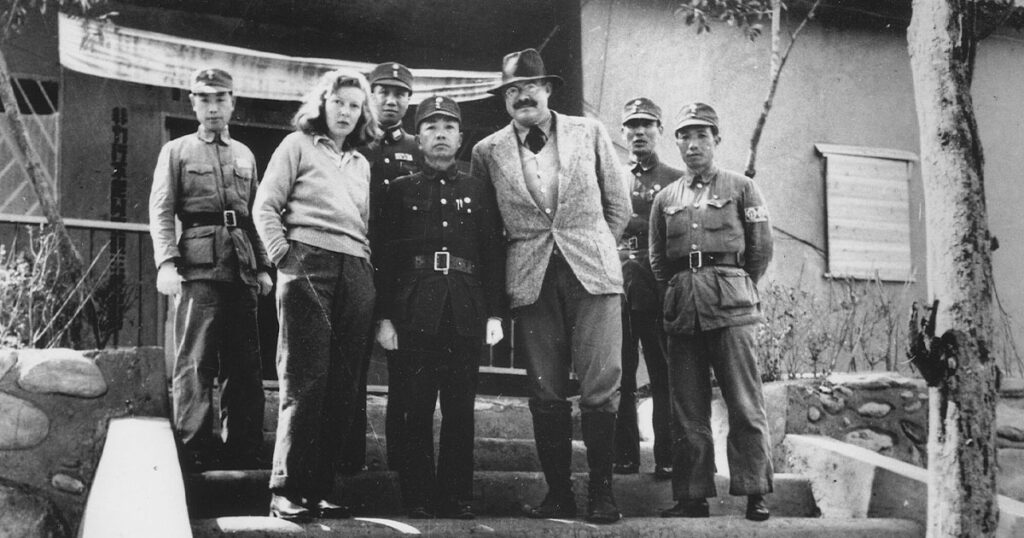
Cuba, 1943. Ernest Hemingway is unhappy. Drinking, fishing, hunting German subs with his private navy: Nothing cheers him because Martha Gellhorn is at the Italian front, and he is not. “Are you a war correspondent,” he demands, “or wife in my bed?” Gellhorn dodges the question. When they divorce two years later, she will have covered D-Day and Monte Cassino, flown a combat mission over Germany, and seen Dachau liberated. She used to be Hemingway’s golden consort, the Carole Lombard to his Clark Gable. Now she is famous, too.
New York, 1943. Emily “Mickey” Hahn, Missouri born, disembarks from a refugee ship carrying her emaciated toddler. Eight years in Asia have made Hahn a Shanghai poet’s concubine, an opium addict, wife to Britain’s chief Hong Kong spy—and a first-class observer. She is raring to tell what she has seen. One of her daughter’s first memories of America is the sound of Hahn typing, typing, long into the night.
London, 1946. Rebecca West (novelist, critic, journalist, ex-mistress of H. G. Wells) wants back in the game, though 10 years have passed since Black Lamb and Grey Falcon, her thousand-page study of the Balkans, published just after the fall of France. Now West heads to Nuremberg for the war-crimes trials, aware that her prose must be good enough to stand beside John Hersey’s extraordinary Hiroshima reporting. It is. In 1947, Time declares her “indisputably the world’s No. 1 woman writer.”
These three women are the protagonists of Julia Cooke’s new book, Starry and Restless, which takes its title from a letter Gellhorn wrote to Hemingway: “I do not like this safe well-armed woman I have become. The loud bleating disheveled starry reckless failed girl was a better person.” Before jet travel, before images ran the show, American and British journalism was proudly raffish and deeply male, a pack endeavor with license to offend, and the apex job was foreign correspondent, tethered to the home office chiefly by frantic cables from bosses: If no news, send rumors. But the interwar years saw women flood into periodical journalism, often paying their own fares abroad to dare all for fame, and Cooke’s heroines thrilled to what Gellhorn called “that life of rushing and asking questions.” Cooke’s account of this boom age and how foreign correspondence became a female specialty is a model of women’s media-history writing.
She specializes in reporting on closed societies, Cuba especially, and glamorous 20th-century women on the move. Starry and Restless offers both. The result is entertaining and disturbing, like browsing vintage issues of Vanity Fair while passing through blood-drenched battlefields on the Orient Express.
Starry and Restless is not reckless, but it is disheveled. Cooke’s 2021 Come Fly the World: The Jet-Age Story of the Women of Pan Am is a study in loyalties, fresh, focused, and personal. This ambitious triple biography of talented people behaving badly, meanwhile, dawdles and wanders because its stars are so tenuously linked—a letter here, a visit there, a wave across a foreign lobby, a throng of famous friends in common. As a portrait of a lost media milieu, it excels. To claim that these three changed work, writing, and the world is a stretch. But to Cooke, they are important change agents, scornful of restraints in prose and in life, leaping onto freighters and planes, charming big names, “swashbuckling through this world with such ambition, vulnerability, and gusto.”
Certainly they evade easy labels: Literary journalists? Novelists slumming? Writers more at home, like Freya Stark, amid the literature of journey, pilgrimage, and quest? Their supremely disciplined foremothers—Ida Tarbell, Willa Cather, Ida B. Wells-Barnett—might have called them adventuresses. All three were winsome, sexual, and hyperfluent, more akin to Edna St. Vincent Millay and Elinor Wylie than the self-made women of the newsrooms back home. All churned out astounding word counts while juggling lovers, intrigues, pregnancies, and addictions—to opium, to attention, to VIP favors. (When Gellhorn first came to Washington, she asked one of her mother’s friends for housing advice. Eleanor Roosevelt invited her to sleep in Lincoln’s bed.)
Cooke is fonder of close-up and panorama than middle ground, which invites omissions and gaps. Closer readings of their work would have been valuable, and new. Cooke also neglects to follow the money: A safety net of rich partners and family funds is firmly downplayed. Conventionally successful female wordsmiths, like Dorothy Thompson and Anne O’Hare McCormick, are kept offstage. This skewing means Starry and Restless is best read in conjunction with the recent individual biographies of all three writers, plus the women-reporting-war classics of Julia Edwards and Nancy Caldwell Sorel as well as Brooke Kroeger’s 2023 Undaunted.
The archival finds in Starry and Restless are nevertheless impressive, from touching letters to glinting gossip that still intrigues. (Rebecca West and Charlie Chaplin broke into the Central Park boathouse for a midnight row. Who knew?) But like Churchill’s pudding, the book lacks a theme and a thesis. We never learn why Cooke chose to write about these three. Nor do we ever get a nutgraph. So the exasperated editor’s eternal note, blue-penciled in margins down the decades—So what?—is neither asked nor answered.
Cooke’s charismatic women make for tiring company, forever getting into scrapes and sticking others with the bill, always clutching a ticket for the next plane out. We marvel at their supernal energy, private and public: all those bounders and rotters, all those millions of words. Cooke tries to ventriloquize them, mind reading and extrapolating from orts, scraps, and fragments (“Mickey felt a complicated happiness in Shanghai. She was stimulated, challenged, revered, disdained. Contentedness came barbed with boredom, frenzy, or fear.”) Unwise practice, at least according to John McPhee’s iron rule for honest nonfiction: You cannot interview the dead.
It was all or nothing, West’s secretary said: “The best way to appreciate Rebecca was to surrender to her. Throw up your arms and go under.” Martha and Mickey, too, evidently. As public figures, here given a late, well-earned bow, these heroines of the press implore women of a safer age to assert the right to live dangerously, no matter the price of wanderlust.