
Tierra de Campos, meaning land of fields, is a broad swath of open farmland on the Meseta, Spain’s northern plateau, in the community of Castilla y León. I’ve driven through Tierra de Campos a dozen times in the past three years on my way to and from footraces in the provinces of Palencia and Valladolid, and I’m always glad to be in this place of big skies, dry fields over rolling hills, and long horizons. At the right hour and in the right season with the right weather, the landscape can seem almost magical. Some people find enchantment in lofty peaks and snow-capped summits, but for me, the enduring allure of a landscape lies in the glow of brown and golden fields, newly plowed or left in stubble. Keep your jagged mountains, your sparkling ice and snow, your leafy grottos and cascading waterfalls. My taste is for the earthy and the plain, the dirt under my feet.
In the middle of this open, windy region is the town of Medina de Rioseco. Even the name—town of the dry river—suggests heat, dust, and sun. Lying about halfway between the cities of León and Valladolid, it is a handy stopping place to buy bread on our way to a footrace farther east or south. The next day, it is a good spot for a break on the three-hour drive back to Asturias. But the first time we stopped, it was much more: It was a discovery, and I was bewitched. “Where is this?” I wondered, as if we’d come to a new, unknown region, a place apart, a different land.
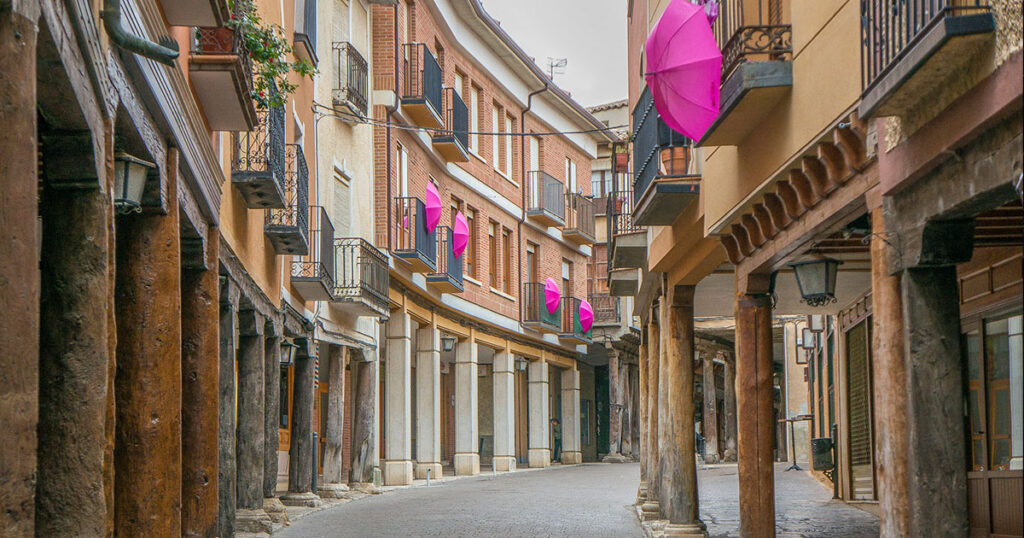
We parked at the gates of an old convent and walked up the hill, past the big open plaza, and soon we were in a narrow porticoed street, where we walked past ancient buildings with pillars supporting sagging beams in the covered walkway. The pillars were a mix of old wooden columns and stone ones, all different, all astonishing in their size and bulk and age. Thinking about the effort required to smooth the tree trunks and sculpt the stone, then transport and erect the pillars, made them all the more remarkable.
A student of architecture and art would have a field day in Medina de Rioseco. The convent and church of San José, founded in 1598 (Herrerian style); the even older church of Santa María de Mediavilla, begun around 1490 (Gothic with Baroque touches); the oldest church in town, San Francisco, with parts dating from the late 1400s (late Gothic) and housing a collection of sacred art; and the church of Santiago Apóstol, begun in 1533 and built over a century and a half (a mishmash of styles). Then the crumbling façades of the houses showing the traditional construction of adobe bricks set within a timber framework. This was history—not in a book or a yearly celebration of an ancient custom, but history at your shoulder, casting shadows in the street where you walked.
This ancient porticoed street is effectively pedestrian. It is called calle Román Martín until it becomes calle Lázaro Alonso, but the common name is la Rúa. Some souvenir shops and several bakeries operate along it, and at least a dozen bars. Near the western end, at the widening mouth of the street where it spills into the newer part of town, the bars had placed tables on the cobblestones, and on that winter Sunday the area was thronged with townspeople out buying bread or having a drink and a tapa. The Rúa was a wind tunnel, and the air was cold. No sun shone into that street. But people filled the tables anyway, or they leaned against a window ledge. It was a happy throng, laughing, talking loudly, greeting each other or taking leave. We chose a bar, entered, and slipped between the customers to find a spot at the barra, where we ordered a coffee.
While we stood there, a change came. The bar began to empty out. It was fast becoming the lunch hour, and the tables that had stood full when we arrived were patchy with people. We left, too. Outside we found a deserted street instead of the party in full swing. Where had everyone gone? They had sunk back into the crevices of their town, like water receding.
We started back to the car the way we had come, in the dry bed of the ancient street. From that deep channel, I got an occasional glimpse of a church spire, a tall tower, or a bell glinting above as I passed between the rows of columns, some literally made from trees, some resembling trunks. I laid a hand on the cold wood and then on the colder stone of the pillars. Old, yes, with nicks and cracks and gouges from the centuries, but not weak or withered. These enormous pillars were like exposed roots, anchoring the buildings to a dry gully and the town to the broad landscape. We drifted on.