
Turbot is ambitious brill. Today, these four words are likely to be as indecipherable to most young, or even not so young, people as they were to an impressionable 12-year-old lad in 1957, besotted with language, books, and music but terrified of sports. That boy was my preadolescent self, serving a term at a summer camp for Jewish kids in the Poconos. If one was not athletic, competitive, or outdoorsy, there was little respite from the courts, fields, lakes, and playing mounds other than in arts and crafts (but after all, how many lanyards, walking sticks, or copper ashtrays can one boy weave, whittle, or hammer in a summer?) or on the stage at the mess hall.
Gilbert and Sullivan saved me from constant embarrassment on the baseball diamond.
I already knew some of their songs. They were part of the air I breathed. Many of my relatives, theatergoing and musically inclined if not especially talented, were amateur singers, would-be treaders of the boards, or modest Anglophiles. Just as the professionals—Cole Porter, the Gershwins, Rodgers, Hart, Hammerstein, and later, Stephen Sondheim and Lin-Manuel Miranda—have always pledged their allegiance to G&S, so did stage-struck lawyers, doctors, teachers, and businesspeople along the Eastern Seaboard.
It was not only big-city sophisticates, opening-night black-tie crowds, and aspiring, middle-class suburbanite groupies who flocked to G&S. The appeal conquered all demographics. Decades later, when I came to write the biography of the American poet Amy Clampitt (1920–1994), the daughter of Quaker farmers in central Iowa, I found out that her tiny New Providence High School—with 20 students in each graduating class—put on an annual G&S production, along with a Shakespeare play or two. G&S was hardly an exotic or even an acquired taste. It belonged to an American culture that, for the better part of the century, followed the original late-Victorian London productions put on by the D’Oyly Carte Opera Company. One hundred years ago, community productions flourished throughout the States.
Allow me to return to my two fishes, the stately turbot and the aspiring, modest brill. Gilbert’s words captivated me; they had me hooked.
Owing perhaps more to a lack of competition than innate talent, I became the Captain of the Pinafore at Camp Tanalo. Our genius music counselor, a Penn undergraduate named Gary Goldschneider—who went on to an eccentric career, mostly in the Netherlands, as a composer and concert pianist—was a one-man director-producer-conductor. Photographic evidence of our H.M.S. Pinafore production, if it ever existed, has long since vanished. Although the camp was co-ed, my Little Buttercup was another roly-poly suburban Jewish boy. We must have made a lovely couple. We sang “Things Are Seldom What They Seem,” and all the rest, to the at-best semi-attentive audience in the hall. I do not remember who played Ralph Rackstraw, Josephine, Dick Deadeye, or Sir Joseph Porter, let alone the chorus of his sisters, cousins, and aunts, and the nautical tars. I like to think that parents visiting for the weekend were amused.
I was enthralled. Buttercup’s opening quatrain in her duet with the Captain passed one test for all great art, a test that I was taking unknowingly, unable as my young self was to articulate it as an aesthetic principle. That is, the verse was partly accessible yet partly mysterious:
Things are seldom what they seem,
Skim milk masquerades as cream;
Highlows pass as patent leathers;
Jackdaws strut in peacock’s feathers.
Skim milk and cream I knew, jackdaws were unfamiliar but easily recognizable as avian if one knew what a peacock was, and the third line of the stanza seemed to be about footwear. Familiarity vied with novelty. So it went, through the entire song, except for that one fishy line in the middle, which tantalized and perplexed equally. Who could know about turbot and brill unless one in fact already knew about them? The words did not explain themselves. I was not a fisherman, let alone an ichthyologist.
First and last, it was the irresistible combination of words and music working in sync that drew me in: Sullivan’s tunes and orchestrations—jaunty and upbeat, or mellow and lush—and Gilbert’s incomparable verbal inventions, which I recognized as poetry almost before I knew officially what poetry was supposed to be.
Four years later, confirmed now in adolescence as a bona fide high school Savoyard, I saw my first full-length production, another life-altering experience. It was Patience, at Philadelphia’s Academy of Music, produced by The Savoy Company, America’s oldest continuously operating G&S troupe (founded in 1901). Its annual performances pooled the resources of talented but amateur Main Line bankers and their families. Nelson Eddy, appropriately enough, got his start with the company. The wondrous patter, with its tongue-twisters and lightning allusions, both undid me and, in a different way, made me. An eager student, I took to the texts in the same way I took to the learning of foreign languages in school. “The dash of a D’Orsay, divested of quackery, / Narrative powers of Dickens and Thackeray” and that “receipt” for a “Heavy Dragoon” combined the known and the unknown as enticingly as turbot and brill had, several years before, and sent me to dictionaries and encyclopedias to learn about the real Count Alfred Guillaume Gabriel D’Orsay and his fellows—“peak-haunting Peveril,” Doctor Sacheverell, Mister Guizot, and the rest. I was learning history via the thrill of musical lists, delivered with crystalline, rat-a-tat-tat precision, spun in soaring melodies, brisk marches, operatic or at least light-operatic richness.
In early-20th-century America, the G&S phenomenon moved from Philadelphia to Manhattan and to Blue Hill, Maine. There, Alida and Seth Milliken, perhaps in jest, perhaps in earnest, wanted to find a way to protect their children from what they perceived as the dangerous and unhealthy tendencies and tastes of the Roaring Twenties. So out with ragtime, in with operetta. In 1924, they produced Pinafore on the deck of their yacht. From on shore, automobile headlights provided illumination. Musicians offered accompaniment from nearby boats. Two years later, the troupe relocated to Manhattan, where, nearly a century on, the productions (now raising revenue for charity) continue.
The zeitgeist shifted, as zeitgeists, like tastes, tend to do. First the shifts were subtle, then seismic. Gilbert and Sullivan were adapted and modernized; then they went out of fashion; then they became virtual unknowns. I was less surprised to find that my undergraduate university students did not know about them than to learn that my younger academic colleagues—educated, with solid middle-class backgrounds and advanced degrees—did not, either. I decided to add another string to the bow of my missionary, educational zeal. I went in search of G&S in the 21st century. I was not disappointed.
As I have learned gratefully, Savoyard productions still exist, although perhaps not as many as before and certainly not as traditional, hidebound, and even ossified (according to some detractors) as the old D’Oyly Carte ones had become. And one younger poet of my acquaintance, when told of my search, responded quickly and enthusiastically: “I am horrible at memorization, and I’ve always envied people who can, with seemingly no effort, quote lines and lines of apt poetry. But for whatever reason (and with no effort that I can remember), I have always known …” And then she spun it out:
To sit in solemn silence in a dull, dark dock
In a pestilential prison with a life-long lock
Awaiting the sensation of a short, sharp shock
from a cheap and chippy chopper on a big black block!
That reason is not hard to find. Not just because the poet recalled her mother cheerily singing this mordant, witty, and dark quatrain in the kitchen, but because the very lines, replete with alliteration and rhythmic pizzazz, are virtually impossible to ignore, or to get out of your head once they have got inside it. The spell is binding. Like Porter, Hart, Sondheim, and Miranda, William Schwenck Gilbert made poems memorable on their own, which—when complemented by tunes—were instantly assimilable by even half-attentive listeners. My friend is not alone. She was responding to what some people call, half disparagingly, “light verse.” But Gilbert, like Ogden Nash, Willard Espy, Dorothy Parker, L. E. Sissman, and others, occupies an important place on a literary-cultural platform. He wrote so that people would remember his words, and then repeat them. Or sing them.
The Mikado, from which the excerpt derives, is, worldwide, probably the most popular of all the G&S operettas. Pinafore and The Pirates of Penzance come in as pretty close seconds. In 1986, the English National Opera offered up, and recorded, a well-received version directed by Jonathan Miller, which “de-Japanned” the original and set the show in a 1920s English hotel instead of mythic Titipu. Like new stagings of opera, the reimaginings of G&S can be ludicrous, modestly annoying, or—however infrequently—revelatory. Gilbert & Sullivan Austin, in Texas’s capital, transported the action to Scotland in its 2022 The McAdo.
More recently, The Mikado has been caught in the cultural crossfire blazing through our country. Although the show is only nominally about Japan (if even that; it satirizes British class and political conditions), detractors accuse it of “yellow-facing” while taking umbrage at what are perceived to be unconscionable swipes at Japanese customs and “otherness” in general. As a result, at least one Mikado has been canceled over the past decade, and others have been revised in step with our current cultural shibboleths and anxieties.
One amateur Harvard production from 2016 (you can see it on YouTube) set the operetta in a Las Vegas hotel. In the opening chorus, “We are gentlemen of Japan” has been updated: “We are gentlemen of the Strip.” And—at least at the beginning, although not further on—the heroine also gets Americanized. Nanki-Poo makes his entrance and asks, “Gentlemen, I pray you tell me, where a gentle maiden dwelleth named Joanne, / the ward of Ko-Ko?” The three little maids from school are … as one might guess … little maids from a Vegas hotel.
Before the show begins, Kat C. Zhou, the then-president of the Harvard-Radcliffe Gilbert and Sullivan Players, steps onstage to remind the audience that The Mikado must be understood in “its geopolitical context.” But trying to have things two ways at once and weighing today’s politics against G&S topsy-turvydom, she also allows that the show is “a satire that renders its own characters ridiculous.” (Of course it does, but what it satirizes is England, not Japan.) She then delivers an unintended coup de grâce, inviting the audience to stand and sing “God Save the Queen.” Victoria? Elizabeth II? It hardly matters. Nor does it matter, according to many experts, that G&S, like Beethoven and Shakespeare, have always been popular in Japan, with little resentment of the so-called cultural appropriations made by the original librettist.
Occasionally, the young performers sing off-key, even timidly. No matter: They possess their own earnest charm. You get a clear sense of the fun the cast is having, just as much fun as is had by the more polished performers in a Pirates of Penzance from Indiana Wesleyan University (also 2016), which stays close to the letter as well as the spirit of the original, with no messing around with libretto and staging.
The revisionary G&S impulse took perhaps its most bizarre or far-out, but not unpredictable, turn more than a half century ago. Roy Cowen and Iain Kerr toured Britain and elsewhere with a two-man show, The Best of Goldberg and Solomon, koshering G&S in the late 1960s and early 1970s. They produced several records. Their basic premise: Had Gilbert and Sullivan been Jewish, they’d have written Trial by Jewry, The Three Little Maids from Schul, and The Tailors of Poznance. There’s a character named Sir Oliver Sholom. There’s a lyric from their version of Pirates about a possible marital mismatch that contains the line “She’s Orthodox!” in lieu of the “paradox” motif in Gilbert’s original. From M.R.S. Pinafore they offer up “I’m called Sarah Schmuttercup.” The humor is broad, the results either laugh inducing, head spinning, or groan worthy.
Although amateur community G&S productions were more prevalent a century ago, the tradition continues. They have sprung up in places such as Sioux Falls, South Dakota, for example, where Graham Wrightson, a Brit who during the day is a university professor of ancient history, has mounted his own amateur G&S for several years. Wrightson was brought to the stage at the age of four by his parents, and he listened to his grandfather’s D’Oyly Carte recordings. As a Cambridge undergraduate, he found a core group of fellow “Gassers” (his own sly neologism)—hardcore and talented devotees; later, in graduate school in Canada, he sought out other kindred spirits. Then he fetched up in South Dakota. He had an itch he needed to scratch. When the local theater company could not be persuaded to sponsor G&S, he went out on his own and involved the community—in this case several families and their children—to do an annual, bare-bones, small-budget operetta.
Larger, more professional, and now in its 51st season, the New York Gilbert and Sullivan Players does several shows a year. In January 2024, I attended two dress rehearsals and a full performance. The company was able to skirt the usual “problems” with The Mikado by staging the operetta in a kind of No-Man’s Land, part American Old West, part Victorian England, almost no part of it—aside from words and story—Japan. The show itself comes within a frame, with a nod to Mike Leigh’s superb 1999 G&S film Topsy Turvy: In 1884, Gilbert and Sullivan must devise a successor to Princess Ida, and an idea comes to Gilbert with a blow to his head. The mise en scène, once the actual operetta begins, features two structures: Ko-Ko’s Tailor Shoppe on stage right and the Titipu Depot on stage left. The eight “gentlemen of Japan” who constitute the chorus represent several shapes, sizes, ages, and races. The entire thing is a fantasy in several ways. It takes place nowhere and everywhere at once. Mostly, to its credit, it’s still 1885 and we are still in Victorian London.
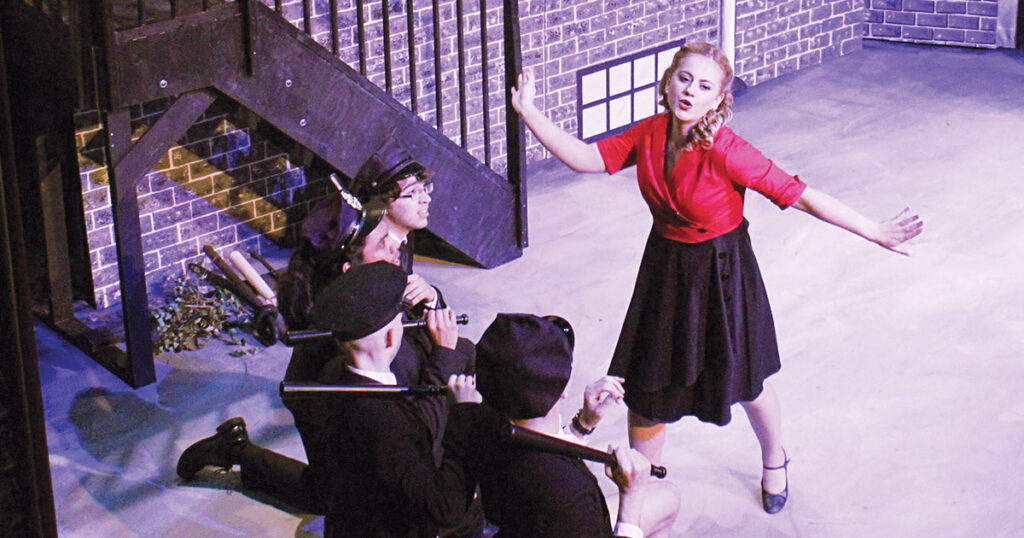
It’s the costumes that really do the trick of transporting the action—and the audience—even though one hardly knows to where. The clothing is a hodgepodge, though not Japanese. Instead, we see some vaguely Victorian touches like exterior bustles resembling bird cages for the chorus girls, one male chorister wearing a top hat, another doubling as a chef and a bobby, another looking like Sherlock Holmes in a deerstalker cap. In his opening scene, the impoverished Nanki-Poo really is a thing of shreds and patches, but when he cleans up for his wedding, into striped pants and matching vest, with a floral lei around his neck, he has become something of a hotel waiter. Pooh-Bah metamorphoses into the Wizard of Oz, or perhaps a creature from outer space in a proto-Victorian sci-fi extravaganza. Dressed as a bride, Yum-Yum looks like a thrift-shop replica of Billie Burke as Glinda the Good. And the designer clearly wanted Katisha to be her foil—Margaret Hamilton as the Wicked Witch of the West. Was there a fire sale at some East Village costume shop? The eye is mystified and dazzled.
It does not matter. George Balanchine once reportedly said that if he went to the ballet and the dancing did not please him, he could imagine the Platonic ideal of the steps. If all else failed, he would close his eyes and envision the action or simply bathe himself in the music. One sure sign of a masterpiece is that it is not marmoreal, especially a text—balletic, musical, theatrical—that requires performance. The more masterly a theatrical creation, the more porous it is, capable of infinite renderings. Or what we call interpretations. It will withstand many of them, even the insulting or assaultive ones. The act of updating calls into question the very idea of authenticity. For decades, we have had classical music performances on original instruments, but we also know that if Mozart and Bach were alive today, they would probably welcome new arrangements, combinations, and revisions of their work, to say nothing of modern instruments.
With G&S, it’s not only the staging—costumes and sets—but, more important, the words that bear looking at, or listening to. Sullivan’s music never changes; Gilbert’s words often do. They have done so since 1908, when the librettist himself made modest revisions and substitutions to his texts. And though Gilbert was a brilliant writer of, and for, his moment, times change. Revisions have subsequently become de rigueur, not just to keep up with those changing times but also to add harmless merriment and a touch of savoir-faire for the sake of the audience. Although they change, the words are more than mere dressing for the tunes. Originally, in the Mikado’s important Act Two aria—with his stated desire “to let the punishment fit the crime”—the n-word appeared (in reference to players in blackface, not to actual Black people). That word also appeared in Ko-Ko’s list song. And it disappeared from the stage decades ago.
The New York Mikado zips along in its modernizing. “I’ve Got a Little List” and other numbers make quicksilver mention of Hunter Biden, hashtags, AI, cyberspace, tweets, “the fracking politician who is full of natural gas,” et al. You get the picture. Lists, whether long or short, like Ko-Ko’s insouciant one, must be of the moment. And Gilbert was right: “It really doesn’t matter whom you put upon the list, / For they’d none of ’em be missed.”
David Macaluso, the show’s Ko-Ko, explained to me the reasons for some of the other changes, all very sensible ones: “Those pestilential nuisances who write for autographs” has become who “beg for autographs” because no one today writes to anyone for anything, but a contemporary audience can certainly picture a bunch of groupies thrusting forth at the stage door. “All children who are up in dates and floor you with ’em flat” is modified to “children who are up to date.” In the stentorian verse to his punishment-fitting-the-crime aria, the Mikado reminds us that his “morals have been declared / Politically [instead of Gilbert’s original ‘Particularly’] correct.” You can bet that this hit a sympathetic nerve in a Manhattan audience.
How far can one go to modernize or jazz up any original? The recent Broadway hit Pirates! The Penzance Musical goes a long way. The exclamation point says it all. This hip gumbo of a musical—we have moved from Cornwall to the French Quarter of New Orleans—keeps the skeleton and the bones, but the clothes are new, as are Sullivan’s orchestrations and rhythms and Gilbert’s words. Only the melodies remain untouched. The show is no longer an operetta. Razzmatazz has replaced charm. This is not my G&S, nor my grandparents’ G&S. Would it have been Gilbert and Sullivan’s G&S? What would they say? Although Victorian delicacy is lost, energy abounds. Even the ending comes with topical, contemporary relevance. Instead of making an appeal to Queen Victoria, the pirates and the rest of the cast sing out on behalf of the new American melting pot (“We all come from someplace else”), and to the tune of “He Is an Englishman” (from Pinafore), they bring the curtain down with a feel-good paean to the glories of immigration that speaks directly to our present moment.
My appetite for G&S has been more than whetted. It has been gratified. The New York troupe was composed of professional musicians and actors. But even in companies with fewer monetary and human resources, G&S remains alive. One November, on a cold, crisp day, I attended the last of six performances of Iolanthe in Northampton, Massachusetts. Founded in 1975, the Valley Light Opera company has produced all the G&S operettas as well as other works. These productions cost an estimated $50,000 apiece, are funded by benefactions as well as ticket sales, and are staffed entirely by locals and volunteers. The results occupy a perch midway between semiprofessional competence and a chirpy, Judy Garland–Mickey Rooney Babes in Arms exuberance. “Hey, kids, we can put on our show right here,” you almost hear them saying every year.
Set in something like a Mendelssohnian fairyland with a clear connection to late-Victorian London, Iolanthe has unexpected relevance for an age such as ours, in which legislatures are sluggish or paralyzed, legislators themselves are incompetent or corrupt, and whole governments totter on the verge of collapse. One critical line of thought maintains that the Wagnerian Queen of the Fairies (a formidable figure both dramatically and vocally) and Private Willis (the object of her love interest) make a sly but daring reference to Queen Victoria and John Brown, her purported lover from a lower rung on the social ladder. Do these things still concern us today? Naturally.
Onstage in Northampton, the frolicking fairies of the female chorus could have been escapees or revenants from the New Yorker cartoons of Ed Koren. Some were dainty, lithe, and young. Others were lumbering, large, and more advanced in age. They all looked like marshmallows outfitted in a kaleidoscope of colors, mostly minty pastels. All the performers were enthusiastic. There were occasional flat high notes, garbled lyrics, and swallowed syllables. Did anyone really care? It was all what used to be considered good clean family fun. People from nearby senior facilities arrived in buses. The audience contained some youngsters as well as local college students. At the intermission, I was tempted to leave—there would be a long drive home—but I spotted a woman of a certain age with her two grandchildren at the refreshments stand in the lobby. They seemed to be chatting animatedly. I approached the family and inquired whether the kids were enjoying themselves. The young girl, maybe six years old, said, “I love the fairies.” Her somewhat older brother—he looked to be about nine—said, “I didn’t understand all of the words, but I want to learn more.”
Satisfied that I had encountered, after more than six decades, the reincarnation of my youthful self, I stayed for the entire second act and drove home, happy, in the dark.