
It was August, and my mother’s friend Fritz had recently opened up his second art gallery in Magdalena, New Mexico, just down the street from my mother’s house. He was eager to show it to us, and we were eager to see it. The gallery didn’t have regular hours, but when we had a free moment and called, Fritz came to show us around. He unlocked the door and ushered us in.
Fritz is a retired marine biology teacher, a fabulous cook, a painter, an art collector, and a businessman with a bed-and-breakfast on Highway 60, just outside town, an established art gallery in town, also on Highway 60, and now Main Street Gallery, on Main, between the Good Samaritan store and the sheriff’s office.
The back third of the building is a small rental apartment, with a garden behind. The gallery sits at the front. I looked around. First impression: a deep, narrow room stretching before me, a pressed-tin ceiling high above, and artwork and rugs hanging from a picture rail on the white walls. The hardwood floor was painted, and a few pieces of furniture were placed to create the semblance of separate areas, as you might have in a house. You still had to fill in the rest.
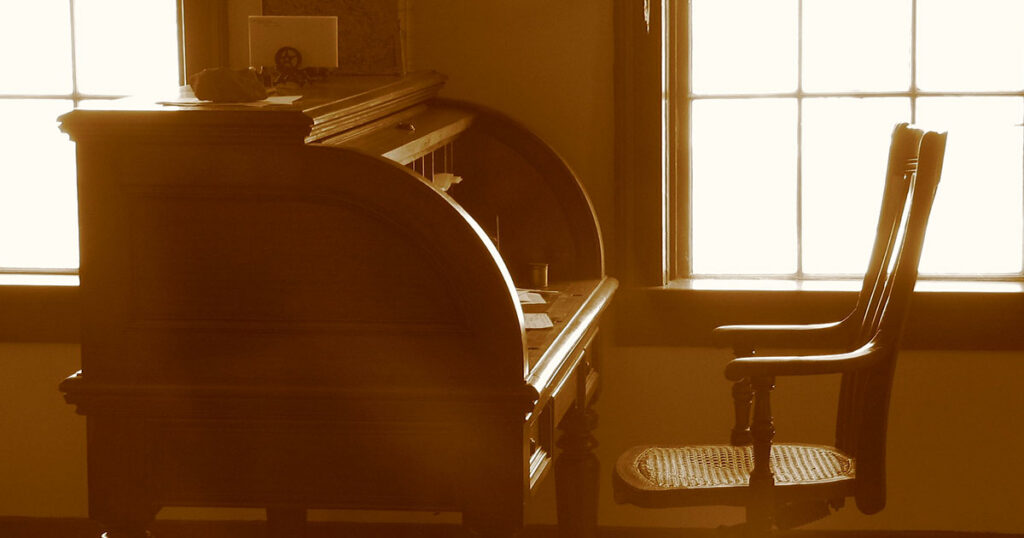
The small roll-top desk toward the back of the room drew my attention. At my dad and stepmom’s house in Colorado, my father’s enormous roll-top still sits in its spot, just inside the door to his study, filling almost the entire length of the wall, with books all around and rising to the ceiling above the desk and on the other walls. On the little remaining wall space, some family portraits and an old pendulum clock keep the desk company.
My dad’s desk is a place of crannies and cubbyholes, slots and shelves, drawers big and small. At least half a century has drifted by while the roll-top has kept its place. Other people have large, beautiful roll-top desks, but those pieces often seem like mastiffs impossibly coifed and combed. My dad’s is a lion in repose. The desk always brings him to mind: I can just about see him, sitting there, looking up from his papers at my entrance.
To have my own perfectly proportioned roll-top—that is a hazy dream that swells at times, fed by a desire to establish myself as a desk-deserving person, someone with accounts to keep or letters to write. Then the desire ebbs because a roll-top for me would be something new, not something in perpetuity, like my dad’s. Not the swaying seaweed, anchored in the ocean floor, enduring the rising and falling waters, but a boat, tossed on the waves.
“Is the desk for sale?” I asked, moving languidly toward it. It sat three-quarters of the way down the long room, between a bulky cabinet and a grand, upright steamer trunk—a compact dignitary accompanied by a couple of swells. To the left of the trunk was the fabricated passage to the work area behind the desk and, farther back, the door to the private apartment.
“Everything’s for sale.”
I saw no price tag, and I moved on, circling back toward Fritz, who had taken the chair beside the loveseat. He was explaining the difference between museums of the past, where picture after picture hung on the wall to be viewed as visitors paraded by, and the modern conception of art in living spaces—a “curated lifestyle.” I sat on the loveseat, propped the woven-wool pillow behind my back, and listened to Fritz talk about how he and his partner, John, had come to live in Magdalena. Driving through on their way west, they had looked around at the dismal surroundings and wondered who would choose to live in this place. It was a “shithole of a town,” Fritz said.
“How long ago was that?” I asked.
“About eight years ago,” he answered.
On the edge of town they had seen a for-sale sign on a building and stopped to peer in the windows. “John,” Fritz had said, “this is an adobe, it has vigas, it’s got everything. It’s for real.”
They turned around, drove back to town, found the real estate agent, and within two hours had bought the house. Soon they built the rooms to turn their new place into a bed-and-breakfast. Then came the first gallery. Then this second gallery. So Magdalena is not a shithole after all. Fritz and John have made a good life here, though Fritz’s stories suggest that for him the village is not even close to ideal.
“Everything’s for sale, everything has a story.” He settled back to tell us a few more. Besides his own story, he recounted what he knew of the origins of the steamer trunk, a Navajo rug, and a portrait of a lady hanging on the wall. He told us about the painter and how he’d tried to get one of the artists he knew to take an interest in him. No one wanted to help. Fritz said he couldn’t understand it.
I already knew that Fritz liked doing good turns. He had found a buyer for a friend of my mother’s and mine who had decided to move. Our friend became Fritz’s friend, too.
I asked, “What about the desk? Has that got a story?”
It was a gift, Fritz said. From the friend who had moved. I was surprised. “I don’t remember the desk at his place. Where was it?”
In the front room, Fritz said. My mother chimed in that our friend had buried the desk under a cloth and a lot of odds and ends, so I had likely never seen it. Had I noticed the desk, relegated to an obscure corner, I might have wanted to rescue it. Our friend was already talking about leaving years ago. You can’t leave, I thought. You belong here. He was an institution in my summer visits. But he did leave. And what did he leave behind? An empty space for the briefest time, and a roll-top desk.
All that remains of my desk desire is a twitch in my fingers, like the one I felt when I saw a desk sitting at the back of Fritz’s new gallery. The desk that I might have seen, might have coveted, but never did.
That close, but not my story. Not my desk.