
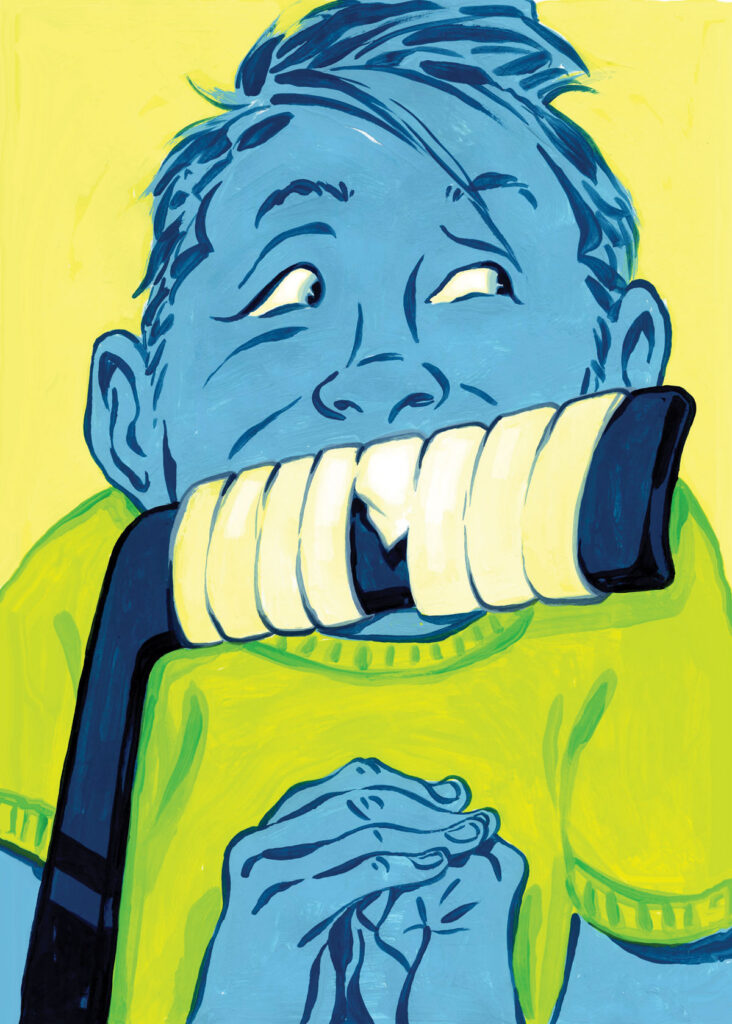
In photographs from my childhood I am often sporting wide, toothy smiles. Guileless grins. It seems I was—despite the complications of divorce, alcoholism, and mental illness in my family—a happy kid. But by my teens I began to develop a sort of tight-lipped, toothless grin. I could feel myself consciously pulling my upper lip tight against my teeth, my tongue poking at the back of my fake, discolored front tooth.
When I attended summer camp in the early 1980s, there was no long journey north from some hot city. No slow drive down a narrow dirt road through a tunnel of tall pines. No tearful goodbye as my parents dropped me off with a duffle bag of jeans and T-shirts, swim trunks and a towel, then drove away. I was a local kid, a poor year-rounder in Maine. “Summer camp” meant my small town’s daily parks-and-rec program on the grounds of my elementary school, which was across the street from the dilapidated house my unstable mother rented with her alcoholic boyfriend. For me, there was only waking to an empty house, making myself breakfast, then crossing the road.
At camp, kids ranged freely around the school’s sandy playground and grass fields, occasionally participating in activities loosely organized by camp counselors who were, I understand now, basically kids themselves: most too young to vote, all too young to buy beer. They corralled us into the school’s small gymnasium when it rained. The summer I turned 10, the camp counselors cajoled us into a game of street hockey on the gym’s squeaky floor. I was not athletically gifted. I was chubby and uncoordinated, and I could not be counted on under pressure. Team sports were not my strength. So when I rushed behind an opponent in an excited tunnel-vision attempt to steal the orange rubber street hockey ball, I took a stick directly to the mouth. Immediately, I tasted sweet, metallic blood. I dropped my stick, brought both hands to my face and groaned. Mike, a handsome camp counselor whom all the boys thought cool and all the girls had a crush on, rushed over and put his hand on my shoulder.
“You’re okay, buddy, you’re okay,” he reassured me. “Just walk it off.” He clapped his hands together twice, like a football coach giving his players a pep talk. “Walk if off.” He clapped again.
I leaned forward and spat bloody shards of shattered tooth into my palm.
“Okaaaaay,” said Mike, backing away. “I’ll go call your mom.”
I slumped on a bench and waited, wondering how much trouble I was in.
Dr. Joseph Iriana’s dimly lit waiting room had dark wood paneling, a gurgling water feature, and a large aquarium thick with tropical fish and a little treasure chest that hiccupped bubbles. It looked less like a dentist’s office than the living room of a rakish 1980s television private eye. When Dr. Iriana leaned over my brightly lit, pulled-wide mouth during routine cleanings, he clicked his teeth the way those gag teeth chatter when you wind them up and set them down. It was unnerving. I always thought he was demonstrating what he wanted me to do, so I would begin to close my mouth, only to feel the hook of his index finger tug my cheek back open.
That day Dr. Iriana looked into my mouth and saw what remained of my left front tooth—little more than a white sliver poking beyond the pink gumline. He didn’t click his teeth. He made a distinct tsk, tsk, tsk sound with his tongue. I sat stiffly in the chair and held my breath. For what felt like hours, but was probably much less, Dr. Iriana piled layer upon layer of composite resin until he’d built up a flat, broad structure that was somewhat toothlike in appearance. A little white tombstone is what it looked like to me.
This cap was, he explained, temporary. My teeth were still moving around, he said, unsettled; I thought of my teeth playing dodgeball at summer camp. Dr. Iriana said he would eventually fit the tooth with a permanent crown. Composite resin. Cap. Crown. At a point in my life when I’d never even had a cavity, I felt thrust into an adult vernacular.
Naïve boy that I was, I believed my tooth trouble to be behind me.
There is a Japanese method of repairing broken pottery called kintsugi. Cracks are filled with lacquer, then dusted with powdered gold or silver. With kintsugi, that which is broken is honored not by attempting to hide the flaw but by drawing attention to the repair.
This is the opposite of how most Americans treat their teeth. With my new fake tooth in place, I wanted nothing but to fade back into preteen anonymity and range unnoticed by friends, family, and strangers.
For a few years, my cap was fine. Then, in junior high, it quickly began to discolor. My tooth seemed to age. It faded like a paperback left in the sun, stained like wallpaper in the home of a smoker. I hated my discolored tooth because I felt certain everyone else hated it. At this excruciating moment of near ceaseless desire for the opposite sex, I felt ugly. I buried myself in Ray Bradbury books and skateboarding. Unable to read the blackboard from my desk, I also got my first pair of dorky glasses. So began my miserable era of tight-lipped toothless grins.
An appointment with the teeth clicker was scheduled. It was time to replace the temporary cap with a porcelain crown, an experience that became the foundation of my lifelong dental fear: Every time I sit in a dentist’s chair, I think of Dr. Iriana leaning over me with a tiny whirring grinder in his blue-gloved hand, his eyebrows rising as if to say, “The only way out is through,” then the dust of my discolored tooth rising like smoke from a tiny forest fire in my mouth.
When the singer-songwriter Adrianne Lenker was 21, she was in a bike accident that knocked out one of her incisors. After years of cycling through cheap caps or just an empty gap, she now has a gold crown.
Lenker briefly met Joan Baez backstage at the Newport Folk Festival in 2024. Baez, who complimented Lenker on her hypnotic solo set, immediately noticed her glinting tooth. “Me, too,” Baez said, opening her mouth and pointing at her own gold canine.
“Oh yeah,” said Lenker, “cool!”
“I got a little diamond in mine,” said Baez, who’d shattered her tooth years earlier on a popcorn kernel.
“Nice!” said Lenker.
By that point she could have afforded a high-quality porcelain tooth and returned her smile to its virgin state, but her new gold tooth served a different purpose: “After all that time with just a gap, it kind of felt strange to not see the scar,” she said in an interview.
Lenker chose, in a way, to make her scar permanent. She and Baez both chose kintsugi: They honored their broken bits by refusing to hide them.
When I was 16, I discovered the short stories of Raymond Carver. I was young, so I didn’t know one could write about the kinds of things Carver wrote about and elevate them to art.
“Feathers”—included in the collection Where I’m Calling From, which I found left behind in the local coffee shop—is about two colleagues who get together for dinner with their wives. There’s Jack, the narrator, and his wife, Fran. And his friend Bud and Bud’s wife, Olla, who invite Jack and Fran to their house in the country.
There are two things most readers remember about this story: Bud and Olla’s baby, Harold, who is described in detail by Jack as being the ugliest baby he has ever seen, and the couple’s petulant pet peacock, Joey. The bird is even featured on the original Vintage Contemporaries paperback edition of Cathedral.
What I remember most is Olla’s teeth.
While the couples have a drink in the living room, Fran notices something sitting on top of the TV and nudges Jack: “Next to the vase, on the doily, sat an old plaster-of-Paris cast of the most crooked, jaggedy teeth in the world. There were no lips to the awful-looking thing, and no jaw either, just these old plaster teeth packed into something that resembled thick yellow gums.”
Bud explains that it’s a cast of Olla’s teeth before her braces: “I’ve got used to them. But I guess they look funny up there. For the life of me, I don’t know why she keeps them around.”
Olla taps her front teeth and says they came in crooked when she was a kid, but her family couldn’t afford to fix them. When she married Bud, he insisted on paying for her braces. She shyly explains that the cast is a daily reminder: “I’ve got lots of things to be thankful for … That’s one of the things I’m thankful for. I keep them around to remind me how much I owe Bud.”
Bud takes the cast from atop the TV and holds it against Olla’s cheek while she smiles. She says the orthodontist wanted to keep the cast and submit it for publication in a magazine. “I said nothing doing. I pointed out to him they were my teeth.”
“After I got the braces off, I kept putting my hand up to my mouth when I laughed,” Olla says. One day, Bud told her she could stop doing that: “You don’t have to hide teeth as pretty as that. You have nice teeth now.”
I found the whole scene between the couples breathtakingly tender and intimate, though I never could have described it that way at 16—I might have simply let out the breath I’d been holding and said softly, “Whoa …”
Could people really be so vulnerable with one another, I wondered. Could I be so vulnerable?
There is no shortage of teeth-related idioms in the English language.
When you narrowly avoid something, you escape by the skin of your teeth. The phrase dates back to the Geneva Bible of 1560, where in the Old Testament pious Job was made to suffer mightily because of a bet between Satan and God. He lost all his property and wealth, his seven sons and three daughters. He endured great physical agony; he repulsed his wife. Job’s hardships left him emaciated and covered in sores. Even his teeth fell out: “My bone cleaveth to my skin and to my flesh, and I am escaped with the skin of my teeth.” Biblical scholars believe that Job had lost all his teeth and only the skin of his gums remained.
One thing I loved about my high school sweetheart was how she laughed. She had a beautiful, honest smile. But she tried to hide it. She hated her teeth because in elementary school a boy once asked her, incredulously, “Why are your teeth that color!?”
She’d grown up in a rural town in the early 1980s and had some harmless brown stains on her teeth, probably from fluorosis.
If I could have been Bud to her Olla and paid to fix her teeth, I would have.
Gap-toothed actresses have always held an unusual allure, from Brigitte Bardot and Lauren Hutton to Aimee Lou Wood and Dakota Johnson. None captured my imagination more than the troubled French actress Béatrice Dalle, star of the 1986 film 37°2 le matin, released in America as Betty Blue. Her expressive gap-toothed grin was captivating. Parisians even have a name for such a smile: les dents du bonheur, the teeth of happiness.
I was a senior in high school when my girlfriend and I discovered Betty Blue on VHS in the foreign film section of our local video rental shop. I recall only the broad strokes. A writer named Zorg is working as a handyman in a seaside resort on France’s Mediterranean coast when he meets passionate, impulsive, and occasionally violent Betty. She thinks he is a genius. They make love regularly and with the wild abandonment with which high schoolers think all French people make love.
Betty’s unpredictability and eroticism were, to me, inexorably linked to her gap-toothed smile.
In my 20s, while absent-mindedly eating an apple, I caught a seed just so. Nearly half my crown snapped away like brittle glass, leaving me with a sharp, jagged splinter of a left front tooth.
A friend joked that it made me look tough. I laughed, but I was horrified. I could swear people’s eyes flicked to my tooth when I spoke. Soon my hand went reflexively to my mouth every time I laughed.
To look like a street brawler in the film Fight Club, Brad Pitt—People magazine’s Sexiest Man Alive in 1995 and 2000—had his dentist intentionally chip away bits of his front teeth. “Brad’s willing to go to great lengths for a character,” his publicist told Entertainment Weekly.
Pitt’s intentionally chipped teeth hollered Look at me! I, however, didn’t want anyone to see my ragged smile. Most of us have the confidence of mere mortals. We don’t want to be gold-webbed kintsugi cups.
My chipped tooth began to turn brownish yellow, like an overripe banana. Every time I opened my mouth, I was leading with one perfect pearly white and one misshapen mess. No amount of brushing with whitening toothpaste made a difference. The tooth was impervious to whitening strips. I couldn’t afford to see a dentist, so my closed-mouth, Mona Lisa smile became second nature.
I hated my tooth. It looked to me as though it was rotting. I assumed everyone saw it as my defining physical feature. I hated this, too: I was susceptible to the taint of narcissism that tricks us into believing that how we look actually matters to most other people. It rarely does. And when it does matter, it’s not often for the right reasons.
Years passed.
It was jarring when, in my 30s, one of my father’s incisors was yanked. One moment he had the handsome smile I’d known my entire life, the next it was as though someone had thrown a brick through a window: Most of the panes still sparkled in the sun, but now there was a dark, unsettling void. In a long line of windows in a brick mill building, a single broken windowpane immediately catches our attention. The eye is often drawn not to what is there but to what it knows is missing.
My father was still handsome—he was far too charming to be anything but handsome—but he’d been vandalized. The missing tooth changed him; not to himself, I think, since he seemed as comfortable as ever in his skin, but to me.
Was it because of my own half tooth? Because I felt unnerved by what I was missing?
A Maine architect once explained to me the various kinds of cedar shingles he used for siding the rustic coastal cottages he designed. Shingles that are treated in a chemical wash, I learned, do not warp or discolor. “They’re so boring,” the bow-tied architect said with a dismissive groan. “They’re like a perfect, bright American smile.”
He much preferred untreated shingles that took on a feathery silver hue as they aged. They curved and chipped and weathered. Across the seasons, they changed in the light. “They’re like a French woman’s beautifully crooked smile,” the architect said. “Gorgeous!”
The wide-hipped Wife of Bath in The Canterbury Tales must be a precursor to the wildly erotic Betty Blue.
The Wife of Bath is the lusty storyteller of perhaps Chaucer’s best known tale. Her face is described as bold and handsome and red of hue. But her most distinctive feature is her gap-toothed smile, which, she says, symbolizes sensuality and lust:
But yet I hadde alwey a coltes tooth.
Gat-tothed I was, and that bicam me weel …
As help me God, I was a lusty oon,
And faire, and riche, and yong, and wel bigon
If gap teeth symbolize lust, why does a missing tooth attract stares?
Why are some people so attracted to a crooked-shingle smile and others prefer stock-straight teeth bleached bone-white? Did Bud, who so obviously loves his wife, Olla, want to change her teeth to make her beautiful by society’s standards? Or did he want her teeth straightened simply because that is what she wanted? What does the state of our teeth tell others about us?
I left my chipped tooth untouched for a long time. It continued to discolor. I suppose I accepted it. Maybe it did make me look, as my friend suggested, tough. At the very least, it gave me an air of wildness. Or maybe it was because I was without dental insurance and acceptance was the easiest path. For long periods, I forgot about my tooth entirely. Until, of course, I met someone new who would ask, assuming it was recent, “What happened to your tooth!?” With that I went tight-lipped.
Then a surprising thing began to happen. As I got older, became a father, moved into a more demanding career, I found that I thought about my tooth less and less. At least, I think I did. I mean, I must have: There are photos of me with friends from this period, laughing without reserve, my half fake tooth on full display. A strange thing was happening to my unchipped front tooth, too: It began to seem more perfect than it actually was simply because it shared the stage with a chipped partner.
When I look now at those photos, I am shocked by how I seem to have accepted my ugly tooth. Or was the power of happiness sometimes more powerful than my sense of embarrassment?
More years passed.
My dear friend Wes, an 85-year-old poet, recently told me he found my chipped, discolored tooth endearing. When I met Wes, in my 30s, I’d been sporting my jagged-tooth smile for a decade. Sometimes I completely forgot about it for long stretches. Wes noticed the tooth immediately when we met. He is attuned to such things, and teeth sometimes even appear in his poems.
He told me, “You’re so handsome and so capable, so your tooth … the imperfection … it made you seem down-to-earth, more approachable.”
Meanwhile a woman I had briefly dated called my chipped tooth “sexy” shortly after we met. It stunned me. We are incapable of seeing ourselves the way others see us. Rather than giving me a boost of self-confidence, the comment made me self-conscious. I began to wonder, Well, what the hell is sexy!? If my chipped tooth was sexy, I obviously had no clue. Maybe it made me seem unpredictable, something this buttoned-up and particularly predictable girlfriend found exciting.
“I think it’s got something to do with the intimate things we do with our mouths,” Wes speculates. We should all be so lucky to have a friend like Wes.
My wife has a slightly twisted incisor. It looks as though it has excitedly stepped out of line with her other teeth. If a tooth could be said to have a personality, her incisor is rebellious. When she’s laughing or smiling widely, her upper lip catches on the tooth in an utterly appealing way.
I call my wife’s tooth Wabi, as in wabi sabi, the Japanese philosophy of appreciating the beauty in imperfection. I love her Wabi.
My wife has a nickname for my chipped, discolored tooth. She calls it Snaggle.
My wife is haunted by a very specific terror about her teeth. She says it is a common fear: She is scared that she will stumble while walking and fall, and her open mouth will hit the concrete curb just so, smashing all her teeth. Again, she says that most people have this exact same fear. Though that seems suspect, I take her point. Our teeth, so unprotected and on display, often make us feel vulnerable.
“I know it’s irrational,” my wife says. “But my heart races if I even think about it.”
I don’t have this fear. Though I suppose my version is falling while ice-skating: When I’m trying to get myself up, with my hands splayed in front of me, someone glides by and cleanly slices off my fingers, which skitter across the ice like frozen hot dogs.
In his long poem “Fire,” my friend Wes included his boyhood distress about his mother’s teeth: “Where is my father? / Why had my mother come home without her teeth?”
“My mother was elated when all her teeth were pulled at once,” Wes tells me on the phone. The culture of the 1950s made his mother obsessed with new white appliances and new white teeth, everything bright, bright. Later in the poem, Wes watches his mother, who took in sewing jobs to earn extra money: “And where, after her promise, were the brand-new teeth? / Her with pins in her mouth where the teeth were meant / to be …”
Teeth still mean something in America. If they aren’t straight and white, they signal poverty, ignorance. That shouldn’t be the case, but it is.
A version of my wife’s nightmare actually happened to my friend Candace.
“I was nine,” she intoned with the ominousness of a campfire horror story. “My family was moving to Panama on a military transport plane. The day before the flight we checked into a Holiday Inn near the airport. I asked my parents if I could go swimming in the motel pool. They both lit cigarettes, poured themselves a room cocktail, and shooed me out the door. I ran to the pool and dived in before I noticed there were only a few inches of water.”
Candace told me this story in the intimacy of our shared office when we worked together as editors of a life-style magazine. I asked her about it again recently.
“As luck would have it, I landed on the side of my face. The pool rash was appalling, but temporary. My six front teeth were chipped and cracked, but shockingly still attached. Eventually the damage made the nerves and roots die, and the teeth turned first gray, then brownish. I was finally allowed to get them fixed in high school.”
It could have been much worse. She’d escaped by the skin of her teeth.
My friend Abbott went through an anguishing, multiyear ordeal having his front teeth capped. He consulted with Candace, who had, after all, had her entire smile rebuilt. He sought a second opinion. Then a third. But not mine. He said my snaggletooth was “no big deal.”
Abbott finally chose a dentist and embarked on the slow process. When the capping process was complete, he slipped into a mild depression. He hated his new smile. Those of us closest to him, friends since our early teens, thought he looked great. But he couldn’t hear us. We’d spent our youth reading Henry Miller when a dash of Anaïs Nin’s wisdom could have done some good: “We do not see things as they are, we see them as we are.”
Abbott wanted his teeth to disappear but felt he’d gotten a kintsugi smile. “I’m stuck with these fucking Chiclets,” he groaned. He had gone too far, spent too much money, to turn back.
Sometimes you’ve already leapt only to realize there’s no water in the pool.
Another idiom: sets my teeth on edge, to communicate extreme discomfort.
In the first complete translation of the Bible from Latin into English, credited to the theologian John Wycliffe and his followers, there’s this line, from about 1382: “And the teeth of sones wexen on egge.”
But the phrase’s place in the lexicon was solidified by Shakespeare’s Henry IV, when the king’s former ally Hotspur—before he dies at the hands of his nemesis, Prince Hal, in the battle of Shrewsbury—says it is bad verse that leaves a sour taste in his mouth: “And that would set my teeth nothing an edge, / Nothing so much as mincing poetry. / ’Tis like the forced gait of a shuffling nag.”
Frida Kahlo explored so much of her physical being in self-portrait after self-portrait. In her paintings, she rejected traditional beauty. She didn’t shy from her unibrow or deny her mustache. Yet she never painted herself smiling. Kahlo was not an unhappy woman—she joked, she laughed, she had a wicked sense of humor—but it is difficult to find even a photograph of her smiling.
According to art historian Parker Lesley, quoted in Hayden Herrera’s biography of Kahlo, “She had two gold incisors and when she was all gussied up she would take off the plain gold caps and put on gold caps with rose diamonds in front, so that her smile really sparkled.”
Kahlo, who married pain and sexuality in her work, didn’t pluck her eyebrows, but she tended to her teeth.
My friend Abbott’s dark response to his new smile frightened me more than I realized at the time—the story of his teeth set my teeth on edge. My complacency deepened. For fear of making things worse, I stayed the course of my self-prescribed dental plan: Do nothing.
At the height of the Covid-19 pandemic, stressed from high-pressure, deadline-driven work and a toxic coworker, I began grinding my teeth. I awoke one night with excruciating electric shocks of pain pulsing through my jaw. The next day, a dentist told me I had cracked both of my lower back molars so badly that they needed to be pulled.
I dragged myself to an endodontist who carried himself with the uninterested air of a man who’d been ready to retire years ago. He made halfhearted small talk while filling me with successive needles of lidocaine over the course of 45 minutes, then leaned into my mouth with a pair of shiny pliers. My entire body clenched. I tried to control my breathing, but my heart thudded. I still have my wisdom teeth, so things were tight back there. The extractions were tricky. The first molar popped out like that of a cartoon boxer hit with an uppercut; the second shattered. The endodontist dug for shards like a child in a sandbox. My jaw filled with pressure. I winced when I heard the unholy scrape of metal tool against tooth; for a passing moment I yearned for the innocence of my childhood dentist hovering over me, his teeth going clickety clack, clickety clack.
The months that followed became a blur: bone grafts on the empty sockets, stitches, healing, laser mapping, custom molds, post-hole drilling, post insertion, more healing, and at last, implants. The whole process took roughly a year.
Still my chipped, discolored front tooth remained.
After perhaps 15 years together, my wife told me I had begun to put my hand near my mouth more and more when I spoke in public. She said I tried to hide my tooth by stroking my mustache or beard.
I had become Olla. My wife was my Bud, encouraging me to take care of my tooth—not because it bothered her but because, as with Bud and Olla, she loved me so much, she hated the idea of my feeling insecure.
A final idiom, another from the 14th century: to lie through one’s teeth means that a person is able to smile while lying.
The origins of this expression can be traced to the legends of the romantic hero Sir Guy of Warwick from the early 1300s. When Guy confronted the traitorous knight Morgadour about his treachery, the wicked man had the audacity to reply, “Thi lerst amidward thi teth.”
Thanks to my wife’s gentle support, I found I couldn’t lie to myself through my chipped tooth any longer. I pushed down the anxiety I felt about how my friend Abbott was unable see himself in his new smile. After the ordeal of my two molar implants was well behind me and I felt healed—physically, mentally, and financially—I decided to have my front tooth repaired. I’d survived the implants. Why not keep going?
The new dentist I’d begun seeing—not the excavating endodontist—was calm and kind. She patiently explained the process. She spoke softly. As she built up the layers of tooth-colored composite resin, pausing occasionally to cure and bond it with a slender light wand, she asked whether I felt okay. She was gentle. If I winced, she rested her hand softly on my shoulder. The whole thing, from the time I sat in her chair to my slow, stunned walk out the door, took less than an hour.
I drove home opening and closing my mouth as it tried to make sense of its new fit. When I called my wife from the car to tell her everything had gone smoothly, I noticed I suddenly had a slight lisp; my tongue, used to so many years of a void where a tooth should have been, didn’t know where to put itself, as though it was moving inside someone else’s mouth. My eyes darted between the road ahead and my reflection in the rearview mirror. My unchipped tooth no longer needed to carry my smile; its partner was back. For the first time in decades, I smiled an unbroken smile. I was nearly 50 years old—not young, but not so long in the tooth that I couldn’t, despite sporadic resistance, find my way to embracing change.
We rarely succeed in changing the things around us, but as Proust wrote, gradually our desires change.
When my friend Abbott told a woman he’d just begun dating how much he hated his Chiclet teeth, years after he’d had the procedure, her brow furrowed. She asked, “What are you talking about?” She hadn’t noticed what he could not help but notice every time he looked in the mirror. That woman is now the mother of his daughter, and Abbott has accepted, if not embraced, his teeth.
When my friend Candace had her pool-shattered smile completely reconstructed, she was stunned by her high school sweetheart’s reaction. “While I was elated with the result,” she recalled, “my boyfriend was less so. He thought my jacked teeth were endearing. That’s what first love looks like.”
Dakota Johnson’s gap tooth disappeared naturally after her orthodontist suggested she remove a retainer she’d worn since her teens. The disappearance made international news. Johnson told interviewers she was devastated and wanted her gap restored. Instead, she got more work done.
Aimee Lou Wood still has her gap. “No Americans have my teeth,” she said.
Brad Pitt had his intentionally chipped teeth repaired once he finished filming as a bare-knuckle boxer. When playing the role of himself, Pitt must have felt something closer to perfection was more appropriate.
Imperfect teeth are going extinct.
In our increasingly stratified society, sparkly white chompers have become a priority for both the actually wealthy and those striving to project a luxury life style. As many as 19 percent of Americans have whitened their teeth; North America accounts for nearly half of the global dental veneer market. The consequences of bad habits or unfortunate accidents are brushed away by a few appointments in a dentist’s chair; what was rotten or broken is spackled over. The cosmetic dentistry market, which generated $11.54 billion in 2022, is projected to reach $33.8 billion by 2030.
Why are we all conforming? Why did I?
After my chipped, discolored front tooth was finally fixed, nobody said anything. For much of my life, I had been both consciously and subconsciously uneasy about my tooth, in all its states. Then, when the thing that I’d come to believe physically defined me was—poof!—gone, no one seemed to care. I waited for people to notice, the way they do when you get a new pair of glasses or lose weight. But, nothing. I was surprised, then a little wounded, which is silly, I know, and embarrassing to admit.
More than three years have passed since my tooth was fixed. Until my tongue reminds me, I sometimes forget; it’s difficult to unlearn the habits of self-doubt. No one is likely to say my ordinary new tooth makes me look tough or sexy. My smile as I knew it for decades has disappeared. It is anonymous now, unexceptional. I got what I wanted—didn’t I? When Thoreau wrote, “Things do not change; we change,” he certainly didn’t have in mind 21st-century dental culture. But there it is.
It seems ridiculous, but I sometimes miss the snaggletooth that made my smile wild and singular, a weathered Maine shingle. And I wonder: What are we trying to change—our teeth or ourselves?