
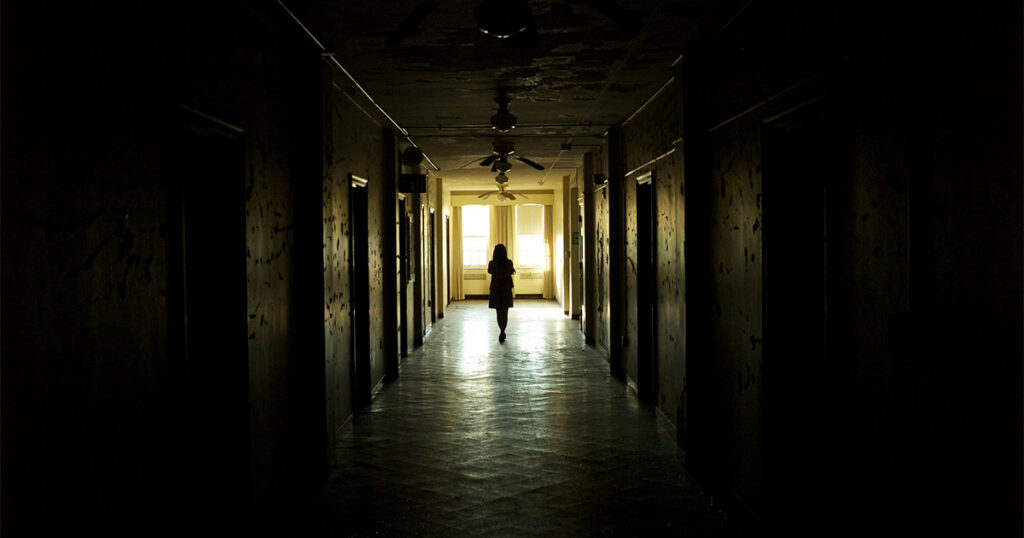
The dreams began in the last weeks of December 1999, soon after my husband, Peter, died at the age of 49. The plotlines were always similar. I would be working in the kitchen, tidying up the apartment, or staring at my computer screen when the front door clicked and Peter would be home, not dead at all, but alive and whole. In these visitations, he was my dream husband, my ghost husband—but never was he my dead husband. Was seeing him this way, even in a dream, the fulfillment of an unconscious wish or the denial of reality? Only gradually was I able to discern the answer.
The first few times, Peter’s phantom presence would sweep me away by sweeping away grief itself. He would greet me as he always did, in a manner that my dream self considered perfectly ordinary. Rather than jump out of my skin, as I tend to do at any sudden interruption, I would remain composed at his approach, reassured and calm as his beard grazed my cheek with loving familiarity.
Clearly, something odd was going on here. Yet in my muddled state of blissful disorientation, all I could say was, “But you’re dead.”
“Am I?” he’d shrug in response. The reports of his death had been greatly exaggerated, he contended. (He always had favored Mark Twain’s quips.) He only appeared to have disappeared from the land of the living. And now he was back—from the dead, so to speak, even though he never really was dead.
In daylight, my logical, Freud-savvy mind would attempt to interpret his words. Why was he suggesting that he wasn’t really dead? Was he inhabiting this world or another? Why were his words always the same?
In my dreams, of course, reason did not prevail. At least not at first. All I knew was that his presence was palpable and that in his ghostly embrace, he was with me—and I with him—still. When the alarm clock rang, I’d find myself alone in my bed, looking forward to nightfall, when the next visitation would comfort me.
Part of this comfort derived from the fact that my dreamscape had brought Peter not only back to life but also to health. Peter had suffered from both cancer and chronic illness, and during his final, devastating weeks in the hospital, his pale skin had turned the sickly yellow-green of a Van Gogh portrait. One morning, toward the end, I was shocked to see his cheeks and chin for the first time in decades, no beard or mustache, only splotched razor nicks. It turned out that the nurses had given him a shave in the aftermath of his coughing up a geyser of blood all over himself.
How reassuring it was, then, to see him in my dreams sporting once more his neatly trimmed pepper-and-salt beard. How distinguished and dapper he looked in the handsomely tailored business suit he’d barely had a chance to wear before his final hospitalization. And how happily I glowed as I took all this in.
By the end of his life, Peter had also become so weakened that he could barely talk. But at night, our repartee flowed as of old, our conversations taking on the familiar patterns of private jokes, shared enthusiasms, gossip, current events. Yet—increasingly, perhaps unavoidably—as time went on, the painful questions of daylight kept seeping through. Where had he gone? Was he back for good—or was this just a ghostly fling?
Only after several months of dreams did my apparition finally reveal his secret: Doctors had spirited him off (so to speak) to a clinic where, unbeknownst to anyone, he had been nursed back to health with treatments so high risk, so ethically questionable, and so bizarrely supernatural that they could never be revealed. Interesting. Was Peter, a lifelong agnostic, telling me that he had been miraculously resurrected? This story strained even my dream self’s credulity. Was my overly active subconscious falling prey to a cheesy movie plot?
In the months after Peter’s death, I had repeatedly watched director William Wyler’s 1939 classic adaptation of Emily Brontë’s Wuthering Heights. It had been “our” film while Peter lived, and in the immediate aftermath of his death, I became even more obsessed with it.
The film condenses the novel’s sprawling plot, narrowing its focus on the doomed romance between the wild-hearted heiress Catherine Earnshaw (played winningly by Merle Oberon) and the ruffian–turned–rich man Heathcliff (embodied with smoldering intensity by the young Laurence Olivier). With melodramatic splendor, he begs her on her deathbed to haunt him: “I know that ghosts have wandered on the earth. Be with me always. Take any form. Drive me mad. Only do not leave me in this dark alone where I cannot find you. I cannot live without my life. I cannot die without my soul.”
I cannot say whether I was projecting my dreams onto the film, but nevertheless, I identified fully with its depiction of raw anguish and ceaseless yearning, and I understood how grief can make our dreams so visceral, we become convinced that they are true. I also knew, however, that I would not, could not follow the fanatical course that Heathcliff’s grief ultimately leads him to pursue.
In the film, amid a raging blizzard, the hapless Mr. Lockwood, newly arrived from London, stumbles upon the once grand, now seedy-looking house known as Wuthering Heights. Heathcliff, the dour owner, grudgingly allows Lockwood to stay the night. But Lockwood is awakened from his sleep by the wind’s banging open his window shutter and an alarming echo that sounds like a woman’s voice. He reaches outside to close the shutter—and feels his hand grasped by the icy fingers of a phantom in female form. Heathcliff, hearing Lockwood’s scream, rushes in, casts his visitor aside, and dashes out into the storm, in search of that phantom—his lost love, Cathy, dead for 30 years. The film concludes with a gauzy image of the ghostly lovers roaming the bleak, snow-covered hillside, arm in arm, united in death.
Heathcliff’s suicidal plunge is inconceivable—unless you are in the grip of mourning. Then you can well understand how the lure of your soulmate’s presence just outside, calling you, waiting for you, could tempt you to follow.
For Heathcliff, to continue to live his life without Cathy was the nightmare—a wasteland of loss and emptiness. But that was not my reality. Despite my flights into dream fantasy, I knew I had to put front and center the raising of our son, Edward, who was just 10 when his father died. I needed to fashion a new life for us as a family of two. I had to nurture Edward’s independence as he grew into manhood and at the same time reclaim my own life as both a single mom and a single self.
By now, my ghostly conversations with Peter had turned toward reminiscence. He reminded me how, because of his cancer and his chronic illness, he had always urged me to be self-reliant. He had made sure I was comfortable with paying bills and taxes, weighing investment decisions, and so forth. He had been prepping me to take on the dual roles of widow and single mom. The thought of that future had always made me sad. And now it had arrived.
Reality was setting in. I could no longer deny that it was hard work to paste on a counterfeit smile to greet my son each morning and to retreat into a ghostly fantasy each night. I had been diverted from confronting the gritty reality of daily life. I had become caught between the tight grip of the past and the beckoning demands of the future. But I had lost the strength to hold on to both at once. I needed to let go. But of what, and how?
Time was the answer. It did not soothe so much as allow me to focus on the altered routines and financial necessities of single parenthood. But my wistful, wishful dreams countered this momentum; they worked against the practical need to adapt, to move on—to literally wake up. And over the course of the next few months, Peter’s phantom visitations began to recede. I was no more aware of willing them away than I had been of conjuring them from the ether of grief. Only as weeks, then months passed without their recurrence could I begin to make sense of the netherworld my dreams had created.
I eventually saw that my dreams represented the attempt from somewhere in my being to reconcile the ongoing timeline of the living with the abruptly stopped watch of the dead. The seeming ability of my dream ghost and my dream self to reconcile these disparate schedules was not so much a denial of death as a resistance against grief. I had welcomed this ghostly reprieve from grief as a stay from the unremitting anguish from which I could not shield myself, even with a ghost to guide me.
But I was not sorry to have been haunted. Awake and asleep, my dream ghost had been beside me to offer comfort and consolation, to murmur words of love, and, as husbands will, to challenge and disagree. And that has been my dream ghost’s legacy: the undying voice and interior well of memory that have endured alive and at home within me, just as he had promised. Like grief itself, the ache of absence will never entirely disappear. But if I am lucky, this sustaining, on-call presence will help guide me wherever my daylight reality—or my dreams—might land me next. And here I am.