
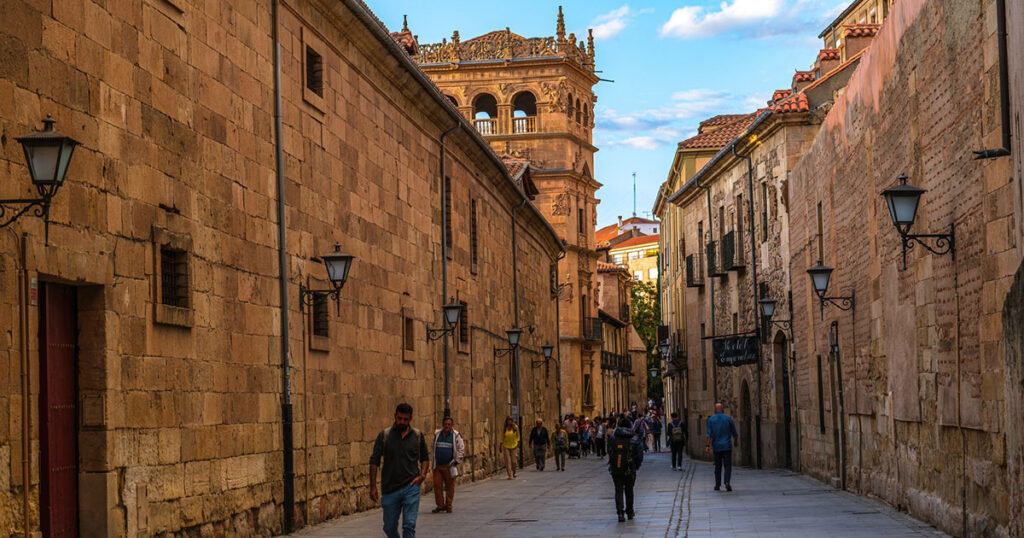
Salamanca is a beautiful Spanish city. Meaning what exactly? That the architecture is gorgeous, especially, it seemed to me, the buildings of the university, but really everywhere in the old town. That the masonry is stone throughout much of the old part, that some streets are cobbled, that fountains burble and splash, and that beyond iron gates and around corners and under arches, shaded gardens appear. In such a secret grotto I found myself one sunny Sunday July afternoon. The garden was tucked against the hill. At the far side was a waist-high wall, and beyond the wall the wide-open world, with the river flowing by, sunlight on the water. The day was hot, and the view was just what you wanted it to be—distant. Much better than to answer the call of the wandering river was to withdraw again into the protected garden and the cool of the shaded walkways, where fronds and branches waved slightly in a passing breeze.
The old town sits on a hillside above the Tormes River. Entry on foot is across an old Roman bridge, built two millennia ago, which is, fittingly, called the Roman Bridge. Portions damaged over the years, especially after flooding in the 17th century, were rebuilt, and the bridge has provided steady access to the city, century after century, for 2,000 years. Nothing flimsy about it, as my running partner and I agreed. On our recent visit to Salamanca, after having parked the car on a quiet street just across the river from the city, we walked over the bridge and then up into the old town. The impression was of controlled austerity: no bright colors, no shoppers laughing or chatting, no signs, no ads. Just discrete placards on plain building façades, heavy wooden doors, and small windows.
Instead of heading straight for the Plaza Mayor, we skewed to the right toward the university quarter and found ourselves in that quiet green alcove above the river. From there we wandered narrow streets between enormously tall buildings, admired the perfectly solid walls, the sturdy corners, the functionality declared in the lines. And then in awe we raised our eyes to the surprise of the astounding stone carvings covering the façades of major buildings. These were not decorative touches along the roofline or at the corners but a stilled waterfall, motion and immobility together, washing over the face of the building.
The stone throughout the old town, cut over centuries from the same quarry, has a recognizably golden hue. I had been to Salamanca once before, very briefly. What I remembered was this stone—its glowing golden hue. In contrast to the almost severe walls, the caramel-colored stone is consistently warm in tone—a color not exuberant in any way, I would say, but gently inviting.
The enormous doors on several of the university buildings are a dull brick red—again, not thrilling, but almost warm, like the stone. The color gave the buildings a friendly feel, despite the austerity of their lines, making it even harder to believe how old the university was. Founded in 1218, the University of Salamanca is the oldest in Spain and one of the oldest in Europe. Students come from all over the world.
In July, however, classes were out for the summer, and the throngs of youthful people we began to see as we got closer to the plaza did not impress one as being particularly studious. They were there, on that Sunday evening, for the same reason we were: to watch Spain take on Argentina in the final match of the World Cup, to be shown on a giant screen erected in the Plaza Mayor. So we wandered on, pausing to snap pictures of a spire against the blue sky or the odd tower.
By the time we reached the grandly impressive baroque Plaza Mayor, all the surrounding streets were alive with people, couples and groups, young and old. At least half of those people were wearing Spanish team T-shirts, or were draped in Spanish flags. Some tooted on red and yellow plastic horns; others sported scarves or hats with the emblematic red and yellow stripes. The sun no longer burned but the heat lingered. An ice cream from an Italian gelateria was perfect while we sat on a bench in the small Plaza del Corrillo, watching the crowds gradually grow denser. At 8:30, when the screen in the plaza and the smaller ones at the restaurant terraces were hooked up and pregame commentary began, we moved into the Plaza Mayor. It was full of milling crowds. The reserved seats at outdoor tables were filling. And still people came. My friend and I picked a spot just behind the tables of diners on the terrace of a restaurant opposite the giant screen.
At halftime, with the game still scoreless, we went to find something to drink at a bar in one of the side streets. At the barra, a young man was waiting for a beer. He smiled as if we were friends. Then, guessing I was a foreigner, he asked me in English where I was from. Twice during the first half, the camera had picked out a frowning President Trump behind bulletproof glass, getting boos from the crowd in the plaza. “From the Land of Trump,” I answered, still with the image of the president exposed behind the glass, as if he were the Wizard of Oz.
“Who are you rooting for?” the young man asked.
“Spain, of course!”
After a few more minutes of chat about Colorado (where he had never been) and New York (where he had visited and where he wished he was at that moment), he took his beer and his leave. “Here’s to a happy ending! I hope we can do it,” he said, raising his mug. We raised our glasses.
My friend and I finished our drinks and went back for the second half.
If only I had bumped into that nice young fellow again after the game. “We did it!” I’d have proclaimed. Because we had. Spain 1, Argentina 0, the winning goal coming in extra time, thousands of fans together in the packed plaza cheering Spain’s second World Cup triumph.
An ice cream before, a glass of tonic water mid-game, and a shot of mild euphoria afterward. All this a week before my flight to the United States for my usual summer month at home. There is no place like home, but unlike Dorothy’s, mine seems less a physical place in a real world than a desire to reconnect with the past. What does that mean? It means that when I’m home in Colorado and New Mexico, with friends and family around me, my days following the pleasant pattern of past days, I might wander in my imagination back to Salamanca, climb the hill, skip the secret garden as I pass the oddly angled corners and cross the narrow streets, and step into a bar close to the Plaza Mayor, looking around for a stranger who knows me.