
The Co-Creation: How Earth Made Life and Life Made Earth by Olivia Judson; Penguin Press, 560 pp., $35
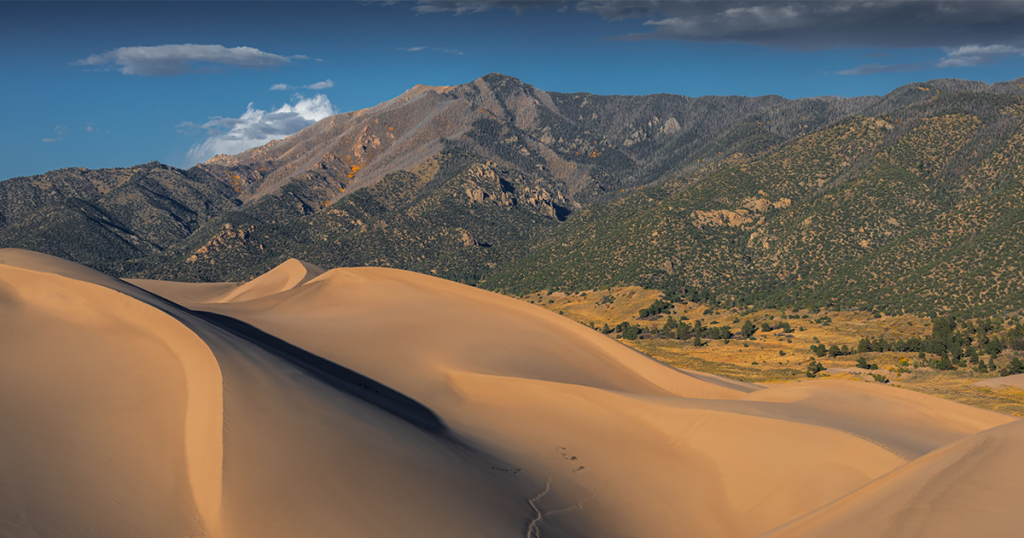
In southern Colorado, the Great Sand Dunes rise above the San Luis Valley in the shadow of the towering Sangre de Cristo mountains. Two seasonal streams flow out of the mountains, catch sand from the mountain-facing side of the dunes, and carry it around. Eventually it blows back into the dunes, and in this way they repair themselves.
They are the tallest dunes in North America and have been here at least 400,000 years, but individual dune ridges are almost always in motion. You can sled down them, and the National Park Service allows it because the dunes and the wind quickly erase your tracks. The dunes can shift tens of feet in a single day. One type of sand dune, called a barchan dune, can even reproduce, budding offspring that retain the same crescent shape as the parent. Sand dunes make sounds as they move. The hills, one might say, are alive.
“Both lifeforms and sand dunes are what you might term energetic constructs,” writes the British evolutionary biologist Olivia Judson in her new book, The Co-Creation. In her telling, we are not organisms that require energy to grow, repair ourselves, and reproduce. Rather, we and sand dunes do those things because we are supplied with energy. Life forms “are transient packets of embodied energy,” Judson writes.
For Judson, all living things are manifestations of the great universal law that energy is never lost, only changed. Life forms, unlike sand dunes, can seek out energy and transform it to sustain themselves—life conducts chemistry instead of just physics, in other words. And over eons, this change in energy has transformed the planet, producing new forms of energy that life continues to use and transform, in a cycle that is unique in our solar system. Earth itself is not quite alive, in the way that a sand dune is not quite alive, but neither is our planet some passive rock that harbors many types of chemistry-performing life forms. Earth is of life. Life is of Earth.
Judson is a companionable, erudite teacher for this new version of planetary history. Her previous book, Dr. Tatiana’s Sex Advice to All Creation, sought to understand reproduction—and the biological urge to pull it off—as the most powerful force in evolution. The Co-Creation pares down the underpinnings of life even further, to a transfer not of genes but of electrons. The most important process in history is not a mating dance but the movement of electrons from one atom to another. This is the process of reduction-oxidation, or redox.
Lest that seem unsexy, Judson does include flesh as one of five “energy expansions” that produced the life-Earth system we have today. The first is rock, including minerals like the hydrogen-bearing olivine in Earth’s mantle that, Judson contends, jumpstarted early redox reactions. The next is light, provided by the sun, which enabled the evolution of “heliovores,” all the photosynthetic organisms. This epochal change is followed by oxygen, which was emitted by those first sunlight eaters and reigns supreme in its affinity for accepting new electrons in that all-important redox reaction. “Oxygen is the queen,” Judson practically hums. Oxygen’s energy-transfer capabilities soon led to eukaryotes, which include bacteria, sea urchins, sunflowers, koalas, and humans.
“Had they, or something like them, never evolved, the planet would have remained as it had been for the previous two billennia: a world of slicks and scums,” Judson writes. Instead, eukaryotes began to eat other things and invent a new way to increase the flow of energy between individuals. This “great chain of eating,” as Judson calls the fourth energy expansion, eventually produced animals, including animals that eat plants, animals that eat other animals, and life forms that eat their remains. Finally, fire arrived, around 430 million years ago—a natural extension of life that can exist only because of it. Fire may start through lightning, but it cannot sustain itself without a life-based energy source. It likely arrived soon after the appearance of “plungus,” Judson’s term for plant-fungi amalgams that transport nutrients and help plants grow.
Those five epochs serve to reframe the history of life on Earth as the history of life and Earth, and life of Earth. According to Judson, life is not a miraculous occurrence that happened and then continued to unfold. It is more like a natural extension of Earth’s physical conditions, just as wind and sand are. Wind blows whether or not dunes exist to swirl and dance in its wake. The redox reaction, the energy-transfer process that powers all life on Earth, happens whether or not there are cells to use it. Perhaps the miracle is that we, an embodied form of energy, can come to know and subsequently tell stories about any of this.
Several recent books have sought to reframe Earth history as life history, from Ferris Jabr’s Becoming Earth to Robert Hazen’s Symphony in C. Judson’s reminded me of Peter Brannen’s The Story of CO2 Is the Story of Everything in its redefinition of life and geology not as separate phenomena but as eternal, equal partners. For instance, I did not expect to learn, in Brannen’s book, that the continental movement that built the Alps during the Cretaceous might explain why Europe has small, isolated political states instead of one vast empire like China or Russia.
Reading Judson’s book, I developed a similarly disorienting feeling. Life is not something that uses chemical reactions; life is chemical reactions. Earth is not a Goldilocks-like, fecund, gentle oasis in an empty universe; instead, living things have wrenched the planet apart from its insides and made it comfortable for themselves. An Earth without any life, ever, would look unfamiliar in ways that sound impossible: no chalk, no marble, and no fire.
The long, bizarre, phantasmagoric history of life as we know it is linked to the availability of energy. The transformation and dissipation of energy, which physicists call entropy, has been occurring since the very beginning of the universe. If life is an inevitable consequence of that truth, it seems even more odd that we have never found it anywhere else. Judson asserts that this may be because complex life is the rarity. Complex life—thinking, chirping, ambulatory, argumentative, planet transfiguring—may need the precise combination of rock, light, oxygen, flesh, and fire that characterizes Earth and, so far as we know, only Earth.
“Contemplating these happenings gives me a kind of vertigo,” Judson writes. The effect on the reader is the same, but it is a welcome feeling, a necessary resetting, the sort of vertigo that one might experience after a roller coaster ride or a rocket launch. It is vertigo that completely shifts your perspective on the only home we will ever have.