
Our Versatile, Durable Pickup
The story of a vehicle that is many things to many people but is, above all, an American icon
America may have been the home of that great innovator Henry Ford, but the inventor of the gas-powered automobile was Carl Benz, a German, and most early car technology originated in Europe. Cupholders aside, two innovations that are distinctly American stand out: the station wagon and the pickup truck. In the 1950s, suburban American families fell in love with the station wagon—until they didn’t. The last American-made full-size station wagon was manufactured in 1996, replaced by the minivan and the SUV. Meanwhile, every mainstream European car company still has a station wagon in its lineup. These vehicles are called estate cars in Britain, kombis in Germany and Sweden, and breaks in France. The obscure origin of the last term is the shooting break, or break de chasse, a horse-drawn wagon that carried dogs and gear for hunting parties. Thus, like the British estate car, the French break conjures an image that is sporty and upper-class rather than suburban. Ironically, the origin of the plebeian American wagon is likewise upper-class: The first Ford station wagons—the charming woodies—were expensive vehicles, marketed to country estate owners and resorts to ferry their guests from the railroad station.
Culture matters. Europeans like station wagons, but they are still lukewarm on pickup trucks. European-made pickups are rare. Volkswagen, Fiat, and Peugeot make pickups in South America exclusively for that market, and although a midsize VW pickup (built in South Africa) is available in Europe, it is not a big seller. Americans, meanwhile, may be over the station wagon, but their affair with the pickup continues. Indeed, the Ford F-150 pickup has been the best-selling automobile in the nation for the past four decades.
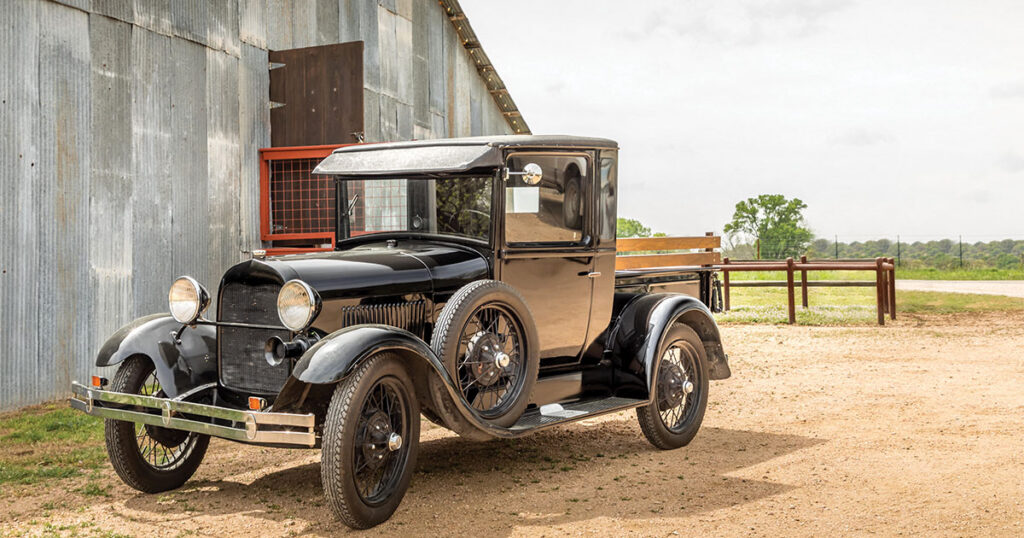
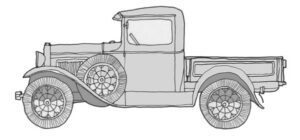
The pickup dates from the dawn of motoring. Immediately after the Model T appeared, private coach builders began adding a shallow box to the rear of a modified Ford chassis. The Galion Allsteel Body Company of Galion, Ohio, is sometimes credited with the idea. Seeing a business opportunity, car manufacturers followed suit, and in 1925, Ford modified its Model T Runabout, a two-seater roadster, by adding a cargo bed to the rear. A few years later, the Model T’s successor, the Model A, was unveiled. It was a closed-body car with roll-up side windows and a safety glass windshield. This was before General Motors popularized the practice of marketing different models, and the Ford was a Ford whether it was a coupe, sedan, roadster, station wagon … or pickup. At less than nine feet long, the wheelbase left room for a small cargo bed with a loading space of only 17 cubic feet, although it could carry heavy loads, thanks to an upgraded suspension. Vans and trucks remained the vehicles of choice for deliveries and hefty cargo, but the carlike truck, intended chiefly for farmers and ranchers, was useful for occasional “pick-ups.” Old photographs show the little truck loaded with milk cans or piled high with bales of hay.
Mechanical devices evolve sometimes slowly, sometimes quickly. It took 50 years for the passenger automobile to achieve its final shape. The first step was to enclose the passenger compartment with a solid roof and windows, then to add a trunk in the rear, and finally to replace the fenders and running boards with a smooth “pontoon” body. By contrast, the first Ford pickup—a two-door cab with a bench seat for the driver and a passenger, and a rear cargo bed with low sides and a hinged tailgate—emerged all of a piece. Over time, the basic configuration persisted while the bed grew larger. By 1948, when Ford introduced the F-1, it was no longer a modified car but a purpose-designed truck, and the length of the cargo bed had grown from four and a half to six and a half feet.
Beginning in the 1950s, something unexpected happened: People—men—started using pickups not for work but as everyday transportation. Why? This was not a technological change, since the same vehicle had been around for more than two decades. It was a cultural shift. Much has been written about cars as status symbols, and in that regard, the pickup truck conveyed a sort of anti-status. It was a two-seater but definitely not a roadster. With its small cab, it was not a family car, and with its prominent rear cargo bed, it largely ignored conventional styling. Overall, the pickup signaled a relaxed, blue-collar independence. In the 1956 film Giant, James Dean’s ranch hand drives a dusty, beat-up Ford Model T pickup. It just gets me there, I’m not trying to impress anyone. That same year, when Renault was designing the 4L—its answer to the venerable Citroën Deux Chevaux—the company’s chairman, Pierre Dreyfus, described what he had in mind: “I want a versatile car, one that’s urban and rural at the same time, and one that suits the needs of everyone. Call it the blue-jeans car.” The American pickup did not suit everyone’s needs, and it was technically (and legally) a truck, but it was definitely in the blue-jeans category.
The blue-jeans pickup later moved upmarket and sprouted creature comforts: power steering, air-conditioning, elaborate sound systems, leather upholstery, heated seats, sunroofs. Eventually, a fully equipped pickup could cost more than a comparable sedan. The most radical change was to the body. First the cab grew longer to create storage space behind the seats, a sort of minitrunk. Sometimes this space was enlarged to include fold-down kiddie seats and half-doors for access; in time, the space grew large enough to accommodate a wide bench seat and full-size doors. This “crew cab” was often used by contractors to transport workers to a building site. Of course, as the cab grew longer, the bed got shorter, shrinking from eight feet, the standard length of a piece of plywood, to less than six. Put another way, what had been one-third cab and two-thirds bed was now two-thirds cab and one-third bed. The smaller carrying capacity did not matter to most owners. Fewer than 20 percent of pickups are used for work; the rest are used for commuting, household errands, hauling trailers and boats, and hosting tailgate parties. The crew cab, also known as a double cab, is the most popular model; it enables the pickup to function as a family car. In the 1930s, Dodge called its pickups “job-rated trucks.” That day is long gone.
The functional history of the pickup is characterized by what the French call bricolage, a sense of improvisation, something associated with the vehicle from the beginning that explains its popularity. The vehicle’s adaptability, which comes from its all-purpose cargo bed, has given rise to an extensive aftermarket, largely stimulated by owner demand. Conversion kits can be as simple as a folding tonneau cover or a roofed fiberglass or aluminum shell, sometimes called a truck cap. Specialized commercial caps, favored by carpenters, electricians, and plumbers, include toolboxes and roof racks for ladders. Truck caps with windows turn the pickup into a sort of no-frills station wagon. A pickup with a shell can be used as a temporary overnight shelter and is popular with hunters and anglers. Want more comfort? There are canvas add-ons: truck-bed tents, rooftop tents, foldout canopies. The full-fledged rigid camper shell, which can slide into the cargo bed, is the working man’s motor home. In its largest incarnation, with its front overhanging the cab, a camper shell can accommodate a queen-size bed as well as a dinette, cooking range, sink, and bathroom with a shower. The shell, which has adjustable feet, can stand in the driveway when not in use and can slide out of the cargo bed and stay behind on the campsite.
I cannot resist saying a few words about the latest iteration of the pickup: the Tesla Cybertruck. This vehicle strikes me as a nifty solution in search of a problem: Is it a truck, a capable off-roader, or a speedster with “giggle-producing acceleration,” as Car and Driver put it? Then there is its unorthodox appearance. According to one Reddit poster, “I like it because it’s ugly and upsets people,” which pretty much sums it up. This mutant offspring of a pickup and a Humvee recalls an earlier hybrid. In 1934, Ford Australia, reacting to consumer demand, produced a pickup on a car platform that it called a Coupe Utility. More than two decades later, Ford introduced the concept to the United States. The Ford Ranchero was basically a full-size station wagon with the rear chopped down to make a cargo bed. The advertising tag line was “More than a car! More than a truck!” Of course, it wasn’t really more than a car, since it sat only three, and though it had a large bed, its emphasis on styling contradicted the traditional pickup’s unaffected sense of no-nonsense utility—like the Cybertruck but less bizarre. Still, the Ranchero found its niche and stayed in production until 1979; its competitor, the Chevrolet El Camino, lasted another eight years. I somehow doubt that the Cybertruck will endure that long.
Europeans may have never fully warmed to the pickup truck, but the rest of the world has. Australians call it a ute, after the old coupe utility; South Africans, a bakkie; Brazilians, a picape. In China it’s a píkă. The pickup in these markets tends to be smaller than the full-size American model. In Japan, it comes in three sizes: micro (the Kei car category), compact, and midsize. The midsize Toyota Hilux is currently the most popular pickup outside North America, followed by the midsize Ford Ranger. The crew cab is the preferred model.
Whatever the size, versatility remains the watchword. Pickups can carry bales of hay, building supplies, portable workshops, foldout tent shelters, camper shells, and not least, people. In many countries, pickups fitted with side benches, canvas roofs, and a back step are capable of carrying more than a dozen passengers and are widely used as makeshift minibuses or shared taxis. In the Philippines they’re called jeepneys; in Thailand they’re songthaews (“two rows”); and in Haiti and the Dominican Republic they’re tap taps (“quick quicks”).
Then there is the “technical.” This lethal modification of the pickup was among the many Hamas vehicles that invaded Israel on October 7, 2023. Typically a midsize Toyota with four-wheel drive, a technical carries a heavy machine gun, a grenade launcher, or an antitank gun mounted in the rear bed. In the Ukrainian war, technicals have been fitted with rocket launchers salvaged from downed Russian helicopters. The idea of using the pickup truck as a mobile gun platform seems to have originated during the Somali civil war of the 1980s, and technicals have since appeared in many African wars, as well as in Afghanistan, Lebanon, Iraq, and Syria. The last phase of the nearly decade-long conflict between Libya and Chad has been called the Great Toyota War, thanks to the pivotal role played by fleets of technicals.
More than 40 years ago, I wrote Taming the Tiger, a book that described how, in the course of history, different cultures and peoples have reacted to technological change: accepting, rejecting, banning, controlling, or modifying new technologies, and often using new devices in unexpected ways. The violent uprising of the Luddites against mechanical looms in 19th-century Britain is well known; so is Mao’s small-is-not-so-beautiful Cultural Revolution. A happier story is that of the Vespa (Italian for “wasp”) motor scooter. Invented in 1946 by Piaggio, an aeronautical company, this affordable mode of personal transportation suited the strained economic conditions of postwar Italy. The scooter was smaller and cheaper than a motorcycle, capable of carrying two people, and had a chairlike seat suitable for women in skirts. Two years later, the company unveiled a commercial version. The three-wheeled Ape (“bee”)—a combination of a scooter front with a rear two-wheeled cargo bed—was a hit, both in Italy and internationally. For the Indian market, the scooter was mated to a bicycle rickshaw, itself a hybrid device that combined the British bicycle and the Japanese hand-pulled rickshaw. The motor-rickshaw taxi substituted a motor scooter for the bicycle; the traditional rickshaw’s bench seat accommodated three passengers. As I wrote: “Thousands of motor-rickshaws can now be seen in most Indian cities, a strange blend of British, Japanese, and Italian technology coupled with Indian ingenuity and driven with Indian abandon.” Like the minibus pickup, the motor-rickshaw can be found in cities in South Asia, Africa, and the Middle East.
On the whole, my conclusions in Taming the Tiger were upbeat. “Technology,” I wrote then, “begins not with the tool, but with the human imagination, and the acts of imagining, inventing, and using tools and machines are human acts. So, while technology is certainly artificial, it is also eminently natural. Moreover, since technology is a human activity, it is thus a part of human culture and hence reflects the human preoccupations of its time.” I didn’t include the pickup in that book, but the conversion of a car into a small truck that can serve as a mobile workshop, a camping shelter, a makeshift bus, or even a machine-gun platform is a good example of the resourceful and unpredictable ways in which different peoples embrace, modify, and exploit technical inventions. At a time when technology is often portrayed as something autonomous rather than under human control, it is worth keeping this in mind.