
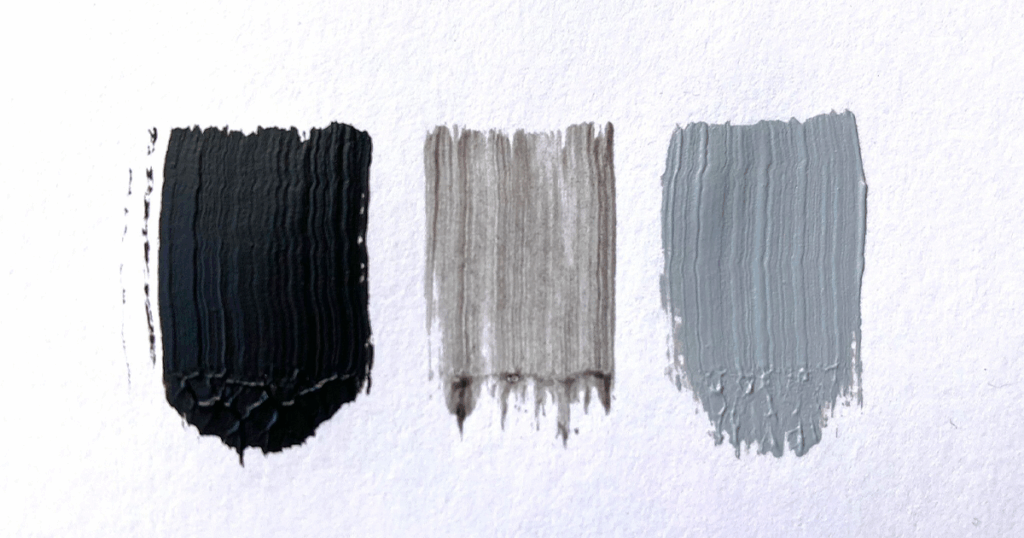
We painters enjoy schmoozing about pigments and can have strong opinions about them. Perhaps writers like to discuss favorite typefaces or pens, and I’ve heard cooks get all excited about certain pots or knives they love. Piet Mondrian, who came to the United States in 1940 to escape the war in Europe, was told to leave New York City to get a sense of what this country was really about. His friends put him on a train to Connecticut for a long weekend and were surprised to see him back in the city within hours. “Too green” was all he said. For painters, green is a tricky color, even if you don’t, like Mondrian, work mainly in primary colors.
Some colors are bullies: squeeze out overpowering pigments like phthalo green or alizarin crimson with real care. Others are sweethearts and can make you feel good just by emerging, toothpaste-like, from their tubes. Winsor & Newton’s jolly “Naples Yellow Light” always improves my mood. But probably the color most argued about is black. It’s been around from the beginning, since all you need to do is collect carbon from a candle, add it to a medium of some kind (oil, egg yolk, even water), and you’re off and running.
Non-painters might be surprised by how long—and how passionately—the pros and cons of black pigment have been kicked around. Leonardo recommended adding black to create the light-dark effect we call chiaroscuro, and all hell broke loose. One Renaissance painter said that he gave up his art and became a tavern keeper because he was so sick of the endless fights about Leonardo’s innovation. Before Leonardo, most artists would start with a tonal underpainting of, say, the Virgin Mary’s blue dress—modeling from light to dark in gray—then glaze it with a layer of lapis lazuli. This made the whole shape glow like stained glass, and as the form turned away from the light, its blue became even richer and deeper. Consider two paintings hanging today in the Louvre: Fra Angelico’s Coronation of the Virgin and Leonardo’s Saint John the Baptist. To modern eyes, parts of Fra Angelico’s painting, for all its jewellike tones, can look a bit like a coloring book: We’re used to Leonardo’s subsequent introduction of black into the darks. However, the only word I can find for Leonardo’s Saint John the Baptist is “sooty.” Unified, yes, but at the cost of the luminosity of the Fra Angelico down the hall. Visiting churches and museums in Italy can be a pure joy, though one can also be overwhelmed by the sheer, depressing sootiness of paintings done in the half century after 1540. Mannerists such as Giorgio Vasari, and even at times Tintoretto, might have been well advised to keep their black powder dry. In the arguments the tavern keeper sought to avoid, I would have sided with the Florentine painter Andrea del Sarto, who wanted, and achieved, a synthesis of the two practices, keeping both the energizing glow of saturated colors in the darks and the optical, gravitational credibility of Leonardo.
In the early 1590s, a young brat from the provinces arrived in Rome filled with piss, vinegar, and new ideas about the uses of black. Rather than letting black pigment act like an enveloping fog, Caravaggio lit his forms as if by spotlight: a bright shape here, an extremely black one there. True, his figures are composed as solids in space and still emerge from a gloom, but we also see blacks coming into their own as defined shapes. By the end of his short life, the dichotomy Caravaggio offered was even more extreme, as his darks came to feel relentlessly, hopelessly black. At an exhibition in Amsterdam in 2006, I was lucky enough to see a profusion of Caravaggios hanging next to Rembrandts, the painterly equivalent of Batman versus Superman. We might think of the Dutchman as the Dark Knight, but that title goes to the Italian in this confrontation. By comparison with Caravaggio’s deepest blacks imaginable, Rembrandt’s darks are filled with ambient light. When you see them together, the contrast is like night and day. Protestant Rembrandt seems to me fundamentally hopeful, whereas Caravaggio strikes me as a brutal skeptic; his is a realm of pure darkness unmitigated by salvation.
That could be my projection, of course. Technically, I’m also amazed that anyone could get such fantastic blacks. I’ve tried. Before the advent of synthetic colorants, cloth had to be dyed repeatedly and expensively in a rainbow of hues to make it an elegant and lasting black. Perhaps Caravaggio did something similar, glazing and layering to get what he wanted, for black pigment itself tends to misbehave. It gets shiny, it dries much lighter than it goes on, it reads as paint rather than as a spatial void. But this moment of Caravaggesque black, though extremely influential, was also somewhat short lived. On seeing Caravaggio’s Death of the Virgin, Nicolas Poussin reportedly said, “I won’t look at it, it’s disgusting. That man was born to destroy the art of painting. … The ugliness of his paintings will lead him to hell.” I can’t help thinking that Poussin was reacting at least partly to the use of black, as he probably thought of color the way his later admirer Paul Cézanne did: “When the color is at its richest, the form is at its fullest.” Avoiding theatrical side-lit contrast and shadowed drama, both Poussin and Cézanne sought color that bloomed forth as an overall unity. Having visited relentlessly sunny Aix-en-Provence, I am amazed that Cézanne came to eliminate or minimize both cast shadows and the color black.
Spaniards certainly enjoyed black, in both their expensively dyed cloth and their local traditions of painting. All their greats, from El Greco to Velázquez and Jusepe de Ribera, depended on black as the foundation of their intentionally limited palettes, with astonishing results. I can’t think of another school of painting quite so self-consciously drawn to lamp or ivory black. We might jump centuries forward to Ad Reinhardt (1913–1967), who saw black as noncolor, and his own black paintings as the absolute zero of painting. His stated intention was to absorb all previous painting like a black hole, making his the last paintings in history. This may sound grandiose, but both his ideas and his paintings are quite subtle. All his black paintings are five by five feet, and if you stand long enough in front of one, a ghostly Greek cross will ever so quietly start to emerge. They’re black, sure, but done in veils of color like old Spanish cloth, so we come to sense depths of perception and even meaning. Reinhardt associated art with negation theology—also called the apophatic tradition—which doesn’t deny the existence of God but insists that we can only speak of that which does not, and cannot, define whatever we mean by God. In the words of the ninth-century theologian John Scotus Erigena: “We do not know what God is. God Himself does not know what He is because He is not anything. Literally God is not, because He transcends being.”
This idea makes me rethink my reaction to Caravaggio in Amsterdam. What if instead of sheer nothingness, his blacks endorsed mystery, the unknowable? What if, in an odd way, the frustrating intransigence of the pigment itself suggests the inherent limitations to our knowing? Théodore Géricault wanted the blackest black he could get for his huge Raft of the Medusa, so he used bitumen—also known as asphalt or pitch (hence the term “pitch black”), which is notorious both for darkening over time and for degrading into a melting mess, as if the medium somehow became part of the message. Like all pigments, black is both substance and image, and our awareness of this knife-edge simultaneity contributes to why painting has fascinated us for 40 millennia. Like Géricault’s Raft, Reinhardt’s paintings have to be very carefully handled. When touched by oily hands, they can lose their perfect otherness, their attempt to transcend our greasy world. Reinhardt knew he was using lowly carbon, basically soot, for metaphysical ends. Christian iconography assigns certain colors to spiritual subjects, such as expensive lapis blue to the Virgin and gold leaf to heaven itself. But black, made from among the cheapest substances around but still so useful in rendering illusion and allusion, may turn out to be the richest pigment of all.