
Ken Burns’s The American Revolution—a six-part, 12-hour, $30 million film now airing on PBS—is sure to shape the way much of the public views our nation’s founding for years and even decades to come. The task is mammoth: to document the bloody and complicated six-year war that birthed the United States. Coming on the eve of the 250th anniversary of that founding, this is clearly a unique opportunity to set aside stale legends for a richer and more compelling tale of how our nation was made, drawing on new scholarship that has unearthed fresh tales and chipped away at old assumptions. Burns should get credit for including the voices of many women, African Americans, and Indigenous peoples, so long ignored. In many instances, however, the filmmaker and his team have failed to get their facts straight, while clinging to outdated narratives that betray a partisan favoritism. This may be good storytelling, but it’s bad history.
The second episode alone, which aired on November 17 and covers the critical year between May 1775 and July 1776, is rife with a slew of errors and omissions that make the patriots appear more heroic and the British more wicked. We learn, for example, that a Royal Navy captain burned part of the Maine city of Falmouth—later renamed Portland—in the fall of 1775. What we are not told is that this brutal act was direct retribution for the killing of a British captain and crew and the seizure of a British warship by Maine patriots.
That might be dismissed as a minor point. Not so the discussion of the Revolution’s start in the colony of Virginia. We are repeatedly told that Virginia’s participation in the patriot cause was essential for transforming what was a regional rebellion in New England into a continental conflict. So why do we not learn about the first bloodshed to take place south of Massachusetts? The October 1775 skirmish in the little port of Hampton was sparked not by anger over taxes but by British refusal to return enslaved people to patriot servitude.
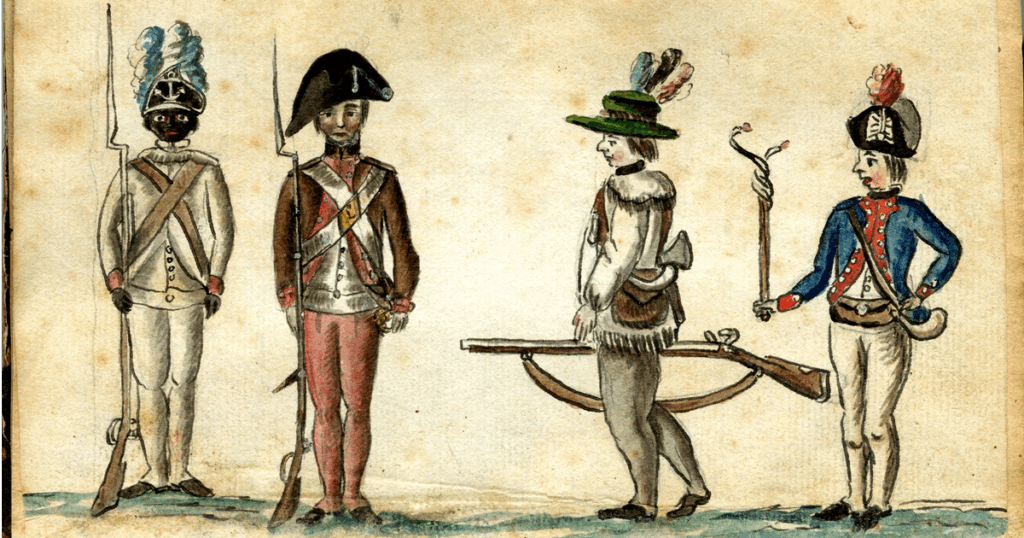
Lord Dunmore, the royal governor of Virginia, makes an appearance as the British leader who freed and armed hundreds of those held in bondage by patriots, and who risked all to flee their owners. Yet he is taken to task for failing to emancipate any of his own enslaved people. The historical record, however, shows that he manumitted a middle-aged woman named Sarah, another named Cathern Scott, and a man—likely her husband—called Roger Scott—and perhaps many more. Most of his enslaved people were, in any case, beyond his power to emancipate, given that the patriots had months before seized and sold the majority.
By contrast, George Washington never freed any of his hundreds of enslaved people during his lifetime, and at first forbade any Black men—free or in bondage—from reenlisting in the Continental Army. He is lauded for reversing course on reenlistment, but we don’t learn that this change of heart took place only after he heard that Dunmore was recruiting Black men. The British governor comes off as a cynical opportunist, while Washington in this instance is portrayed as a man who overcame deep-seated prejudice for the sake of his country.
Some basic facts are also mangled. In the aftermath of Dunmore’s loss at the Battle of Great Bridge in December 1775, we are told that he “fled back to sea” with the battered remnants of his Black troops and a few score of families, mostly Scots. Yet the flotilla remained firmly anchored in the harbor of Norfolk for nearly six months. Made up of some 100 vessels and perhaps 3,000 people of European, African, and American stock, this floating community, and the secure land base Dunmore had constructed to train the constant influx of Black recruits, posed a mortal threat to Virginia’s patriot leaders in nearby Williamsburg. The fleet’s presence encouraged these slaveholders to vote unanimously in May 1776 for independence—the radical step broke the deadlock in Philadelphia. But you won’t learn this from the documentary.
Most perplexing of all is the film’s silence on the single greatest war crime of the Revolution: the burning of Norfolk, the eighth largest city in the 13 colonies. In the wake of the calamity, which began on January 1, 1776, every one of its 1,333 buildings was destroyed, more than three times the number at Falmouth. No American city before or since has suffered such complete annihilation.
The patriots pointed the finger at Dunmore, and as a result, many wavering Americans—fearful that New York, Philadelphia, or Charleston might be next—were persuaded to back separation from Britain. The myth of the arsonist governor persists. But a detailed 1777 report, commissioned by Virginia’s patriots themselves, concluded that patriot officers encouraged their soldiers to loot and burn the town, and found them responsible for 96 percent of the damage. The eyewitness accounts taken under oath are shocking. Patriot soldiers burst into the home of one woman in labor and threatened to set fire to the structure. Only after she produced a note proving her patriot sympathies did they leave her in peace, though they warned her that they would return, since “they had orders to burn every house in the town.”
We know that patriot leaders encouraged the demolition of the defenseless city that Virginia’s Richard Henry Lee dismissed as “a nest of Tories and Negroes.” Thomas Jefferson privately urged another senior Virginia patriot in October 1775 to ensure Norfolk’s utter ruin. Then he complained in the Declaration of Independence that King George III had “burnt our towns.” The man who favored the destruction of his own colony’s port used the false-flag operation to argue for separation from a perfidious Albion.
The film goes on to quote a patriot soldier appalled by the sick and dying men—mostly Black soldiers—left behind when a patriot attack forced Dunmore to hastily abandon his last base in Virginia, five days after the Declaration was adopted. What goes unmentioned are the eyewitness accounts of the victorious patriots burning alive many of those ill soldiers within their brush huts. At least these victims were spared the fate of those captured Black loyalists sent to labor in a western Virginia lead mine under horrific conditions. This Appalachian gulag, which used “public Negroes” to produce the bullets needed to win the war for liberty, merits no mention.
No documentary on a topic as broad as the American Revolution can encompass all its myriad characters and events. Surely, however, we are now old enough as a nation to set aside comforting old myths and embrace the challenges posed by an honest accounting of our history. We desperately need that fuller story of yesterday so that we can find practical ways to overcome today’s terrible divisions. If we can’t be true to our past, how can we hope to address the troubles of the present?